Episode #120: Strategic Planning: Efficient, effective, neither?

Ed’s LinkedIn Post

Five counterintuitive truths about strategic planning

  1. Profit is not an adequate foundation for a strategy

  2. We do not want for answers; we suffer from an inability to ask new and better questions

  3. The Mother of All strategic Questions does not come back to revenue

  4. Strategic planning is more creative than analytical

  5. Strategy is about effectiveness, not efficiency

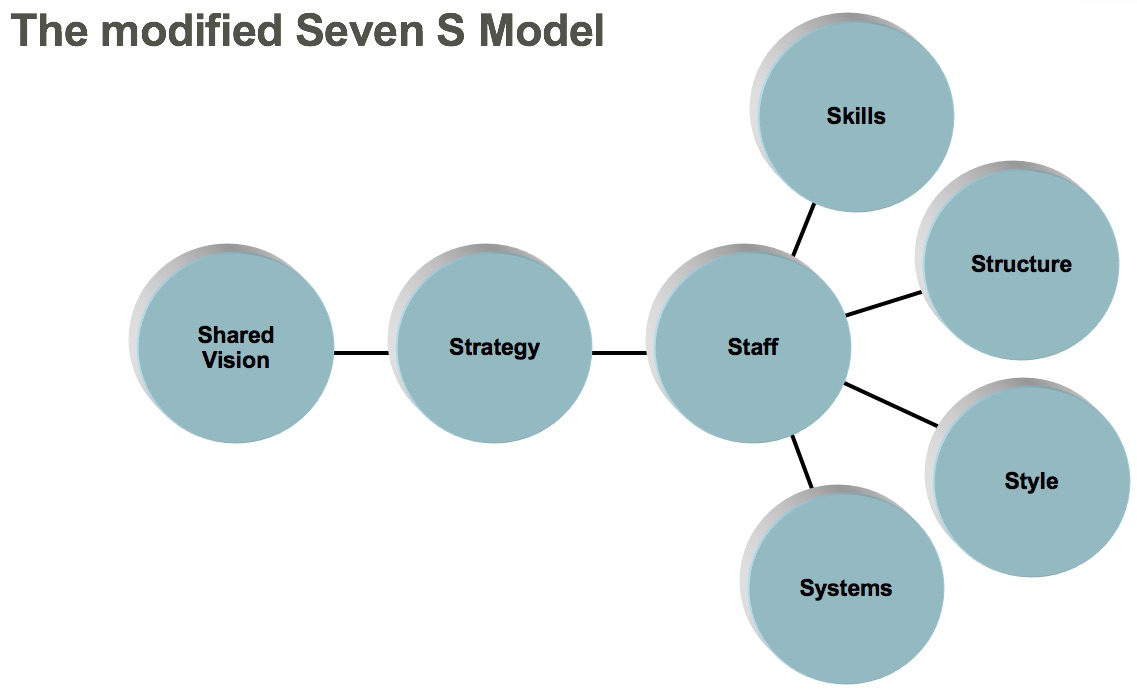
As modified by Great Plains Software leadership, circa 1990

As modified by Great Plains Software leadership, circa 1990

Summary of The Rise and Fall of Strategic Planning, by Henry Mintzberg, 1994

Planning is future thinking, or controlling the future.

Planning = Latin = planum “meaning flat surface.” The word entered English language 17th century, referring principally to forms, such as maps or blueprints drawn on flat surfaces.

The squirrel plans (stores nuts): are they more sophisticated or is planning less so?

If only you dumbbells executed better!

If you so smart, why didn’t you take into account we are dumbbells?

To Michael Porter, strategy = position.

To Peter Drucker, strategy = perspective (the theory of thebusiness).

Fundamental fallacies of planning

  • Predetermination (predicting the future)

  • Detachment (from operations/managers

  • Formalization

All three = The Grand Fallacy: that analysis can produce synthesis.

Analysis ≠ Synthesis, and strategic planning is not strategy formulation, so the term is an oxymoron.

Strategic planning (SP) is less about creativity and more about rearranging established categories; stability over adaptability, or institutionalized incrementalism.

It’s more extrapolation than invention.

The quantification of SP is not much more than quantification of goals as a means of control.

Jack Welch dismantled GE’s SP; he wanted more judgment not data.

PPBS = Planning-Programming-Budgeting System. Robert McNamara, Secretary of Defense under President Johnson. Vietnam was USA’s most humiliating military defeat, ever. PPBS has failed everywhere and at all times.

But the planners will say, “Any plan is better than none at all. It’s the process that counts (SP is not Utopia, only the road to it).

But SP is a rain dance, and the process improves the dancing not the weather.

SP assumes there’s “the one best way” to formulate and implement strategy, inspired by Frederick W. Taylor.

SP is not defended for what it accomplishes but for what it symbolizes—rationality.

Henry Kissinger referred to planning as “a sop to administrative theory.”

Pseudo-scientific knowledge can be more dangerous than plain ignorance or common sense.

Americans get off on strategy like French get off on good food.

How do you make God laugh? Tell him your plans.


Episode #119: Interview with Accounting Thought Leader Joe Woodard

Ed and I were honored to have Joe Woodard on the show.

As an author, consultant, Intuit contractor and national speaker, Joe has trained over 75,000 accounting professionals in the areas of practice development, changing technology trends, and how to maximize the use of QuickBooks in their accounting practices. 

In 2012, 2014 and 2015, Joe was recognized by Accounting Today as one of the Top 100 Influencers within the Accounting Profession. In 2008, Joe was recognized by CPA Practice Advisor as one of the top 40 up and coming thought leaders under the age of 40. 

Woodard's Vision

Woodard has adopted a powerful vision: “To transform small business through small business advisors.”

Woodard’s purpose is an extension of its vision – a single statement that shapes every task Woodard performs to achieve its vision: “We empower small business advisors.” 

What Woodard Does

As part of a larger purpose to empower small business advisors, Woodard fosters networking relationships among small business advisors, conducts the highest quality learning experiences for small business advisors, and builds relevant, powerful resources for small business advisors.

Questions We Asked Joe

  • Explain your Vision Statement

  • Why focus on small business as opposed to medium or large business?

  • Why accountants, and not lawyers, or others who serve small businesses?

  • What’s your view on the Efficiency vs. Effectiveness (Eff’ing) debate?

  • What are the major challenges and opportunities you see facing the accounting profession? (Joe thinks Automation for both).

  • Do you agree with the strategy of giving away compliance work for free in order to get the advisory services? After all, I’ve been hearing about the death of compliance services since I’ve been in the accounting profession. Do you really see compliance work going away?

  • When you look out at the vast majority of the accounting profession, do you really think it’s possible for them to make the transition to advisory services?

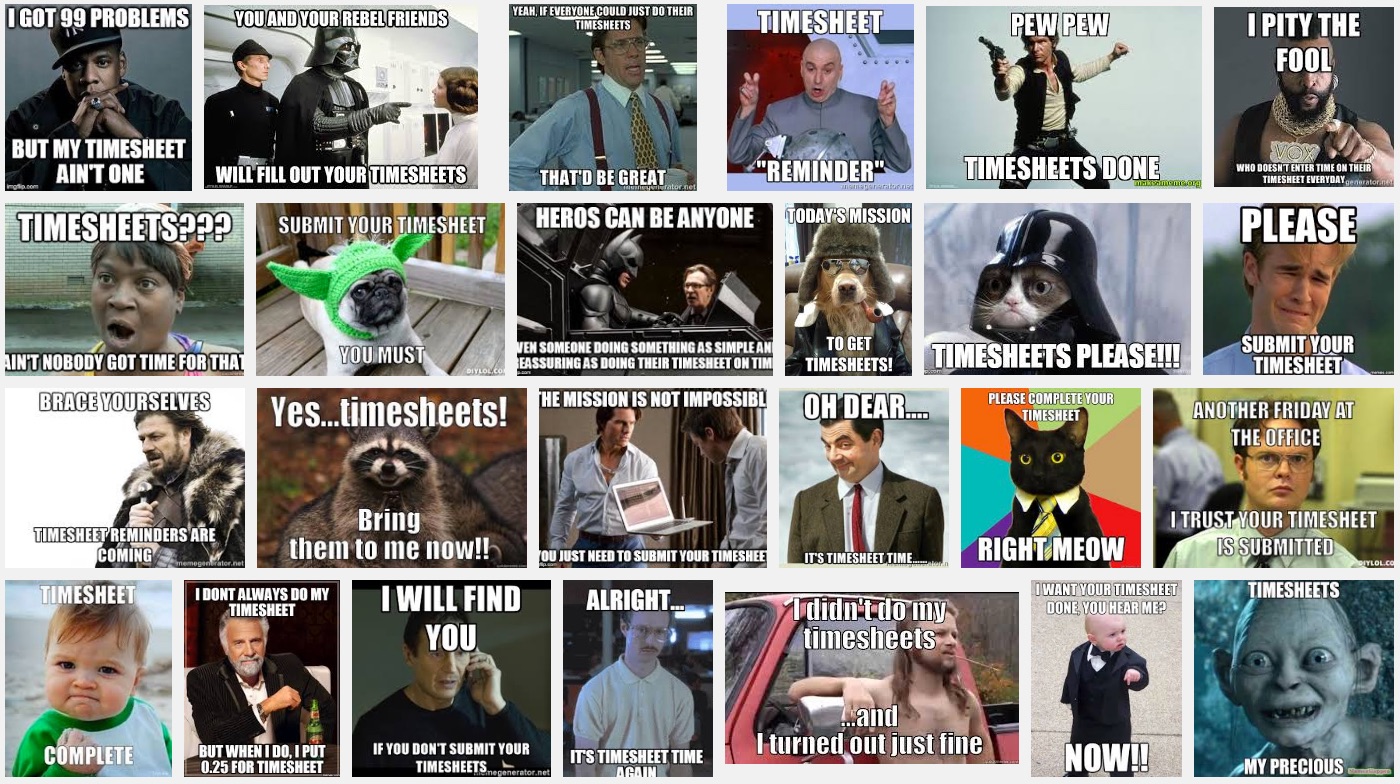
  • Do you see a lot of firms moving to Value PricingWhat is your opinion on timesheets? And why do consultants to the profession advocate for them?

  • We’re all fans of the Susskind book, The Future of the Professions. Tell us about your “Rise of the Machines” webinars and work.

  • The competition that kills you doesn’t look like you. What will disrupt the profession?

  • Have you use Amy, the AI that helps you schedule meetings?

  • Are you in alignment with Ray Kurzweil on the arrival of the Singularity by 2029?

  • What advice would you give a young CPA about to launch his career?

Episode #118: Free-rider Friday - November 2016

Segment One

What a month! Donald Trump wins the presidency and the Cubs win the World Series.

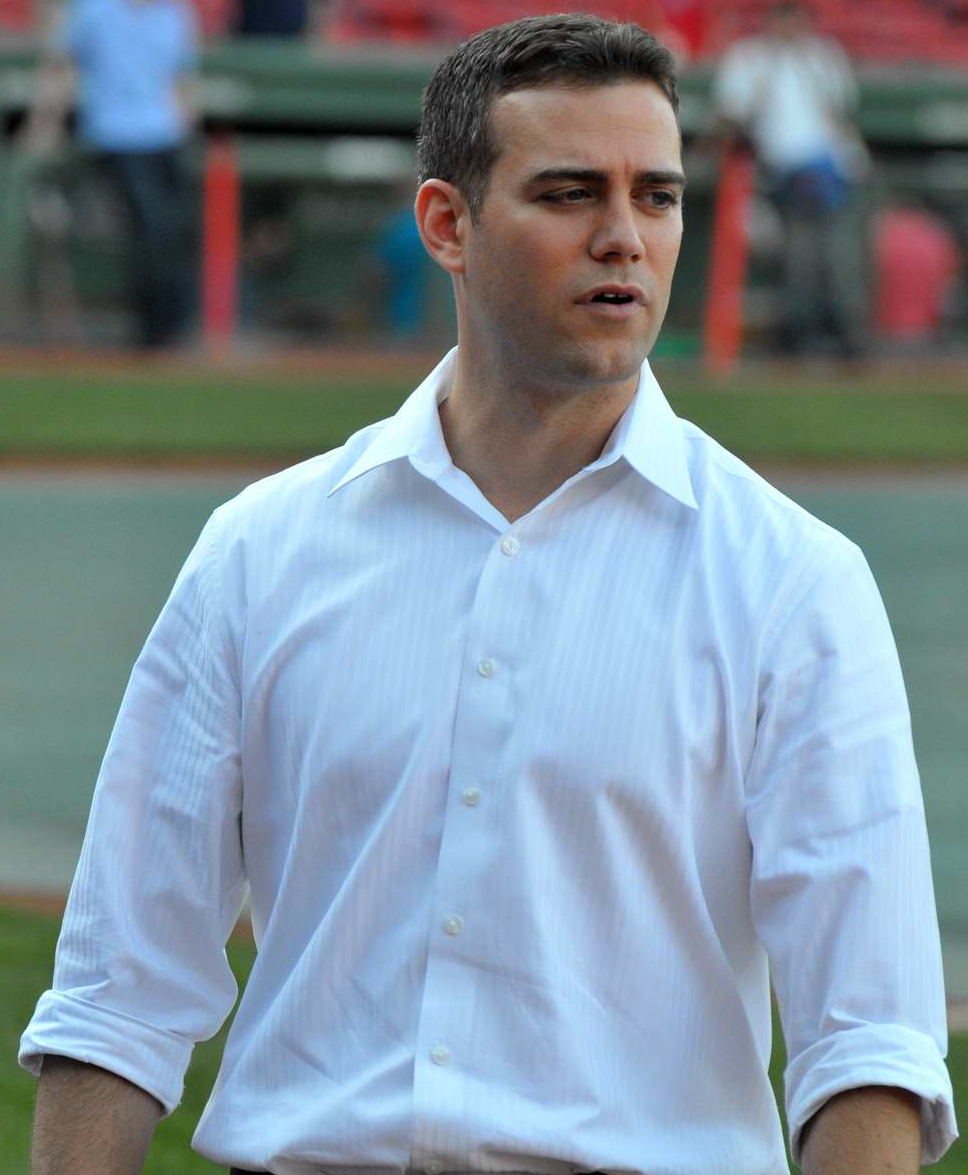
Theo Epstein broke the curse of both the Red Sox and the Cubs. Ed thinks he destined for the Baseball Hall of Fame.

The prediction markets, Nate Silver, and the polls got the election wrong. They all reinforced each other and it was a classic example of an echo chamber.

Only three polls got the results right, and one private pollster: Investors Business Daily, Los Angeles Times, and Trafalgar. The private pollster was working for the Trump campaign, John Mclauglin of the Hoover Institution.

Is the election result similar to the 1961 World Series, when the Pirates beat the Yankees in four games, even though the Yankees outscored them overall?

If we scrapped the Electoral College, it’s a static analysis to argue that Hillary would have won. The election dynamics would have been different, with the candidates spending time differently in different states.

Segment Two

Did Trump receive a mandate?

Have the Democrats been reduced to a bi-coastal party?

The plurality of Americans voted for no one, which has always been the case.

Either way, voting is a flawed way to make decisions.

Imagine making decisions on whom to marry, what car to buy, where to live, your job, by popular vote.

Maine passed a law allowing for rank-choice voting.

Ed explained Approval Voting and N/3 Analysis as a way for organizations to make better decisions than simply majority or plurality voting.

Segment Three

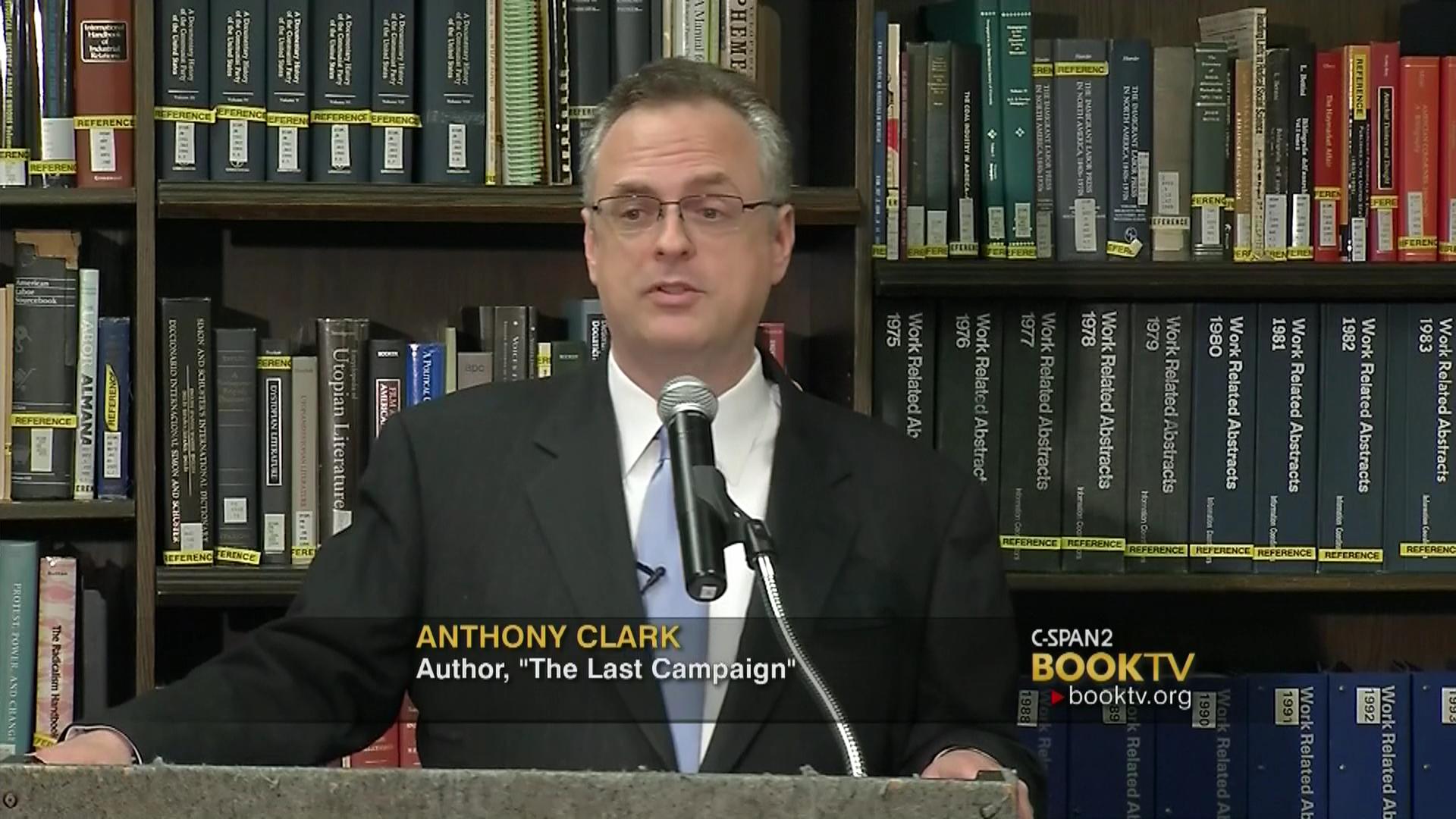
Author of The Last Campaign: How Presidents Rewrite History, Run for Posterity & Enshrine Their Legacies, Anthony Clark appeared in this segment to discuss the Obama Presidential Library.

The Obama Presidential Library site has been selected: Historical Jackson Park, Chicago, Illinois, expected to open in 2021.

However, the records will be out in 2121—it takes 100 years for the National Archives to process and release all the records. More emphasis is placed on opening the museum to promote the legacy rather than hiring archivists to process records.

The Reagan Library opened in 1991 and they still haven’t processed 75% of the records yet.

Segment Four

Rocket Man: Elon Musk

“I’d like to die on Mars. Just not on impact.”

On September 27, Musk outlined his plans to colonize Mars within 10 years:

  • 100 passengers @ $200K each

  • The journey will take 6 months

It’s a hedge against Earth-bound extinction. Stephen Hawking, among others, believes we are all sitting ducks for a supervirus, malevolent AI, nuclear war, etc.

The Economist called this view “Claptrap.”

Living on Mars would be difficult: Need pressurized buildings, communication with Earth would be tedious, you’d have to recycle nutrients and waste, etc. Biosphere 2 in the 1990s was quickly abandoned as impractical for some of these reasons.

Musk also said the government would have to open its checkbook.

Cool, but why should we all pay for it?

Cool, but why should we all pay for it?

Musk might be more impressive to show results here on Earth first, perhaps by turning a profit in one of his three enterprises.

  • $1.3B Tesla subsidies

  • Export/Import Bank subsidized payloads for SpaceX launches

  • $4.9B in total subsidies over the past 10 years, according to the Heritage Foundation (approximately 50% of Musk’s wealth).

Quick and Dirty,” The Economist, October 8, 2016

Short-Termism is a problem?

  1. The average holding period of shares is 200 days

  2. Managers are perceived to be harried to meet targets in one year or less

This is not a helpful lens: the same system that’s poured capital into Tesla, Uber, Twitter, Amazon, etc., is accused of short-termism.

America is the most hyperactive market with the best-performing economy, and with dominant firms.

S&P has a new index, and it claims to track firms with a long-term focus.

Three out of ten of its largest holdings are cigarette firms, which may outlive their customers for all the wrong reasons.

The tension between short-term vs. long-term is what makes capitalism tick.

Episode #117: Interview with David Friedman, Anarchist, Anachronist, Economist

About Our Guest

Ron and Ed are thrilled to have as a Guest this week, the self described anarchist-anachronist-economist David Friedman

David is an American economist, physicist, legal scholar, and libertarian theorist. He is known for his writings in market anarchist theory, which is the subject of his most popular book, The Machinery of Freedom.

He has an active blog at which he opines about everything from medieval recipes to global warming. 

Segment One: Ed’s Questions

What are your thoughts on the election?

Would President Obama pardon Hillary Clinton, even though she hasn’t been convicted of anything? Is there precedent in any legal system for a pre-emptive pardon?

Should we transfer the pardon power to Congress?

Segment Two: Ron’s Questions

In Hidden Order: The Economics of Everyday Life, 1996, you discuss the assumption of rationality. It’s false, but useful. It describes our actions, not our thoughts.

Why do economists hold on to the assumption of rationality?

You haven’t seen any major advances because of behavioral economics?

Price discrimination. What are the welfare benefits of price discrimination?

Segment Three: Ed’s Questions

The market is often blamed for inequality, but you point out that often times it is government that is more unequal to the poor. Could you give us an example or two?

You’ve written on public-key encryption, is blockchain and Bitcoin a manifestation of that?

Question from Jay, one of our listeners: Who or what led you to your anarchism?

Segment Four: Ron’s Questions

In Law’s Order, you point out that the death penalty is irreversible, but so is prison time. And since prison has to be imposed at a higher probability to get same deterrent effect, there will be proportionally more mistakes with imprisonment than the death penalty.

You have a PhD in physics. What’s your view of Global Warming?

Are you concerned about the declining population in some countries, such as Europe, Japan, etc.?

Three times as many disagreements each year among eBay traders are resolved using its online dispute resolution system than there are lawsuits filed in the entire US court system. Might this be an example of some of the ideas in The Machinery of Freedom being implemented?

Illustrated Summary of Machinery of Freedom

Episode #116: Interview with pricing expert, Tim Smith

Biography

Dr. Tim J. Smith is the founder and CEO of Wiglaf Pricing, an Adjunct Professor of Marketing and Economics at DePaul University, and the author of Pricing Done Right and Pricing Strategy, and founder of Wiglaf Pricing. He has been a keynote speaker and workshop leader on a variety of pricing topics to professional audiences across the globe. Smith began his career as a research scientist in quantum mechanics. He’s an Academic Advisor to the Professional Pricing Society’s Certified Pricing Professional program, a member of the American Marketing Association, Business Marketing Association, and American Physical Society.

He holds a BS in Physics and Chemistry from Southern Methodist University, a BA in Mathematics from Southern Methodist University, a PhD in Physical Chemistry from the University of Chicago, and an MBA with high honors in Strategy and Marketing from the University of Chicago Booth School of Business.

Segment One—Ron’s Questions and Summary of Answers

You have a PhD in physical chemistry. How did you get into pricing?

I fell into it! Became an entrepreneur in technology and sales and discovered that value-based selling was basically the same as value-based pricing. Selling and math make a pricing professional.

Your first book was Hawks, Seagulls and Mice, (2006), what was it about?

It looks at the structure of sales and marketing across different industries, and how they vary.

In Pricing Strategy: Setting Price Levels, Managing Price Discounts, & Establishing Price Structures, 2012, you write:

The science of pricing refers to the act of gathering information, conducting quantitative analysis, and   revealing an accurate understanding of the range of prices likely to yield positive results.

The art of pricing refers to the ability to influence consumer price acceptance, adapt structures, and align pricing strategy.

Is pricing more art or science, or conceptual? You write it’s not an engineering challenge, but a strategic challenge?

It’s a strategic science, which puts it closer to an art.

You wrote in your latest book, Pricing Done Right

Although price not a competitive advantage, pricing may be.” Rethinking the unit in pricing, and change your industry, such as hourly to fixed prices, Zipcar, iTunes and music, etc.

 You can imitate a price, but it’s march harder to imitate a pricing structure, which can be a          competitive advantage.

Why does cost-plus pricing continue to be endemic?

Because it’s simple, common, mechanical. It’s a form a satisficing (satisfy + suffice). It’s precisely wrong, rather than approximately right.

The shift from setting prices to communicating value is really a business model change, isn’t it?

Yes.

Clayton Christensen’s new book, Competing Against Luck, argues that the job the customer is doing with your product or service needs to be understood.

It goes back to Ted Levitt, nothing new, really.

Segment Two—Ed’s Questions and Summary of Answers

Why Wiglaf Pricing?

Wiglaf is a character in the Anglo-Saxon epic poem Beowulf. He is the son of Weohstan, a Swede of the Wægmunding clan who had entered the service of Beowulf, king of the Geats. Wiglaf was Beowulf’s advisor, and helped him slay his dragon.

Your mantra

You have a mantra, three questions: What’s my alternative? Are you better or worse? And why should I care? [these are the questions customer’s ask themselves].

If a customer isn’t profitable, they aren’t a customer—they are a leech. It’s all about servicing customer needs... profitably. Not every customer is your customer, or your target customer.

What are some of the biggest mistakes organizations make regarding their pricing strategies?

Treating price as an outcome; what price do we need to   make this sale. Pricing is a verb, not a noun—it’s a process.

Do you think discounts are needed in some industries?

They are in some industries, but they need to be managed dynamically, and planned, over time. Unplanned discounts are ripe for better planning. Key question to ask: how will this discount improve the relationship with this customer.

Segment Three

Tim's latest book is Pricing Done Right: The Pricing Framework Proven Successful by the World’s Most Profitable Companies, 2016, he lays out five key decisions of a Value-Based Pricing Framework:

  1. Business Strategy

  2. Pricing strategy

  3. Market pricing

  4. Price variance policy

  5. Price execution

Also, four pricing strategy issues:

  1. Price positioning

  2. Price segmentation

  3. Competitive price reaction strategy

  4. Pricing capability

Should pricing be centralized or decentralized?

The extreme of both have failed in most firms. I advocate cross-functional teams (marketing, sales, finance and pricing). It’s an enabler, not a replacer—it can’t be alone. Is pricing too important to leave to the pricers?

It’s fascinating research coming out of Germany, demonstrating most profitable firms are those that don’t have complete centralized or decentralized decisions. There’s no way a centralized pricing group has the same tacit knowledge of the sales force in the field. You have to marry that tacit knowledge with the explicit knowledge of the pricers.

This is the approach of Target Costing at Toyota, Nissan, IKEA, etc.

You write neutral pricing is default strategy (least likely to have price wars), and that penetration pricing cannot generally be defended from a strategic viewpoint (failures are greater than success, e.g., Amazon).

GoPro failed with it as well. Just because you have a lower price doesn’t mean people want it.

What industry does the best job at pricing?

Some have the algorithms down well (airlines, hotels), but no one industry has the strategy down. Some individual firms do, such as Eastman Chemical, and Peugeot with its Vespa sales into India.

Sports, music, and other event based industries are dynamically priced. We still don’t have a perfect model,   but things are changing.

Is there really such a thing as price gouging?

Price gouging is a legal term. It’s illegal. Outside of that, it’s buyer beware.

Value a feeling?

You write: “Beyond economic benefits, there are behavioral, emotional, hedonistic, and psychological benefits. Though calculating the impact of these benefits may be difficult, their impact on customer choices often outweighs purely economic arguments alone.” Is value a feeling more than a number?

 It goes along with it, but I wouldn’t have used the same words.

Pricing legend Robert Cross posited that people with musical ability make good pricers. Do you have any theories on what makes a good pricer?

I’d put diplomacy as number one.

The pricing profession has grown dramatically in the past 15 years or so, do you think professional pricers have lessened, or increased, price wars?

I would like to say yes, but look at the current price wars in airlines, hence they are unprofitable. Freedom includes the freedom to be stupid. Amazon and Wal-Mart were trying to show how low they could sell a book, even below cost.

What advice would you give to someone who wants to get into pricing?

Read my books, join the Professional Pricing Society, understand your business.

Episode #115: Free-rider Friday - October 2016

Warning and Ed's Note: This show got overly wonky (even for us) and is overly focused on issues related to the Presidential Election in the United States. We will resume our regular commentary next month. 

Ed’s Topics

Poverty on the decline

There are fewer people in absolute poverty today the there were in 1820. While this does not mean the problem of poverty can be ignored, it does mean we should celebrate more our human accomplishments over the last two centuries. 

Ron added statistics from The Economist, October 8, 2016, How the other tenth lives.

Ballot selfies

The laws against taking a selfie with your voting ballot. No really there are! Article: In these states, taking a selfie with your ballot could get you arrested

Joe Buck’s dumb-ass commentary

The worse part of watching the World Series is having to endure the droning on of Joe Buck. Article: Joe Buck's 15 Lamest On-Air Moments

Here are some samples of things he said thus far during the Series:

  • "Good swing by Soler, he'd like to have that back."

  • "If he gets that down, you can't defense it..........uh, there's no defense against that play."

  • "That will make Tomlin have to swing that bat. And he shows right there he knows how to do that." As Indians pitcher swings way late on the first pitch he sees. He went on to whiff on three pitches.

Ron’s Topics

Gamblers getting old

Casinos customers are aging, and they are having a difficult time attracting the millennial generation, as explained in Putting it all on grey, from The Economist, Oct 8, 2016.

TSOE Guest Rabbi Lapin on self-driving cars

Rabbi Daniel Lapin’s thought-provoking Thought Tools edition, Strike Them Down.

Lapin discusses the ethics of the self-driving car, and how as an orthodox rabbi he would never buy a car that was programmed to make ethical decisions.

In the comments section, he also discusses the morality of governments invading other countries to feed or protect its people, and the Just War doctrine.

Intellectual Idiot

A tirade from Nassim Nicholas Taleb, author of The Black Swan and AntiFragile, entitled The Intellectual Yet Idiot, September 16, 2016.

More on driverless cars

Is Apple teaming up with McLaren, a British maker of sports cars and Formula 1 racing team? Ford announces it will launch a fully autonomous car in 2021, without steering wheel or pedals, for car-sharing schemes.

The Economist, September 24, 2016, Who’s self-driving your car?, and Look, no claims!, for the impact on the auto insurance market.

Episode #114: Reflections on The Post-Professional Society

Ed and Ron reflected on the lessons from the two-day workshop, The Post-Professional Society, they led in Niagara Falls for Strategic Leadership Association. If you are interested in joining this organization check them out

We discussed the Question Formulation Technique exercise, developed by The Right Question Institute, and how powerful it is to think in questions rather than brainstorming ideas.

There’s much less anxiety; good questions can come from anyone; and everyone tends to agree on what a great question is, as opposed to an idea that can be challenged.

We also discussed the books: A More Beautiful Question by Warren Berger, and Kevin Kelly’s latest book, The Inevitable, where he lists his eight types of Generative Value.

Here is a copy of the slide deck we used with the topics discussed above.

Listener Email

We received the following email from Mark, who suggests a topic we will address in a future show:

I'm working here in my office today listening to you and Ed in the background.Just finished your conversation with Thomas Sowell--wow, outstanding. 

As a CFO, my biggest frustration is the 25 flavors of strategic planning. Too much, too many connect-the-dots, too unproductive.  So the brainstorm is to have a show about building off-site planning (if any) about what the customer values most. One of my clients is going through Verne Harnish's Scaling Up. One is going through Wickman's E.O.S. But the focus is on internal factors, not what matters to the customer. 

I would love to hear your perspective on planning (short, mid, long-term). And just for fun, pick up Stacy Barr's book on Performance Measurement as an example of how these strategy planning processes are too extreme. 

Thankfully, Dan Sullivan of the Strategic Coach (I'm in year 4) gets this right through his lingo - Front Stage, Back Stage. So he's making sure our planning is always with the customer and what they value at top of mind.

One last comment. I read the Firm of the Future back in 2004 thanks to a recommendation by Gary Boomer. It ranks right up there with The Goal.   Keep writing!! You guys rock.  Mark

Thanks, Mark, we think you and all our listeners ROCK! 

Episode #113: Interview with Dr. Timothy Chou

About Dr. Timothy Chou

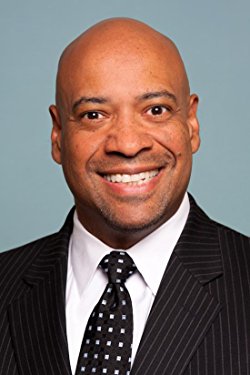
Timothy Chou has been lucky enough to have a career spanning academia, successful (and not so successful) startups and large corporations. He was one of only a few people to hold the President title at Oracle. As President of Oracle On Demand he grew the cloud business from it’s very beginning. Today that business is over $2B. He wrote about the move of applications to the cloud in 2004 in his first book, “The End of Software”. Today he serves on the board of Blackbaud, a nearly $700M vertical application cloud service company.

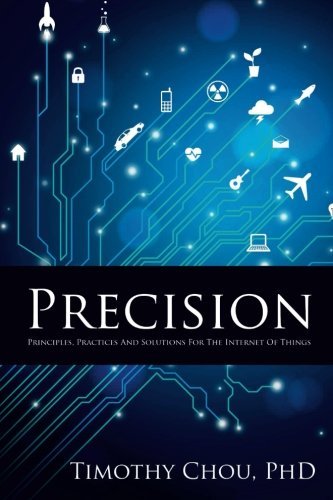
He most recent book is Precision: Principles, Practices and Solutions for the Internet of Things to introduce the basics of the Industrial Internet of Things (IoT). You may not be sure why your coffee pot should talk to your toaster, but precision technology powering an Internet of Things has the potential to reshape the planet. 

Interview Notes and Questions

What was it like working for Larry Ellison?

Tim's Three fundamental differences between things and people

  • A lot more things than people

  • Things can be were people are not

  • Things can “talk” constantly

AI has been around for years, why is it gaining more traction lately?

Are you optimistic or pessimistic about the AI transformation? Why?

What about Stuxnet? Are IoT devices secure?

Ed just saw the movie Sully, the drama in the movie was about the NTSB and their simulations that said they could get back to LGA, but when human decision factor was added (35 seconds) they could not. Would it be a good idea to give computers the final say? One the one hand, there is no creativity. On the other there is no “human factor” or delay. Thoughts?

Tim's IoT Framework 

Some articles by or about Tim's work

And two videos

And, of course, Tim's new book

Episode #112: Interview with Reginald Tomas Lee

Biography

Dr. Reginald Tomas Lee is an advisor and researcher in the areas of cash flow, capacity management, and profitability. Using a deep background in engineering and math, he has created tools and models that have helped executives in businesses of all types improve the management of cash flow and other financial data.

Professionally, Reginald has worked in industry, academia, and consulting including leading global companies such as EY, GM, IBM, and Oracle.

He has advised many marquee names such as Bristol Myers Squibb, Disney, DuPont, Home Depot, Lockheed, Office Depot, Raytheon, Toyota, and United Healthcare.

Reginald has a PhD in mechanical engineering from the University of Dayton, and is the author of three books and over 40 published articles and white papers. He is a feature writer for Journal of Corporate Accounting & Finance and a contributor to the Cincinnati Business Courier.

Resources by and about Dr. Lee

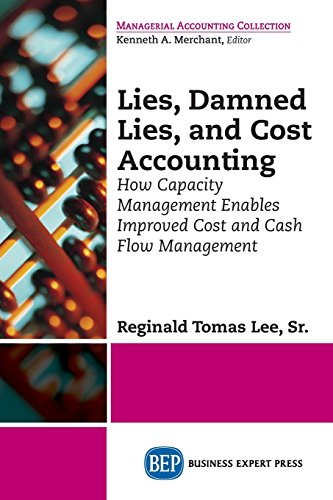
Lies, Damned Lies, and Cost Accounting: How Capacity Management Enables Improved Cost and Cash Flow Management, 2016

Explicit Cost Dynamics: An Alternative to Activity-Based Costing, 2001

Article: Three steps to improving project ROI performance

Article: Making technology pay

Dr. Lee’s Website, The Cash Innovation Lab

Discussion Topics

Three reasons cost accounting is a bad practice

  1. Creates and forces math and relationships that don’t exist

  2. You lose touch with operations

  3. Creates meaningless numbers that people consider gospel

Accounting reports financial performance, they doesn’t model cash flow

  • Cash flow is most important

  • Accounting not good proxy for managing cash flow

  • Idea and importance of capacity

Capacity = Largest Expenditure

  • Hotels, Airlines, Cruise ships, don’t do cost accounting

  • They invest in yield management—value/pricing side

You can calculate different costs from same data, and it has nothing to do with cash

  • Standard, ABC, Lean, Full-Absorption, Marginal costing, all lead to different results

  • Yet all methods are sanctioned by GAAP

  • Segal’s Law: a man with a watch knows what time it is. A man with two watches has no idea.

  • A single representation of an artificial reality

Companies are spending a lot of money managing costs that have nothing to do with money

  • Dr. Lee distinguishes between: Cost C (cash) and Costs NC (non-cash)

  • Cost is an opinion; cash is a fact!

Costing and cost accounting create false relationships and inappropriate use of math

  • No relationship to buying time and what you do with it

  • Cheaper to make 20 pens than 5? How?

  • Economies of scale?

Capacity modeling: unifying concepts of finance, accounting, and operations

  • Contribution margin analysis won’t predict need for additional capacity

  • Overstate ROI because of Costs NC—hospital example

Other resources

In his seminal book, Profit Beyond Measure: Extraordinary Results through Attention to Work and PeopleH. Thomas Johnson revels how Toyota doesn’t use standard cost accounting.

The Goal: A Process of Ongoing Improvement, by Eliyahu M. Goldratt. He is another critic of cost accounting, as seen in this Youtube video:

Episode #111: Free-rider Friday - September 2016

Ed and Ron recorded this show live before an audience at the Institute of Professional Bookkeepers of Canada 2016 Ignite Conference in Richmond, BC, Canada.

Ed’s Topics

Wells Fargo Gets What it Measures

Some 5,300 Wells Fargo Bank (WFB) employees opened a couple of million fake accounts, since their compensation system was designed around opening up accounts. This created an incentive for otherwise ethical people to perform an unethical act. It’s hard to be a good citizen in a bad country.

The Best Critique I’ve ever Received

“This presenter, should he be brought back for a session in the future, should be dressed appropriately, and that is, as Clarabelle would appear at a children’s birthday party complete with red bulbous nose and horn, remaining silent otherwise.”

Watson Creates a Movie Trailer

For Morgan, a new suspense horror film.

Uber goes to 1.8x during NY Bombing

Did they price gouge? Hell, NO! What would happen if Uber were ruled to be illegal. It creates $6.8 billion in “social value,” roughly $20 per person per year.

Hey Vancouverites!

If you have tickets to Louis CK’s show, don’t scalp them! I love Louis CK, but he is a terrible pricer and even a worse economist. Charge more and give the money away! 

Department of Transportation Policy on Driverless Cars

Whadd'ya know, it makes sense!

Ron’s Topics

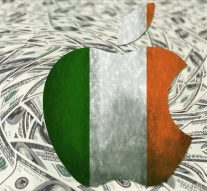
EU to Apple: Pay $14.5 billion in Taxes to Ireland

EU accuses Ireland or “providing illegal state aid” to Apple, and says the company owes $14.5 billion in back taxes to Ireland. Tim Cook, CEO of Apple, said the Commission can have taxes or they can have jobs, but they can’t have both. Ireland claims there was no “special deal” with Apple, and the tax rates were always statute-based.

It’s hard to have employees without successful employers. It’s time to take the corporate tax to zero, since corporations don’t pay taxes—only people do!

Another asinine regulation from the EU, this one on American winemakers: They must relabel their bottles for export because they list alcohol content to one decimal point more than the EU deems permissible.

Don’t Buff it up

Warren Buffet loves to talk about the rich not paying their “fair share” of taxes. But his company, Berkshire, pays the equivalent of 13% of its pre-tax profits, making it one of the lightest taxpayers among big firms.

More Bootleggers and Baptists

Alcohol and pharmaceutical companies are funding the fight against legalized pot.

In Plain Words

In analyzing more than 135 years of speeches in the Congressional Record, in 1990, the probability of correctly guessing a lawmaker’s party from a one-minute speech was 55%. By 2008, the probability jumps to 83%. We’ve become more partisan, a linguistic divide.

Leaked Email from DNC

From Bernie Sanders to former DNC head Debbie Wasserman Schultz, "I hear from people you are planning to attack me and say I do not believe in an all-wise, benevolent creator with a glorious beard and a love for all humanity. If so you are vile and this is beneath you. I do believe in Marx."

(Thanks to James Lileks, who writes the “Athwart” column for National Review.)

Vancouver’s Ghost Neighborhoods

Many Chinese are buying up condos and not living in them. This creates a reverse “tragedy of the commons,” as cities depend on people actually living in them. Same thing is happening in Israel. These countries are going to start taxing non-resident buyers. Does government have a right to do this? Rabbi Daniel Lapin thinks so, because businesses in these cities depend on populations living there.

Episode #110: How to use key PREDICTIVE indicators

Because economies are governed by thoughts, they reflect not the laws of matter but the laws of mind. One crucial law of mind is that belief precedes knowledge. New knowledge does not come without a leap of hypothesis, a projection by the intuitive sense. The logic of creativity is leap before you look.

You cannot fully see anything new from an old place. . . . It is the leap, not the look, that generates the crucial information; the leap through time and space, beyond the swarm of observable fact, that opens up the vista of discovery.

—George Gilder, Wealth and Poverty, 1993

We have all heard the famous saying, often referred to as the McKinsey Maxim, named after the famed consulting firm: “What you can measure you can manage.”

This bromide has become such a cliché in the business world that it is either specious or meaningless.

Specious since companies have been counting and measuring things ever since accounting was invented, and meaningless because it does not tell us what ought to be measured.

Besides, has the effectiveness of management itself ever been measured? How about the performance of measurement?

Measurement for measurement sake’s is senseless, as quality pioneer Philip Crosby understood when he uttered, “Building a better scale doesn’t change your weight.”

The Triple Crown Criteria

In his book, From Worst to First, Gordon Bethune details how he was able to turn around the failed airline (which had filed for Chapter 7 bankruptcy twice in the preceding decade) between February 1994 and 1997, turning it into one of the best and most profitable airlines in the sky.

It is a remarkable story, and it illustrates the importance of utilizing leading key predictive indicators (KPIs) to focus the entire organization on its purpose and mission.

Bethune basically tracked three leading Key Predictive Indicators (KPIs), known as the “Triple Crown Criteria” in the airline industry:

  • On-time arrival

  • Lost luggage

  • Customer complaints 

What makes these three KPIs leading is that they measure success the same way the customer does. And that is critical because, ultimately, the success of any business is a result of loyal customers who return.

None of the three indicators would ever show up on a financial statement, but, as the airlines have learned over the years—by testing the theory—they have a predictive correlation with profits.

Is there a Triple Crown Criteria for PKFs?

Now that there are well over a thousand firms that have trashed timesheets, VeraSage Institute is proud to announce, based upon empirical evidence, the Triple Crown Criteria for Professional Knowledge Firms.

We are emphatically declaring that the following three KPIs are all your firm ever needs to track to predict future customer loyalty and buying behavior.

Think about it: If an airline can run on three KPIs, why can’t a PKF?

An airline is far more complicated than any PKF, which is what makes KPIs so powerful: they are measurements (or judgments) guided by a theory.

But the theory is the senior partner. It’s not just measurement for the sake of measurement. It’s measuring—and judging—what actually matters, to customers.

It’s defining the success of your firm the same way the customer does, just like with the airline KPIs.

The Three KPIs

Turnaround Time

Michael Dell likes to refer to the time lag between a customer placing an order and the company assembling and shipping the finished product as velocity.

We believe professional firms should also be diligent about tracking when each project comes in, establishing a desired completion date, and measuring the percentage of on-time delivery.

As Ed always points out, a firm can measure “time spent” or “duration.” The latter is the only thing that matters to the customer, hence that’s what needs to be tracked.

This prevents procrastination, missed deadlines, and projects lingering in the firm while the customer is kept in the dark.

Imagine installing 360-degree webcams everywhere in a firm. Also imagine customers being able to log onto a secure Web site, type in their names and passwords, and the appropriate web camera would find their project and give them a real-time picture of it, probably laying on a manager’s floor or credenza awaiting review.

Would this change the way work moved through a firm? Would this hold the firm accountable for results, not merely efforts?

Customers don’t want to hear about the labor pains—they want to see the baby.

FedEx and UPS do exactly this; and in fact some law firms utilize intranets that provide their customers with real-time access to the work being performed on their behalf.

This one metric would go a long way towards mitigating most of the reasons customers defect from firms (not kept informed, feel ignored, and so on).

Value Gap

This measurement attempts to expose the gap between how much the firm could be yielding from its customers compared to how much it actually is.

It is an excellent way to reward cross-selling additional services, increase the lifetime value of the firm to the customer, and gain a larger percentage of the customer’s wallet.

Marriott International uses predictive analytics through its Hotel Optimization program. Marriott has developed a revenue opportunity model, comparing actual revenues as a percentage of optimal prices that could have been charged. It attributes the narrowing of this gap, from 83 to 91 percent, to this metric.

One CPA firm made this calculation part of its partner compensation model. What actions can your firm take to close the value gap?

High Satisfaction Day™

I am indebted to John Heymann, CEO, and his Team at NewLevel Group, a consulting firm located in Napa, California, for this KPI.

When John’s firm held a retreat for the purpose of developing their KPIs, the suggestion of High Satisfaction Day (HSD) was made.

An HSD is one of those days that convinces you, beyond doubt, why you do what you do. It could mean landing a new customer, achieving a breakthrough on an existing project, receiving a heartfelt thank-you from a customer, or any other emotion of exhilaration that makes you happy you got out of bed in the morning.

Sound touchy-feely? John admits it is; but he also says the number of HSDs logged into the firm’s calendar is a leading indicator—and a barometer—of his firm’s morale, culture, and profitability.

Is this too Simplistic?

No.

Compare the above KPIs to what most firms are measuring now—billable hours, utilization, realization, write-downs, write-offs, and other internally-focused metrics that have nothing to do with how the customer defines the success of their firm.

These metrics have zero predictive ability when it comes to future customer behavior. They are lagging indicators, not leading.

Stop measuring things that don’t matter, and focus on what does. The above three KPIs will work in any PKF—period.

Ron and Ed stand by this Triple Crown hypothesis for all PKFs.

Prove us wrong.

We’ll enjoy losing the argument, because it means we’ll learn something new.

Grown-ups love figures. When you tell them that you have made a new friend, they never ask you any questions about essential matters. They never say to you, “What does his voice sound like? What games does he love best? Does he collect butterflies?” Instead they demand: “How old is he? How many brothers has he? How much does he weigh? How much money does his father make?” Only from these figures do they think they have learned anything about him.

Antoine de Saint-Exupéry, The Little Prince, 1943

Episode #109: Trashing the Timesheet

In general, there are four defenses for maintaining timesheets:

  1. We need them to price.

  2. We need them for project management.

  3. We need them for team member performance evaluations.

  4. We need them for cost accounting.

VeraSage has proven, without a doubt, that every one of these defenses is incorrect, and that there are superior methods and tools for each of these objectives.

First, prices are set by value, not hours, even within the context of competition. After all, none of us buy the cheapest of everything, which proves there is room in all markets for price searching by sellers to take place.

Second, anyone who spends a day listening to Ed Kless teach project management cannot possibly come away thinking that “time spent” is more important than “duration”—that is, turnaround time—from a project manager’s perspective. Duration is where the bottlenecks occur, not time spent.

Time is not value, it’s not a cost; it’s a constraint.

Third, anyone who has studied nearly every single private business, or a Results-Only Work Environment (ROWE), knows timesheets are not needed to conduct performance evaluations for team members.

Yet, it’s the last defense we really want to bury, once and for all, in this post.

Timesheets are a Cost Allocation Tool - NOT!

Some claim the only way to calculate profitability per customer is with timesheets. Really?

First off, you don’t need timesheets to know your firm’s costs. Look at your income statement. Don’t confuse total costs with cost allocation.

Give me half a day, maybe less, with your income statement, revenue per customer, and allow me to interview your team, and I will allocate your costs over any time period you want, and the result will be customer profitability that’s close enough for horseshoes and hand grenades.

Let’s get over the idea that any cost accounting—be it timesheets, Activity Based Costing, or any other method—requires 100 percent accuracy. The simple truth is, cost accounting is full of arbitrary allocations and errors, and if you don’t understand that, you’ve never been a cost accountant.

Cost accounting just has to be close enough, and the important point is that your costs need to be known before you do the job, not afterwards.

This is why Japanese manufacturing (especially automobile) companies utilize Target Costing, not standard cost accounting. They are about 40 years ahead of American companies with this practice.

This is an enormous difference, since value drives price, and price drives the costs you can incur to earn a profit you can live with. It does no good to know your cost allocation to the penny if the customer doesn’t agree with your value and/or price.

Further, costs are largely fixed in professional firms. This is why airlines, cruise ships, hotels, etc., do not engage in low-value cost accounting, but rather concentrate on yield management—that is, pricing for value, not to cover arbitrarily allocated costs.

Why Your Hourly Rate is Not Cost Accounting

However, I want to dive deeper on this issue, because the above logic doesn’t seem to convince many CPAs.

Your hourly rate is not even an accurate cost allocation method. Here’s why:

  1. It includes profit. There’s no such thing as allocating profit in cost accounting. That’s profit forecasting, not cost accounting. Opportunity cost has no place in cost accounting either, as that is an economic concept, not a cost accounting concept.

  2. Even if you remove the profit component from your hourly rate, it still bears no relationship to your firm’s actual costs. Since most firms establish their hourly rates based upon reverse competition—that is, what your competitors charge—the cost component is completely arbitrary. I have yet to encounter more than a handful of firms that tie out their cost per hour to their general ledger.

  3. With the timesheet, you are attempting to run a Profit & Loss statement on every hour of work logged. This is absurd, since your firm is an interdependent system, and cannot be atomized into a series of recorded hours.

  4. The hourly cost allocation gives no weight to the lifetime value of the customer—and the lifetime value of the firm to the customer.

These are egregious errors for CPAs to commit, given our supposed fastidiousness when it comes to numbers.

And when you compare this costing method to target costing—or price-led costing—you realize timesheet allocation is suffering from what philosophers call a deteriorating paradigm—the theory gets more and more complex to account for its lack of explanatory power.

This is why many firms will allocate the same dollar of revenue three or four times, based upon different criteria—from origination to realization to cash collections—which is overly complicated and not a great use of limited executive attention.

But Wait, There’s More

Here’s a Gedanken (thought experiment).

Assume you’re a sole proprietorship, and have $100,000 of fixed overhead this year (rent, wages, pencil lead, paper, etc.).

Further, let’s assume you plan to work 3,000 hours, and expect one-half of this to be “billable,” and the other half “nonbillable.”

The first question is do you divide the $100,000 of costs by 1,500 or 3,000 hours? Forget adding your desired profit, as that’s not cost accounting but profit forecasting.

The theory of hourly rates says you’d divide by the number of hours you expect to bill, not work, so that’s $100,000/1,500, or $66.67 per hour of allocated costs per hour worked.

Let’s also assume that you’ve billed 1,500 hours between January and November 30th of the current year, and you’ve completed all of your work, looking forward to your month off (you were able to get all your work done early because you took Ed Kless’s excellent project management boot camp).

Now, on December 1st, a new customer engages you to perform 100 hours of additional work that month.

Your cost allocation now becomes $100,000/1,600, or $62.50.

Therefore, you’ve been over-allocating your costs by $5 per hour for eleven months of the year.

[It’s even more absurd if you originally divided the $100,000 by 3,000 hours worked (not billed), even though you no longer have the $5 per hour over-allocation issue. Why? Because, then, to which customers do you allocate the 1,400 “nonbillable” hours? And how do you determine that allocation? This is why cost accounting is full of arbitrary assumptions].

Multiply that by more and more employees, customers that are constantly being added and subtracted, account for all the lies in timesheets, the eating of time, non-recorded time, and all the other games played, and you have an egregiously incorrect cost allocation scheme that is incredibly elastic, not accurate.

And, to add insult to injury, timesheets are not helping you price better, conduct project management more effectively (or even efficiently, for you Taylorite disciples), qualify your customers better, predict the performance of your team members, or measure what matters to your customers, or improve future performance of your firm, as with After Action Reviews—and, even more absurd, they are lagging indicators that give us the illusion of control.

By definition, once you see something on a timesheet, it can longer be managed.

Moreover, they cost a fortune to maintain—usually the biggest customer in the firm. What’s the ROI from this investment in tracking time? We believe it’s negative.

All this said, what’s the point of timesheets?

As Ed says, “If you suck at what you do, bill by the hour…”

And I would add, given the logic of the above, “…and keep timesheets.”

If you think the above is flawed, please let us know where.

This debate is getting stale, and we should have moved on a long time ago, since there are many more important issues for the professions to deal with rather than wasting time on a deteriorating paradigm.

Additional Resources and Mentions

Jamey Johnson - The Dollar

For a comprehensive Q&A on timesheets, see the VeraSage post, Ask VeraSage: All About T&A.

Episode #108: The True Professional Ideal

Life is not worth living if we exercise our profession only for the sake of material success and do not find in our calling an inner necessity and a meaning which transcends the mere earning of money, a meaning which gives our life dignity and strength. –Michael Novak


We must hold a man amenable to reason for the choice of his daily craft or profession. It is not an excuse any longer for his deeds that they are the custom of his trade. What business has he with an evil trade? Has he not a calling in his character? –Ralph Waldo Emerson

The term profession comes from the Latin noun professio, which is derived from the past participle professus, or the verb profiteri, denoting “to declare publicly, own freely, acknowledge, avow.” Professionals are said to “profess” something, they stand for something. The noun professional didn’t appear in American dictionaries until 1861.

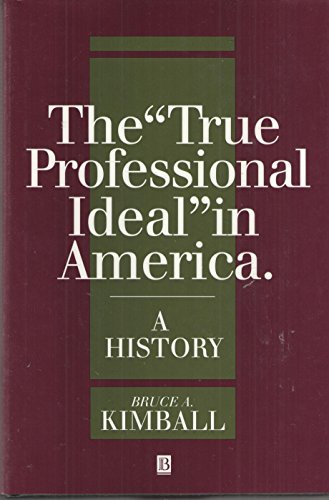
In the 18th and 19th centuries “professions” referred to theology, law, medicine, and education. From the early 17th till the mid-18th century, theology was considered the preeminent profession. Sociologist Bruce Kimball, in his book The “True Professional Ideal” in America, suggests three eras of professionals: religion through the mid-18th century; polity (law) through the mid-19th century; and science through the 1910s. It took until 1925 until the first public opinion survey of vocational status showed that doctors had passed lawyers and ministers (though not professors) in public esteem.

It’s interesting to note that a trip to the doctor didn’t do much good until the 1920s or 1930s with the introduction of antibiotics. Before then, most visits were ineffective and a large number were downright harmful. The Hippocratic principle of primum non nocere (“first, do no harm”) continues to be an essential guideline for all professional conduct.

Scholars have traced regulation of the professions to ancient Babylon and the Code of Hammurabi. Written about 1800 B.C., the Code set predetermined fees for surgeon’s services and imposed penalties for malpractice (including the severing of a surgeon’s hand if the patient died from an operation). The first law to regulate a profession in America was in 1639 in Virginia, where the purpose was to control fees physicians could charge. Ten years later, Massachusetts passed a law regulating the quality of medical care.  Under the U.S. Constitution both professional licensing and education are “residual powers” and deemed state prerogatives, which is why occupational licensing is under the jurisdiction of the states. 

The Characteristics of a Profession

According to Kimball:

By the beginning of the twentieth century, the term [profession] denoted a dignified vocation with three fundamental characteristics. One topic concerns the body of functional knowledge, or expertise, associated with a profession and involves issues of epistemology, utility, and education. A second topic concerns the profession’s organization into an association and involves such issues as autonomy, exclusion, licensing, and certification. The third fundamental topic is the ethic of professional service.

Needless to say, these three basic topics––expertise, association, service––have often been subdivided by scholars into lists of six, eight, ten, or more characteristics. But such characteristics are often redundant or may easily be aggregated on grounds of parsimony. Meanwhile a good deal of testimony affirms that “there are three ideas involved in a profession:  organization, learning...and a spirit of public service.” ...the “collegial, cognitive, and moral,” that is, “autonomy, service, and knowledge”––are characteristics of the “ideal” of a profession (Kimball, 1995: 323-24).

Let us explore these three characteristics as they relate to the CPA profession.

Expertise

Because professionals possess a specific body of knowledge, obtained through education and on-the-job training, the belief is only those with this knowledge are able to regulate the activity. Also, professionals provide advice and intangible knowledge––as opposed to offering tangible goods––and therefore the technical competence and quality of those offering this advice need to be ensured in order to protect the public.

CPAs obtain this specialized knowledge through formal education in college, and demonstrate their competence by passing the Uniform CPA Examination, and also by on-the-job training and continuing professional education.

It is interesting to note that in June 1898, Christine Ross (a native of Nova Scotia) passed New York CPA exam, but certificate No. 143 was withheld till December 21, 1899, after the Board of Regents decided whether or not a woman should be certified. What this delay had to do with her technical competence and expertise is an interesting question.

Autonomy and Exclusion

Autonomy is from the Greek words for “self governance.” One of the hallmarks of a profession is its ability to self-regulate itself.  Because information in professional markets is asymmetrically distributed––that is, sellers know more about the quality of the services rendered than do the consumers––this further enforces the need for professionals to regulate who may enter, and continue to remain, in the profession.

The CPA profession––through the voluntary association of the AICPA, various state societies and the state board of accountancies––engages in self-regulation by: administering the Uniform CPA Examination process and the requirements necessary to qualify for it; granting and administering licenses to practice; promulgating a Code of Professional Conduct; requiring peer review of firms providing attest services; enforcing continuing professional education requirements; carrying out disciplinary actions against members of the profession who violate the Code or laws, or engage in acts discreditable to the profession.

Exclusion––or monopoly status––is granted to the profession through licensing and certification requirements. Society grants monopoly status to a profession in order to protect the public from unlicensed practitioners. The only monopoly status the CPA profession possesses is in the attest function. One must be a CPA in order to render an opinion on a financial statement. The other services CPAs provide––from tax services to management advisory services––are not covered by this monopoly status. Approximately 15% of the CPA profession is engaged in auditing activity, which is why many states have now developed separate avenues to get certified without providing audits.

Monopoly status is not a right of a profession, it is a privilege granted by the state. Theoretically, if society believes the profession is not properly servicing it, monopoly status can be revoked. Also, increased regulation and legal liability are other methods that can be used to ensure a profession is fulfilling its obligations to society. Expansion of legal liability of CPAs and recent legislation such as the Sarbanes-Oxley Act of 2002 is a manifestation of this reality.

It should also be noted that most economists are against monopoly status being granted to any professional, because it reduces innovation, raises prices to consumers, and hinders the dynamism of a free market. The deregulation of the professions that has occurred over the past few decades reflects this view. 

The Spirit of Service

Two Latin phrases sum up the ethic of service that is another core value of a profession: Non sibi sed allis, “Not for ourselves but for others” and Pro bono publico, “For the public good.” Because society grants professions monopoly status, it expects members of that profession to put the interests of the public ahead of its own member’s interests. 

In fact, the AICPA Code was modified January 12, 1988 and a public interest principle was added, which states that conflicts are to be resolved in favor of the public. Even in the absence of codes and principles promulgated by a professional body, individual members and firms have been known to hold themselves to higher standards. 

For instance, George May, a British Chartered Accountant born in 1875, and a senior partner at Price Waterhouse, insisted on financial independence from clients thirty years before the idea occurred to accounting’s professional bodies.

Prior to 1978, some legal and accounting professional ethical codes placed limits on advertising, and soliciting clients––known as afferent ethics, since they deal with relationships among professionals. But since these regulations affect the public, they can also be thought of as efferent ethics, which deal with how the profession shall act in the public interest.

An example of this is the famous 1977 Supreme Court Case Bates & O’Steen v. State Board of Arizona, 433 US 350 (1977), wherein the Court ruled that attorneys could market their legal services. Prior to this landmark case, the AICPA Code of Professional Conduct explicitly proscribed advertising, stating:

Solicitation to obtain clients is prohibited under the Rules of Conduct because it tends to lessen the professional independence towards clients which is essential to the best interests of the public. ...Advertising which is a form of solicitation is prohibited...Promotional practices such as solicitation and advertising, tend to indicate a dominant interest in profit.

Infamous “Bates” Ad

Th ad that started the controversy. It went all the way to the Supreme Court of the United States.

Th ad that started the controversy. It went all the way to the Supreme Court of the United States.

In 1978, the CPA profession responded to the Bates decision by amending this rule to read, "A member shall not seek to obtain clients by advertising or other forms of solicitation in a manner that is false, misleading, or deceptive."

Many economists have argued that advertising has had a salutary effect on professional services by providing more information to consumers, more competition, more choices, new innovative services, better client service, and lower prices. Some members of the profession dispute this and have a tendency to look upon this deregulation as one of the problems causing the alleged compromises to auditor independence, which may have contributed to the recent accounting scandals.

The True Professional

A professional is someone who is responsible for achieving a result rather than performing a task ––Michael Hammer

In The Experience Economy, Joseph Pine and James Gilmore posit a progression of economic value. We believe professionals are poised at the top of their curve: transformations:

If you charge for stuff, you are in the commodity business (fungible)

If you charge for tangible things, you are in the goods business (tangible)

If you charge for the activities you execute, you are in the service business (intangible)

If you charge for the time customers spend with you, you are in the experience business (memorable)

If you charge for outcomes the customer achieves, then you are in the transformation business (effectual—the customer is the product)

Listen to our interview with Joseph Pine from March 6, 2015.

Episode #107 - Free-rider Friday - August 2016

Ron’s Topics

Ten ways to tell you might be sitting next to an economist,” May 9, 2016, The Economist

Those incredible flying machines,” The Economist, June 25, 2016

Maximin,” The Economist, June 25, 2016

Stay with me,” The Economist, May 7, 2016

  • May 3, Hyatt profits up 55% over same QTR 2015

  • REVPAR (revenue divided by rooms available in a given period) has risen last 6 years in America

  • Booking from online sites increased to 1/5 rooms, up from 1/10 in 2006

  • AIRBNB valued at $25B

  • One solution: get bigger. Marriott buy Starwood $13B, 1.1 million rooms, get lower fees from online sites

  • AIRBNB has even more rooms than 1.1M

  • Sued SF over $1K/day fine for each renter not registered (8-%). Airbnb not responsible for failure to comply?

Brexit

July 2, 2016 The Economist

  • Breversal: 4m+ signed petition for a re-run of vote

  • Support for EU is collapsing, esp in France (Germany feels reparative responsibility)

  • EU buys ½ UK exports

  • Norway option: continued access to Europe’s “single market” in return for the free movement of people, and cont to EU budget

  • Article 50 is about Exit, not trade (has to be separate negotiations). Trade requires approval of members

  • Canada-type trade deal, or WTO rules

  • Will Brexit undermine NATO?

  • English may no longer be language of European business

  • Airlines divert investments to EU, Pharma R&D, too

  • Morgan Stanley says 1.5% off Britain’s growth rate 2016-17, half as much for EU, .5% off global growth (UK 4% of world GDP?)

  • Boston Beer Company (Samuel Adams) applied for the Brexit trademark—cider!

  • European Parliament announced a proposal to tax robots as “electronic persons.”

  • Ronald Reagan. Government's view of the economy could be summed up in a few short phrases: If it moves, tax it. If it keeps moving, regulate it. And if it stops moving, subsidize it.

Artificial Intelligence: The return of the machinery question

The Economist, Special Report: June 25, 2016

David Ricardo first posed “The machinery question” in 1821, "The influence of machinery on the interests of different classes of society, and in particular the opinion entertained by the labouring class, that the employment of machinery is frequently detrimental to their interests."

Thomas Carlyle, 1839, railed against the “demon of mechanism, oversetting whole multitudes of workmen.”

During the Industrial Revolution, John Stuart Mill said, "There cannot be a more legitimate object of the legislator’s care than looking after those who livelihoods are disrupted by machines."

1930s: Keynes coined “Technological unemployment.”

JFK issued a domestic challenge: “to maintain full employment at a time when automation…is replacing men.”

1964 Nobel winners formed the Ad Hoc Committee, on the Triple Revolution, which sent president Johnson a memo warning of the "Danger of the combination of the computer and the automated self-regulating machine that would divide society into skilled elite and unskilled underclass."

2013 Oxford study, 47% of jobs in America were high risk (overblown?)

Merrill Lynch by 2025, $14T-33T impact?

McKinsey Global Institute, transformation is happening 10X faster and at 300 times the scale (3000x) impact of Industrial Revolution.

Stephen Hawking, Elon Musk, Bill Gates: AI poses an existential threat to humanity.

2015: $8.5B spent on AI companies.

Long-term goal: Artificial General Intelligence (AGI), capable of solving a wide range of tasks, rather than a new AI system for each problem. AI experts can still publish after joining industry.

Companies ok with this transparency, since they can give away AI systems because they have access to the data. Elon Musk co-founded OpenAI, $1B, with the goal of openness for AI research.

Daniel Susskind quoted: “We compare machines to perfection, not to humans doing the same tasks (driverless cars).”

Will AI get its own regulatory agency (FDA, FAA)?

Pessimists vs. optimists? The Economist is somewhere in the middle.

Governments need to make it easier for workers to retrain and switch jobs. MOOCs, Udacity, Coursera will help. In future, learning to relearn will become the skill needed.

What determines vulnerability to AI?: whether work is routine.

Jobs will be redefined rather than destroyed.

Impact won’t be as great as epochal shift from agricultural to industrial economy.

After AI’s dark winter, and the slow rate of progress, it’s ironic that many now think it’s moving too quickly.

Ed's Topics

Travis Kalanick on Uber's bet on self-driving cars: 'I can't be wrong'

Episode #106: Interview with Professor Steven Landsburg

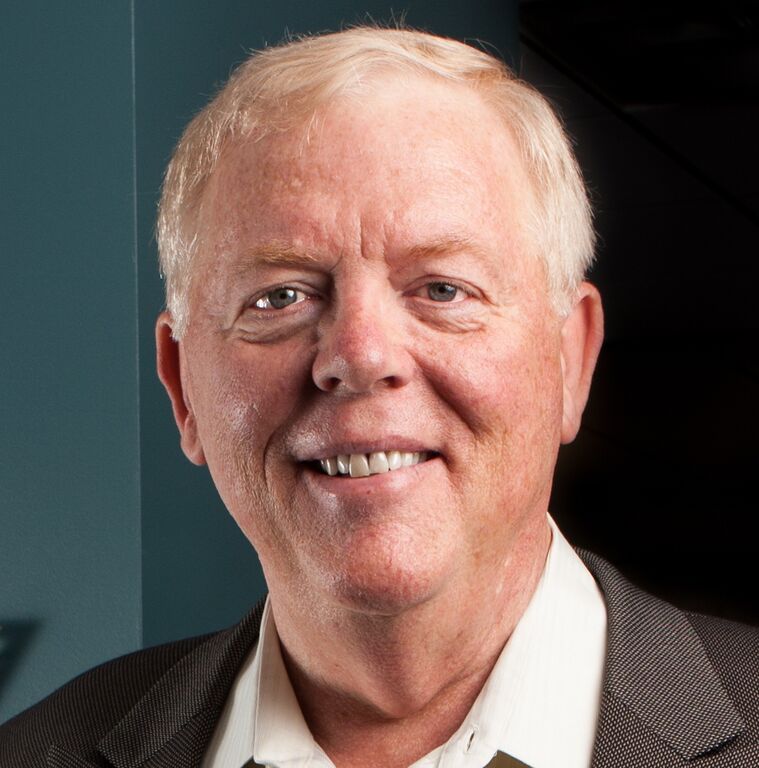
This week Ron and Ed are thrilled to have had Professor Steven E. Landsburg, professor of Economics at the University of Rochester, where students recently elected him Professor of the Year. He is the author of The Armchair Economist, Fair Play, More Sex is Safer Sex, The Big Questions, two textbooks in economics, a forthcoming textbook on general relativity and cosmology, and over 30 journal articles in mathematics, economics and philosophy. His current research is in the area of quantum game theory. He writes the monthly “Everyday Economics” column in Slate magazine, and has written regularly for Forbes and occasionally for the New York Times, the Wall Street Journal and the Washington Post. He appeared as a commentator on the PBS/Turner Broadcasting series “Damn Right”, and has made over 200 appearances on radio and television broadcasts over the past few years.

Segment One

Ed and the Professor discuss quantum game theory. Well, Professor Landsburg talks about it, Ed is still confused.

Quickly, they move on to Presidential politics wherein the following blog posts from Landsburg's blog, The Big Questions, get elaborated upon:

Ed then asks what advice the Professor would give the next future President. 

Segment Two

Inscribed on Karl Marx’s Tomb: "The philosophers have only interpreted the world in various ways. The point is to change it." In The Armchair Economist, Steven Landsburg writes, "The economist’s greatest passion is not to change the world but to understand it."

Ron asks why economists have not given up the assumption of rationality?

Also, in The Armchair Economist, Landsburg writes, "Most of economics can be summarized in four words: People respond to incentives. The rest is commentary."

Does behavioral economics shed light on the, perhaps, one-half of human behavior that is “irrational”?

The last chapter in The Armchair Economist is titled, “Why I’m not an environmentalist: the science of economics versus the religion of ecology.” 

You write about being lectured to by 4 and 5 year-olds about safe energy sources, mass transportation, and recycling (you also mention attempting to throw away your recycling bin), so why aren’t you an environmentalist?

Landsburg’s Rules of cost-benefit analysis:

  • Only individuals matter, and

  • All individuals matter equally

Are you optimistic about mankind’s ability to adapt to any climate change?

Segment Three

Ed asks about income inequality based on a speech the Professor gave three years ago in Dallas at an event for the National Center for Policy Analysis. There was no wealth inequality in the 16th century because everyone was starving and "it all sucked."

Since 1965, the average American has gained 6.5 hours of leisure per week, and low-income people have gained 14 hours per week, leading Landsburg to ask, “Why do we tax an hour of work but not an hour of leisure?” Should we “redistribute” leisure?

Healthcare today is a better bargain than it was in 1965. Ignoring AIDS, the quality of healthcare in America in 1975 was the same as what were seeing in the poorest parts of the third-world today. That’s how much better it has gotten in America, and the third world, in the last 40 years.

Segment Four

Fair Play
By Steven Landsburg
Buy on Amazon

In Fair Play Landsburg writes, "There’s nothing less interesting than a fact unilluminated by a theory. Theories make knowledge possible."

Ron asks what is the premise in your book, More Sex Is Safer Sex? For the record, Ed had to put his mic on mute because he was laughing uncontrollably. 

Is the death penalty a deterrent? My economics professor at San Francisco State made us read Isaac Ehrlich’s research, which shows that for every execution somewhere between 8 and 24 murders are deterred? (And professor Ehrlich is opposed to the death penalty on moral and religious grounds).

Landsburg does write that there is a difference between the enactment and the enforcement of the death penalty. Could we run an experiment where if you commit murder on Monday, Wednesday and Friday, you get life in prison with no parole, but if you commit murder on Tuesday, Thursday, or the weekend, you get the death penalty, and see if changes behavior?

An FDA commissioner can make two types of errors: Type I error: approve a harmful drug that kills people, thereby losing his job; or a Type II error: don’t approve a drug that could save many lives, but the dead patients won’t ever know. To reduce the likelihood of a Type II error, you suggest paying the FDA commissioner in pharmaceutical stocks for every drug he approves. Would this work?

Thank you Professor Landsburg for appearing on The Soul of Enterprise. It was an honor to speak with you.

Steven E. Landsburg’s Books and Blog

Blog: www.thebigquestions.com

Episode #105: The Eight Myths of Capitalism

Ed and Ron recapped their experience at Sage Summit, discussing speakers such as Richard Branson, Ashton Kutcher, and Daniel Susskind.

Click Image to Register and view these sessions on Sage Summit Live

Click Image to Register and view these sessions on Sage Summit Live

Ron and Ed are presenting a workshop in Niagara Falls on “The Post-Professional Society,” October 16-18.

Then, based on the book by Jay Richards, Money, Greed, and God: Why Capitalism Is the Solution and Not the Problem, published in 2009, they discussed the eight myths of capitalism.

Richards' book was also the inspiration for the January 22, 2016 show, Episode #73: Lessons from the Trading Game.

Episode #104: Interview with Gregory LaFollette

Ed and I were honored to interview Gregory L. LaFollette, CPA, CITP, CGMA

Biography

Greg is one of the most recognized and respected voices on technology within the accounting profession. He has a broad background in the field, having spent time in private practice, as an executive with a top-tier technology vendor and as an editor of a leading publication keyed to accounting technology. He is also a sought-after speaker at trade shows and conferences.

Prior to joining CPA.com, Greg was a consultant to public accounting firms and to technology vendors with a focus on the accounting profession. Additionally, he was the Executive Editor of TheTechGap — the country’s first blog specifically created for the tax and accounting profession and for vendors who seek to serve that community, and Senior Manager of Tax and Technology Consulting with the Top 25 firm of Eide Bailly, LLP.

Earlier in his career, Greg served as the Executive Editor of The CPA Practice Advisor (formerly The CPA Technology Advisor), VP of Product Strategy at ThomsonReuters Creative Solutions, and founding partner at LaFollette, Jansa, Brandt & Co., LLP in Sioux Falls, SD. He served on the AICPA’s CITP Credential Committee (Chair), the National Accreditation Commission (ad hoc via the Credential CITP Committee), the Top Technologies Task Force, the TECH+ Planning Committee, and the Journal of Accountancy Technology Advisory Board.

Greg completed his professional training at Augustana College (SD) and is a CPA, a CITP, and a member of the AICPA Information Technology Division. He is a graduate and former staff lecturer at the AICPA’s National Tax Institute.

He and his wife Kaye have one grown daughter and choose to live in their hometown of Sioux Falls, SD.

Discussion

We had a wide-ranging discussion, including:

Why Greg changed his mind on no timesheets (it wasn’t Ron’s screaming at people to trash them).

The #1 Issue facing the profession?

Some of the major trends happening in the accounting profession?

The implications of the Richard and Daniel Susskind book, The Future of the Professions.

The impact of Blockchain, Bitcoin, AI, Deep Learning, and PriceWaterhouseCooper’s HALO audit software—that runs algorithms through entire data sets—no more audit sampling.

On driverless cars, Greg thinks his grandchildren will be alive when the Supreme Court has to decide whether humans should be allowed to drive, since we are so unsafe.

He also proposed a ratio to determine if an industry (or firm) is being disrupted by a new business model driven by technology:

            Legal Expenses / Technology Exp

If you were to run the music industry’s ratio during the Napster imbroglio, Greg’s point is an excellent one!

Thanks, Greg, for appearing on The Soul of Enterprise.

Episode #103: Black Swan Friday

Ed’s son, Sean, had a baseball game, so rather than doing Free-Rider Friday alone, Ron did “Black Swan Friday” by interviewing two of the Canadian bookkeepers who have been through the Black Swan Mentoring Program.

Cindy Kindret, founder and owner of Kindret Business Solutions, Inc., started her business from scratch 14 years ago with 2 clients and grew it by year 8 to over 100 clients. Her home-based business today includes 3 employees, and 2 contractors. Nothing has more positively changed her business than The Black Swan Program. 

Today she has less than 40 clients and generates more profit than when she had over 100 clients, has more time to think and enjoy her clients and more time to plan for a better future. 

Cindy is a Certified Professional Bookkeeper through Institute of Professional Bookkeepers Canada, is a Distinguished Financial Advisor “Bookkeeping Services Specialist” through Knowledge Bureau, and is both a Sage50 and QuickBooks Pro Advisor.

Melissa Michalski, B.Comm(Hons), CPB

Melissa is one of the co-owners of CertPro Accounting Team in Winnipeg, Manitoba Canada. Her love of accounting started during high school when her mom and grandpa encouraged her to take an accounting course as an elective. She holds an undergraduate degree from the Asper School of Business at the University of Manitoba. Before joining CertPro, Melissa worked in public accounting.

She is a proud member of IPBC and a Certified Professional Bookkeeper.  Melissa volunteers her time as the IPBC Regional Developer for the province of Manitoba.

Melissa was lucky to be part IPBC’S BLACK SWAN program in 2014.

She also teaches competitive dance to children ages 9-18. In her teens she represented Canada on the World Tap Team where she brought home the bronze medal.

When she isn`t crunching numbers you can find Melissa travelling to California and Disneyworld and spending time with her two cats.

Topics discussed

  1.  Why did you want to change your business model?

  2.  How scared were you? No hourly billing, no timesheets?

  3.  What’s the most critical component of pricing?

  4.  What’s your approach to the value conversation now?

  5.  Did you get pushback from your customers? How many customers did you lose?

  6.  We recommend pricing the customer, not the service

    1. How do you craft your options?

    2. What are the advantages of options?

  7.  Have you become more selective about customers you take on?

  8.  Explain how you manage your emotional capacity vs. your physical capacity?

  9.  What advice would you give to a bookkeeper who is thinking of making this change?

  10.  Give an example of where you created and captured extraordinary value.

Episode #102: Interview with David Barrett - CEO of Expensify

Ed and I were honored to interview David Barrett, Founder and CEO of Expensify, whose purpose is “To improve the world one expense report at a time.”

David is a wine aficionado, and all around alpha geek. He started programming when he was 6 and it has been his primary activity ever since, with a brief hiatus for world travel, technical writing, project management, and now running Expensify.

Since 2008, David and Expensify have been making the world a better place, one expense report at a time.

Expensify was recently named one of the Most Innovative Companies in 2015 by FastCompany. A pioneer in the expense management space, Expensify has become the model for all similar solutions.

David is married to an opera singer and has the cutest beagle in the world. David loves third world travel and first class wine, but hates expense reports.

Expensify does "expense reports that don't suck!" by importing expenses, and receipts, from your credit cards and mobile phones, submitting expense reports through email, and reimbursing everything online.

It has raised over $6 million in venture funding, has hundreds of thousands of users, has won awards aplenty, and is basically taking the small-business expense reporting space by storm.

tardigrade.jpg

We discussed his “Please Don’t Call Us “Cockroaches post, where he suggests the name Tardigrade instead of cockroach.

History/Biography

How’d you get here?

Company almost never happened? Started as prepaid debit card idea?

Expensify’s Non-Enterprise Sales Model

It sells to the end user and is thus pulled into organizations from the bottom up, getting around IT and procurement!

Since it started in 2008, it has spent nothing on promotion and grown to 4 million users.

As Robert Stephens, founder of Geek Squad, says, “Advertising is a tax companies pay for being unremarkable.”

Expensify uses a Freemium Pricing Model, which has led to 600,000 companies using it for free.

David’s Blog Posts and Articles

David’s blog posts, along with those discussed:

David Barrett on BitCoin


What’s your advice for entrepreneurs?

Stop getting distracted by the bad advice from others. Most advice you get is awful. You can only be an “expert” on the past.

What’s your favorite California wine?

 Little Vineyards, Glen Ellen, CA

What’s been your favorite travel destination?

Episode #101: Interview with Baruch Lev

Ed and I were honored to have on Baruch Lev, co-author of The End of Accounting and the Path Forward for Investors and Managers (Wiley Finance) by Baruch Lev and Feng Gu, 2016.

The book is divided into four parts, which we asked Professor Lev about.

Part One: Relevance Lost

The End of Accounting is divided into four parts:

  1. Relevance Lost

  2. Why is Relevance Lost?

  3. So, What’s to Be Done?

  4. Implementation

Like a Consumer Reports evaluation, they provide an unsatisfactory report. Based on a comprehensive, large-sample empirical analysis, spanning the past half century, we document a fast and continuous deterioration in the usefulness and relevance of financial information to investors' decisions. The pace of this usefulness deterioration has accelerated in the past two decades.

Our analysis indicates that today's financial reports provide a trifling 5-6 percent of the information relevant to, and used by investors.

One amusing illustration they use in the book is to compare United States Steel Corporation’s 1902 and 2012 financial statements. The former is 40 pages; the latter is 174 pages. Yet they focus on the same information. Uniformity has lead to less experimentation and innovation as the world moved from an industrial/service economy to a knowledge economy.

Another indictment that what the accounting profession is peddling is the Edsel of our day, proforma (non-GAAP) earnings disclosures have doubled from 2003 to 2013, and now are over 40%.

As The Economist stated, "The real Enron scandal is that so much of what Enron did     conformed with GAAP."

How much of stock prices are attributable to earnings and book values? It was roughly 80-90% in the 1950-1960s, the authors say it’s 50% today.

Part Two: Why Is the Relevance Lost?

 The authors document three major reasons for why accounting reports have lost relevance:

1.    The inexplicable treatment of intangible assets—the dominant creators of corporate value. Intellectual capital—such as brand development, human capital, R&D, etc., are all expensed by current accounting standards.

2.    Accounting isn’t about facts anymore but more and more about manager’s subjective judgments, estimates, and projections.

3.    Unrecorded business events increasingly affect corporate value (competitor moves, regulatory changes, restructurings, alliances, etc.).

Just one example, the prevalence of Mark-to-Market rules is a clear case of asking GAAP to do something it is constitutionally incapable of doing—project value into the future, because accounting is not a theory, it’s an identity equation. GAAP can only record value once a transaction has taken place.

This is why the “goodwill” of a business is booked after is has been sold. It is why our late colleague, Paul O’Byrne, FCA, used to say that goodwill is the name accountants give to their ignorance.

Warren Buffett remarked, “This is not marked-to-market, rather marked-to-myth.” As the authors point out, Enron was marking-to-market 30-year gas contracts in which they were the main market-maker.

Much of this is due to the Financial Accounting Standard Board’s obsession with the “Balance sheet approach,” adopted in the 1980s, with the prime objective to value assets and liabilities at fair (current) values. These adjustments spill over into the income statement, making it less relevant. If balance sheet is flawed, so is income statement.

Part Three: So, What’s to Be Done?

There has been initiatives to supplement the traditional financial statement report, such as with Key Performance Indicators, the Value Reporting Revolution, Intellectual Capital reports, the Enhanced Business Reporting Model, Integrated Reporting, and so forth.

They haven’t amounted to much, and they are not grounded in solid economic theory. Lev and Gu propose adding “The Strategic Resources & Consequences Report” to the financial statements. As they explain:

The focus of this Resources & Consequences Report is on the strategic, value-enhancing resources (assets) of modern enterprises, like patents, brands, technology, natural resources,    operating licenses, customers, business platforms available for add-ons, and unique enterprise relationships, rather than on the commoditized plant, machines, or inventory, which are    prominently displayed on corporate balance sheets.

Our proposed disclosure to investors is primarily based on nonaccounting information, focusing on the enterprise's  strategy (business model) and its execution, and highlighting fundamental indicators… more relevant and forward-looking inputs to investment decisions than the traditional accounting information, we grade the ubiquitous corporate financial report information as largely unfit for twenty-first-century investment and lending decisions, identify the major causes for this accounting fade, and provide a remedy for investors.

They illustrate this report in four separate industries—media and entertainment, property and casualty insurance, pharmaceutical and biotech, and oil and gas, using real examples from various companies.

It’s an innovative and empirical approach, as the authors studied investor calls, earnings disclosures, etc., to learn what educated investors were asking to help them peer into the future potential of companies.

This is enlightened way to develop Key Predictive Indicators—that is, theories that can be used to peer into the future, rather than merely looking backwards with data that comprise most Key Performance Indicators.

Part Four: Implementation

The authors are not fans of more regulation. In fact, they advocate lessening the disclosure rules. They believe their proposals could be voluntarily adopted, perhaps with a “nudge” by industry trade associations and the SEC.

What about the retort that some of the information they want to see disclosed would lead to a competitive threat? The authors are sympathetic to this fear, but point out examples where companies have voluntarily disclosed “sensitive” information, such as one Drug company’s disclosure of pipeline info, FDA filings, clinical trial status, marketing info, etc.

The authors also advocate eliminating quarterly reporting, since frequency and reporting quality are substitutes, making it semiannual, such as in the UK and Australia, among other countries. They would still require quarterly reporting of sales, cost of goods sold, and gross margin.

Finally, they propose three reforms to GAAP:

1.    Treat intangibles as assets (at cost) and improve disclosures (such as separating Research from Development)

2.    Reverse the proliferation of accounting estimates—such as marking-to-market, leaving Fair Market Value to investors since accountants have no expertise in valuation. Compare the top five to seven key managerial estimates and projections to actual.

3.    Mitigate accounting complexity—regulatory complexity now exceeds business complexity. A 15-year FASB revenue recognition project resulted in a 700-page rulebook! It’s futile to have a rule for every scenario. We need more principles and professional judgment, and less rules.

A Deteriorating Paradigm

Abraham Briloff, late professor of accounting at Baruch College and irritant to the auditing profession, used to say that accounting statements are like bikinis: “What they show is interesting, but what they conceal is significant.”

The accounting model is suffering from what philosophers call a deteriorating paradigm—the theory gets more and more complex to account for its lack of explanatory power.

Not Final Words

We are very curious to see the profession’s response to this book going forward. Our guess is, for the most part, it will be ignored, which would be tragic, and a missed opportunity.

The number one issue facing the accounting profession is loss of relevance. Does anyone doubt that using financial statements to run—or invest in—a modern-day intellectual capital organization is the equivalent of timing your cookies with your smoke alarm?

Thank you, Professor Lev for having the courage to challenge the profession , and offering a better path forward.