



Episode #200: Interview with Reginald Lee

Welcome to our 200th episode! Four years on the air! Thank you!

George Gilder was suppose to be on the show today to discuss his latest book, Life After Google: The Fall of Big Data and the Rise of the Blockchain Economy, but a change in his schedule would not allow it. George was kind enough to send us an advance copy, which we highly recommend. He will be on the show on August 31, 2018 to discuss this important book.

For our 200th show, we brought back Dr. Reginald Tomas Lee, author of Lies, Damned Lies, and Cost Accounting: How Capacity Management Enables Improved Cost and Cash Flow Management. Reginald first appeared on October 7, 2016, Episode #112.

We focused on his upcoming book, Strategic Cost Transformation: Using Business Domain Management to Improve Cost Data, Analysis, and Management, which is due out this November or December.

Biography

ReginaldLee.jpeg

Dr. Reginald Tomas Lee is an advisor and researcher in the areas of cash flow, capacity management, and profitability. Using a deep background in engineering and math, he has created tools and models that have helped executives in businesses of all types improve the management of cash flow and other financial data.

Professionally, Reginald has worked in industry, academia, and consulting including leading global companies such as EY, GM, IBM, and Oracle. He has advised many marquee names such as Bristol Myers Squibb, Disney, DuPont, Home Depot, Lockheed, Office Depot, Raytheon, Toyota, and United Healthcare. Reginald has a PhD in mechanical engineering from the University of Dayton, and is the author of three books and over 40 published articles and white papers. He is a feature writer for Journal of Corporate Accounting & Finance and a contributor to the Cincinnati Business Courier, and a professor at Xavier University, and is a senior fellow at VeraSage Institute.

Ron’s Questions

What do you teach at Xavier University?

In Lies, Damned Lies, and Cost Accounting: How Capacity Management Enables Improved Cost and Cash Flow Management, 2016, you argue that there are three reasons cost accounting is a bad practice:

  1. It creates and forces math and relationships don’t exist

  2. You lose touch with operations

  3. It creates meaningless numbers that people consider gospel

I know you’re teaching more and more CPAs, what’s there reaction to this?

Engineers developed cost accounting, not accountants. Further, they issued several warnings about how inexact it was, but no one paid attention—it just became gospel. I do blame accountants for that, for educating that cost accounting is some type of exact science.

Your upcoming book is Strategic Cost Transformation: Using Business Domain Management to Improve Cost Data, Analysis, and Management, due out in November [Ron is writing the Foreword]. You start this book by stating: “We’ve been fooled. Bamboozled.” How so?

What is so profound in both your books is the difference between metrics and measurements. Measurements are not dependent upon a choice (e.g., the choice of cost accounting method generates different amounts).

In the new book, you lay out four common cost-related sacred cows:

  1. Costs equal money

  2. Reducing costs saves money

  3. More profit equals more money

  4. Costs and profit are measured

The above looks reasonable to me. Why are they wrong?

Your distinction between cash costs and noncash cost is much better that cost accounting’s distinction between fixed and variable costs that cost accountants use since that still requires you to make arbitrary allocations.

cash-mound-1504235741.jpg

You say that Strategic cost transformation (SCT) shifts focus of cost analysis from accounting-based to a corporate-wide system that models and aligns cash, operations, and accounting, comprised of:

Business Domain Management =  Operations & Cash Domain (OC) + Accounting Domain (AD)

You point out that no new information is created in the Accounting Domain! The OC domain is information without the drama.

The OC Domain answers such questions such as:

  • How much spending on capacity?

  • How efficiently and productively is it being consumed?

  • What is consuming it?

  • What output is being created?

  • How do we project cash?

map-confused.png

You write that the AD information is “dangerous to the untrained eye.” But really, it’s just as dangerous to the trained eye, providing a false sense of accuracy and control. Imagine the three of us are lost in New York City. Ed says, “I have a map!” And you say, “But it’s of Los Angeles.” And I say, “Yeah, but it’s better than nothing.”

Ed’s Questions

One of the influences on my career in project management is Eliyahu Goldratt, author of The Goal, and he also influenced you on cost accounting.

Time is really a constraint, not a resource. What you’re saying is that cash is not really a resource, it’s a constraint.

The title of your new book is Strategic Cost Transformation. What does that mean?

How does the Operations and Cash Domain differ from just running your business on a cash basis?

Cost accounting is just a derivative of logical positivism, a philosophical term that says just because we have numbers it’s scientific. But it’s not. What about the work you’re doing at the Cash Flow Innovation Lab. How does it translate into the field?
Episode #199: Memorable Mentors - Peter Drucker

Peter F. Drucker is one of the truly serious thinkers the management consultant industry can point to with justifiable pride. Even though Drucker passed away November 11, 2005, at age 95, it does not mark the beginning of the end, but the end of the beginning, since he has left such a rich legacy. Along with the economics profession, Drucker alone is responsible for introducing, and being among the first to recognize, the knowledge worker and knowledge economy to the business world. Join Ron and Ed as they discuss the ideas, writings, thinking and influence of the most seminal management thinker of our times.

Peter-Drucker.jpg

Peter Drucker is often invoked as saying, “If you can’t measure it, you can’t manage it.” Yet, you cannot find this as a direct quote of Drucker’s. In our research looking for this quote, I found the following:

Reports and procedures should be the tool of the man who fills them out. They must never themselves become the measure of his performance. A man must never be judged by the quality of the production forms he fills out – unless he be the clerk in change of these forms.

He must always be judged by his production performance. And the only way to make sure of this it by have him fill out no forms, make no reports, expect those he need himself to achieve performance. – Peter Ferdinand Drucker, The Practice of Management, 1954, page 135.

Someone once wrote that you should read Drucker just to learn how he thinks.

Amazon Block

Nowhere is that more true than this gem of a book: Technology, Management, and Society. A collection of 12 essays, dating from 1957 to 1969, which are so evocative all we can say is we are still grappling with the issues Drucker was so prescient in foreseeing over 50 years ago.

The essays are best summed up by Drucker himself, "…they stress constantly the purpose of management, which is not to be efficient but to be productive, for the human being, for economy, for society."

Drucker discusses the vital role of risk and profit in enterprise, as well as the brilliant observation that of all the institutions in society (family, church, government, professions, unions, not-for-profits, etc.) only the business enterprise is designed to create change:

Indeed, in the business enterprise we have the first institution which is designed to produce change. All human institutions since the dawn of prehistory or earlier had always been designed to prevent change—all of them: family, government, church, army.

Change has always been a catastrophic threat to human security. But in the business enterprise we have an institution that is designed to create change. It means that every business, to survive, must strive to innovate.

change.jpg

We can only provide a few examples of Drucker’s thinking, which do not do this little book justice. Here are some of our favorites:

But it should be said that in human institutions, such as business enterprise, measurements, strictly speaking, do not and cannot exist. It is the definition of a measurement that it be impersonal and objective, that is, extraneous to the event measured. A child’s growth is not dependent on the yardstick or influenced by being recorded.

 But any measurement in a business enterprise determines action—both on the part of the measurer and the measured—and thereby directs, limits, and causes behavior and performance of the enterprise. Measurement in the enterprise is always motivation, that is, moral force, as much as it is ratio cognoscendi.

This is another way of expressing [Ed] Kless’ Law: All measurements are judgments.

On youth, Drucker wrote this, "The young are always in the right, because time is on their side. And that means we have to change."

Executives who believe they can change one aspect of a company without affecting others are ignoring the reality of a firm being an interdependent system. Drucker explained the phenomenon this way:

There is one fundamental insight underlying all management science. It is that the business enterprise is a system of the highest order: a system whose parts are human beings contributing voluntarily of their knowledge, skill and dedication to a joint venture. And one thing characterizes all genuine systems, whether they be mechanical like the control of a missile, biological like a tree, or social like the business enterprise: it is interdependence.

The whole of a system is not necessarily improved if one particular function or part is improved or made more efficient. In fact, the system may well be damaged thereby, or even destroyed. In some cases the best way to strengthen the system may be to weaken a part—to make it less precise or less efficient. For what matters in any system is the performance of the whole; this is the result of growth and of dynamic balance, adjustment, and integration, rather than of mere technical efficiency.

This seems to be lost on advocates of Lean Six Sigma, whether in professional knowledge firms or factories.

There’s also an excellent discussion of why knowledge workers are different than manual workers, and why this requires leaders to change their thinking.

Our only quibble is Drucker gives far too much credit to Frederick Taylor, who recent scholarship has determined was a fraud. 

Peter Drucker on Business Models

Peter-Drucker-2.jpg

One of Peter Drucker’s (1909–2005) many articles published in the Harvard Business Review (September-October 1994) was entitled “The Theory of the Business,” which laid out what he considered to be the essential elements executives would have to define in order to create wealth:

Not in a very long time—not, perhaps, since the late 1940s or early 1950s—have there been as many new major management techniques as there are today: downsizing, outsourcing, total quality management, economic value analysis, benchmarking, reengineering.

Each is a powerful tool. But, with the exceptions of outsourcing and reengineering, these tools are designed primarily to do differently what is already being done. They are “how to do” tools.

Yet “what to do” is increasingly becoming the central challenge facing managements, especially those of big companies that have enjoyed long-term success.

What accounts for this apparent paradox? The assumptions on which the organization has been built and is being run no longer fit reality. These are the assumptions that shape any organization’s behavior, dictate its decisions about what to do and what not to do, and define what the organization considers meaningful results.

These assumptions are about markets. They are about identifying customers and competitors, their values and behavior. They are about technology and its dynamics, about a company’s strengths and weaknesses. These assumptions are about what a company gets paid for.

They are what I call a company’s theory of the business.

In fact, what underlies the current malaise of so many large and successful organizations worldwide is that their theory of the business no longer works.

It usually takes years of hard work, thinking, and experimenting to reach a clear, consistent, and valid theory of the business. Yet to be successful, every organization must work one out.

What are the specifications of a valid theory of the business? There are four: 

  1. The assumptions about environment, mission, and core competencies must fit reality.

  2. The assumptions in all three areas have to fit one another.

  3. The theory of the business must be known and understood throughout the organization.

  4. The theory of the business has to be tested constantly. It is not graven on tablets of stone. It is a hypothesis. And so, built into the theory of the business must be the ability to change itself.

Peter Drucker’s autobiography: Adventures of a Bystander, 1978, 1994

Amazon Block

“I realized that I, at least, do not learn from mistakes. I have to learn from success.”

Socrates wasn’t a teacher, but a “pedagogue”—a guide to the learner.

The Socratic method isn’t a teaching method, it’s a learning method. For the teacher, the passion is inside him; for the pedagogue, the passion is inside the student.

A Functioning Society: Selections from Sixty-Five Years of Writing on Community, Society, and Polity, 2003

More of Drucker’s books deal with community, society and polity than management.

Marxism was the God that failed. “I once, in 1932, heard Hitler say in a public speech:

‘We don’t want higher bread prices; we don’t want lower bread prices; we want national-socialist bread prices.’ And 5,000 people in the audience cheered wildly.”

He coined the term re-privatization, from which Margaret Thatcher derived her policies of privatization.

The only successful policy of the Megastate is avoidance of World War III.

We no longer expect results from government. Only two things effectively: wage war and inflate the currency.

One thing red-tape is good for: to bundle up yesterday in neat packages.

“In the knowledge organization every knowledge worker is an “executive.” The number of people who have to be effective for modern organization to perform is therefore very large and rapidly growing. The well-being of our entire society depends increasingly on the ability of these large numbers of knowledge workers to be effective in a true organization. And so, largely, do the achievement and satisfaction of the knowledge worker.

To speak of “social responsibility of business assumes that responsibility and irresponsibility are a problem for business alone. Clearly, however, they are central problems for all organizations. The least responsible org today is not business, it’s universities.”

“Organizations don’t act socially responsible when concern themselves with social problems outside of their own sphere of competence and action. They act the most responsibly when they convert public need into their own achievements.”

“We need to what performance means. We need to be able to measure, or at least to judge, the discharge of its responsibility by an institution and the competence of its management….justifies their existence and power. Everything beyond is usurpation.”

“Knowledge workers cannot be supervised effectively. Unless they know more about their specialty than anybody else in the organization they are basically useless.”

Harvard Business Review Article, 1991

“Professional management hasn’t earned an ROI equal to its cost of capital. The raiders thus performed a needed function. Old proverb: If there are no grave diggers, one needs vultures.”

German and Japanese management don’t “balance” anything. Rather, they optimize the wealth-producing capacity of the enterprise (market standing, innovation, productivity, people and their development).

In his book The Landmarks of Tomorrow, 1957 is where Drukcer first used the term knowledge economy, and knowledge worker.

From Management Challenges for the 21st Century, 1991: The most important contribution management needs to make in the twenty-first century is to increase the productivity of knowledge work and the KW.

Knowledge work is unisex, equally well by both sexes. Corporations need knowledge workers more than they need them. Ultimately, knowledge workers are volunteers. Knowledge workers are more loyal to their profession than any organization.

depositphotos_5680971-stock-photo-risk-profit-and-loss.jpg

Profits Come From Risk

Drucker’s three types of risks:

  • The risk a business could afford to take

  • The risk a business could not afford to take

  • The risk a business could not afford not to take

The Effective Executive in Action, 2006

This was the last book he published before passing away.

It details the five practices of the effective executive:

  1. Managing your time;

  2. Focusing your efforts on making contributions;

  3. Making your strengths productive;

  4. Concentrating your efforts on those tasks that are most important to contributions; and

  5. Making effective decisions.

“An organization that is not capable of perpetuating itself has failed. It has to renew its human capital.”

“Strong people always have strong weaknesses too. Performance can only be built on strengths.”

“Character and integrity by themselves do not accomplish anything but their absence faults everything else.”

"Are you a reader or a listener? Trial lawyers are both."

“Good executives focus on opportunities rather than problems. Problem solving does not produce results (reverts to status quo). Exploiting opportunities produces results…”

“A decision is a judgment—a choice between alternatives. Rarely a choice between right and wrong. It is at best a choice between ‘almost right’ and ‘probably wrong.’ Untested hypotheses are the starting point. One does not argue with them; one tests them.”

“There’s too much about leadership and not enough on effectiveness. The only thing you can say about a leader is somebody who has followers. The most charismatic leaders of the last century were Hitler, Stalin, Mao, and Mussolini. They were misleaders.”

“I have yet to see a knowledge workers who couldn’t consign one-fourth of the demands on his time to the wastepaper basket without anybody’s noticing.”

There’s no such thing as business ethics

It is common today to speak of “medical ethics,” “bio ethics,” “accounting ethics,” and so forth.  Yet some thinkers deny there are different ethical theories for these various functions. 

In his 1981 article in The Public Interest, “What is Business Ethics”?, management thinker Peter Drucker challenges the concept of a separate ethics for business:

If “business ethics” continues to be “casuistry” its speedy demise in a cloud of illegitimacy can be confidently predicted.  Clearly this is the approach “business ethics” today is taking. Its very origin is politics rather than in ethics.  It expresses a belief that the responsibility which business and the business executive have, precisely because they have social impact, must determine ethics––and this is a political rather than an ethical imperative.

What difference does it make if a certain act or behavior takes place in a “business,” in a “non-profit organization,” or outside any organization at all?  The answer is clear:  None at all.

Clearly, one major element of the peculiar stew that goes by the name of “business ethics” is plain old-fashioned hostility to business and to economic activity altogether––one of the oldest of American traditions and perhaps the only still-potent ingredient in the Puritan heritage.  There is no warrant in any ethics to consider one major sphere of activity as having its own ethical problems, let alone its own “ethics.”  “Business” or “economic activity” may have special political or legal dimensions as in “business and government”..., or as in the antitrust laws.  And “business ethics” may be good for politics and good electioneering.  But that is all.  For ethics deals with the right actions of individuals.  And then it surely makes no difference whether the setting is a community hospital, with the actors a nursing supervisor and the “consumer” a patient, or whether the setting is National Universal General Corporation, the actors a quality control manager, and the consumer the buyer of a bicycle.

Altogether, “business ethics” might well be called “ethical chic” rather than ethics––and indeed might be considered more a media event than philosophy or morals (Drucker, 1981:  22-23; 31; 33-35).

Other Drucker Books

Drucker’s Lost Art of Management, Joseph A. Maciariello, 2011. This book details Drucker’s calling management a “liberal art,” and linking it to the humanities disciplines.

A Class with Drucker, William A. Cohen, 2007

Drucker on Marketing, 2012

The Practical Drucker, William A. Cohen, 2014

People complained Drucker didn’t tell them “what to do” or “how to do.” Rather, he asked questions.

This book details 40 important concepts on:

  1. People

  2. Management

  3. Marketing and Innovation

  4. Organization

Peter Drucker: Shaping the Managerial Mind, by John E. Flaherty;

The Definitive Drucker, by Elizabeth Haas Edersheim

The World According to Peter Drucker, Jack Beatty

Disagreements with Drucker

He gave Frederick Taylor too much credit.

He believed CEO pay was too high.

He did refer to people as assets [but also volunteers].

He believed time is the executive’s scarcest and most precious resource, and organizations are inherently time wasters. We believe time is a constraint, not a resource.

Episode #198: Free-Rider Friday - June 2018

Ron’s Topics

Fawning Press for Elon Musk

Elon Musk Just Gave the World’s Best Productivity Advice in a Single, Short Sentence: and we all owe him a debt of gratitude for pointing out the obvious. April 28, 2018, Geoffrey James, Contributing editor, Inc.com

Recent memo from Musk to Tesla employees proposes a number of actions to increase performance with Model 3 MFG:

  • Avoid large meetings and keep them very short

  • Avoid acronyms and company-specific jargon lest you confuse contractors

  • Ignore corporate rules if they are obviously idiotic

But this suggestion takes the cake: “Walk out of a meeting or drop off a call as soon as it is obvious you aren’t adding value.”

In a related article, “Driving to the next circle of hell,” The Economist, April 7, 2018, on April 1 Elon tweeted: “We are sad to report that Tesla has gone completely and totally bankrupt.”

  • Tesla share price has fallen by 16% since end of February 

  • On March 23, a Tesla crashed and the driver killed

Tesla_Model_3_parked,_front_driver_side.jpg

The new Tesla Model 3

  • Price: $35,000

  • Range: 200+ miles

  • Deposits: Over 400,000

In July 2017, Musk claimed production would be 20,000/month by December 2017, however fewer than 2,500 were produced in entire 4th quarter. By April 2018 they had ramped up to around 2,000 a week was actual production. Tesla reportedly lost $2 billion in 2017.

The company boasted, “Model 3 assembly line is now providing the fastest growth of any automotive company in the modern era. If this rate continues, it will exceed that of Ford and the Model T.” The Economist replied, “Such bluster does not withstand scrutiny.”

Musk wants his factory to be a machine that makes machines. But auto companies have found a mix of man and machines is best.On March 17th, Moody’s downgraded Tesla’s debt. Others predict Tesla will need to $2.5B to $3b cash this year.

“Not Finished,” The Economist, April 28, 2018

183641-004-3F7DEB9C.jpg

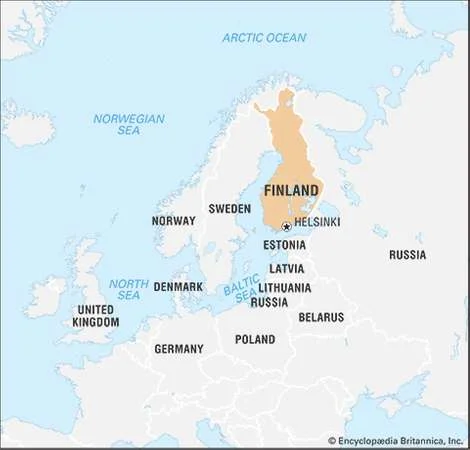
Finland ran a trial Universal Basic Income program on Jan 2017 whereby 2,000 people received $680/month. The experiment ended December 2018. It was planned to end after two years, but had hoped to expand it beyond, but the legislature denied funding. It was not universal as all recipients were unemployed, and no results have been published yet.

California Incubator Y Combinator in the USA is using randomized control trial for a UBI in Oakland, CA, and Kenya is launching one, run by Give Directly. There’s another in Ontario, with 4,000 participants in 4 towns, and one in Scotland, Glasgow and Edinburgh working on pilot UBI programs.

Is Adam Smith spinning in his grave?

“Thinking outside the police box,” Buttonwood, The Economist, May 12, 2018

In writing the his final column the author surmises "what useful knowledge would he impart if he could go back 12 years (550 columns)?"

Avoid confusing financial markets with the economy (S&P Index doubled from 2006)

  • The market has incredible resilience: corporate profits, pre-crisis levels rapidly regained, and surpassed 2008 levels.

  • Less competition means globalization of suppressed wages.

  • Never underestimate the power of central banks: quantitative easing did not cause expected inflation.

  • Relax about China!

  • Microeconomists are wrong about specific things, whereas macroeconomists are wrong in general. 

Ron would add professional pricers are getting better.

The Economist, Exclusive access, Special Report, Financial Inclusion, May 5, 2018

Mobile tech brought hundreds of millions into financial system, such as bKash in Bangladesh, began in 2011, with 30 million users, known as the collective mattress.

globalfindex-landing.png

In 2012, The World Bank created “Findex,” a financial inclusion index (the Gates Foundation funded). The Unbanked numbered 2.5 billion in 2011, 2B in 2014, and 1.7B in 2017.

Adults with a bank or mobile money account: 69%. Though access is not the same as inclusion, since 25% of all accounts are inactive.

Mobile tech also pays crop insurance (e.g., when rainfall is below a certain level).

Also, credit scores: GPS can tell is someone has steady job, permanent address, social media data, shopping data, etc.

A Findex survey asked this question: why do those 1.7 billion people remain unbanked? Two-thirds replied because of having too little money. Technology is essential, but obviously not enough.

Carved into the Post Office building in New York: “Neither snow nor rain nor heat nor gloom of night stays these couriers from the swift completion of their appointed rounds.: A graffito was once scrawled alongside: “What is it, then?” It’s time to privatize the US Postal Service.

Updates on Venezuela

Venezuela’s Future—And Ours,” Kevin D. Williamson, June 24, 2018.

Venezuelans Shrugged. Ayn Rand Was Right,” Townhall, Marina Medvin, June 4, 2018

According to Newsweek, Polio has returned to Venezuela. Other reports now dispute this.

Ed’s Topics

In four years, should Ed buy his 12-year son, Sean, a car or give him an Über account with a $400/month allowance?

d84293f9-5be1-4435-ab58-1fdd049df09b.jpg

Children of a couple who were Russian spies who lived in Canada are fighting to keep their Canadian citizenship. Will the FX TV show, The Americans, have a spin-off?

Should California be broken up into three states?

According to Bloomberg News, millionaires now control one-half of the world’s personal wealth, up from slightly less than 45% in 2012. Estimated world-wide wealth is $201.9 trillion. This does not mean that the poor are getting poorer, but that people are getting richer, especially in China.

ASKTSOE: Email Question from Listener

Dear Ron and Ed,

Hello from London UK.

Thanks for your eye opening programmes and books. I read your book on "Implementing value pricing” and I’m trying my best to implement your ideas in my business. I am a UX design consultant and in progress to build with a design consultancy.

One of the points I struggle with, isn’t the fixed price itself, but how to justify the direct relationship between business value (say revenue) and my services. See, the client is suspicious when I get too deep into their business model and think “this guy wants to see how much we earn to charge us more”. I see the suspicion in their face.

Wondering how you’d turn that perspective around. I’d appreciate giving us some hints on your podcast.

Best wishes,

Spyros Zevelakis
Director
www.2xUX.com

Digital Product Design

Ed suggested listening to our show on Consulting Theory, We Are All Consultants Now, Episode #40. The key is to recognize that ones purpose as a professional is to help people make the best possible decisions.

Ron suggested that we have to infer value through better questioning in the value conversation. Also, you must consider not just the materialist value (that which can be measured, such as cost savings, tax savings, etc.), but spiritual value—those things that cannot be measured. Relationship, brand, social capital, etc.

Episode #197: Interview with Jeff Kanter

0i76Y8ju_400x400.jpg

Jeff Kanter is the co-founder of HealthExcellencePlus.com, which provides a holistic approach to healthcare and wellness. They help individuals and groups including small entrepreneurs save money on medical expenses, everyday needs and wellness solutions. 

They "MPower" their members to choose their own doctors, healthcare professionals and allow for alternative solutions by educating, communicating and creating community around all aspects of health and wellness so you can make the best decisions for you and choose the healthiest lifestyle that suits your needs.

Ed’s Questions

What is healthexcellenceplus.com and your role in it?

The people most supportive of your initiatives have been doctors, is that right?

The healthcare system was broken long before the Affordable Care Act (Obama Care), is that true?

Where did it start? Was it with wage & price controls in World War II that brought us employer-provided health insurance?

Large companies are reluctant to alter their health insurance because it will cause turnover?

There’s been an increase in on-demand workers (the “gig economy”), and I would think that would create a larger pool of individuals that will need what you’re offering?

confused-doctor.png

If you want to stump your doctor, don’t ask him a medical question. Ask him the price of something.

The number of people who work in a medical office who don’t provide medical care is amazing, sometimes 2 to 3 to 1.

Most healthcare is not done on the free market, since there is no real price transparency. It’s all tied back to Medicare prices isn’t it?

Now that we’ve depressed our audience, and diagnosed the problem, what’s the prescription to get ourselves out of this mess?

Most of our audience is small business, or sole proprietors in the USA, what are some things they should be looking for?

What do I get when I get to www.healthexcellenceplus.com?

Tell us about how one of your organizations is dabbling with its own cryptocurrency.

Do you think that the more people do this, the more government will have to pivot and open up the healthcare market to more patient choice?

The only way it could be stopped is if we moved to a single-payer system, right?

Ron’s Questions

Employer-provided health insurance locks people into their jobs. We don’t get our auto, home or other insurance from them, why should we get our health insurance from our jobs. We could reform this pretty easy, and make the health insurance companies compete for one customer at a time. Wouldn’t that be a better system?

There would be more variety and choice in policies with more competition.

Choices.png

How do you deal with the fact that we really don’t have health insurance in the actuarial sense, we have pre-paid health care. We buy insurance we don’t want, but when it comes to health insurance, we want $5 co-pays, free drugs, etc. That’s not insurance is it?

Mandatory benefits also raise the price of the plans, because they are trying to fit everyone into a one-size-fits-all plan.

I asked my dad’s hip replacement surgeon how much it was going to cost my dad. It did, indeed, stump him. He had no idea. Could you imagine if you were in a Lexus dealership and got that answer you’d walk out. Why do we tolerate this lack of price transparency in such an important industry?

I know it’s not a perfect analogy, but if the health care sector ran like the hotel industry, there would be price points attempting to cover every customer need, based on what they can afford. But the objection is that not everyone would get the same quality care. How do you deal with that objection?

It’s a good point that reputation is more important than regulation. Perhaps a better analogy is the airline industry. It’s life and death as well, and they offer many price points.

You mentioned the price of an MRI. But if you have insurance, and get an MRI, you receive the EOB (Explanation of Benefits) statement that shows a $5,000 price, but that’s not what the insurance company actually pays the hospital. They won’t disclose what they actually pay because they consider it a trade secret. It’s lunacy, isn’t it?

Look at outfits like LabCorp, they offer very reasonable prices, since they are competing for the customer one at a time, and offer price transparency.

ORGTLOGO-lg.png

You mentioned cryptocurrency, have you selected one yet? (yes: www.organictoken.info)

Along with the cryptocurrency, you also mentioned blockchain. How do you see this technology unfolding in the medical world?
You also mentioned Direct Primary Care physicians. Do you know how many are out there now?

I actually read Milton Friedman’s PhD thesis, a study of five difference occupations. He railed against licensure for them because it kept prices high. Do you think we could do away medical licensure?

When you look at medical services that are provided on the free market, where the patient is spending their own money, such as with plastic surgery, Lazik surgery, and even veterinarian medicine. Those prices have been coming down. Wouldn’t the same thing happen if the consumer was spending their own money?

You’re going to be at Freedom Fest in Las Vegas, July 11-14, 2018?

Episode #196: Top Ten Pricing Lessons

We are sorry folks. John Stossel had to cancel because an injury. We wish him a speedy recovery and look forward to having him on in the future.

We decided to discuss a Ron’s Pricing Masterclass that he presented in Melbourne, Australia on May 30, 2018 at the launch of our VeraSage colleagues’ (Liz Harris, John Chisholm, and David Wells) new consulting firm, Innovim.

Ron presented his Top 10 Pricing Lessons, and John wrote a fantastic recap of this presentation, including additional links, etc.

I asked Ed to list his Top 10 Pricing Lessons over these past years, so we will present both of our lists below, along with specific links to prior shows where we covered these topics.

Top-10-Restaurants-image.jpg

Ron’s Top 10 Pricing Lessons

  1. Hourly Billing is a Lousy Customer Experience

  2. The Transition from Hourly Billing to Value Pricing Requires Liminal Thinking, see the book Liminal Thinking, by Dave Gray.

  3. Strategy and Positioning Dictate Your Pricing Strategy

    1. Episode #23, Interview with Tim Williams, author of Positioning for Professionals

    2. Episode #133, Second Interview with Tim Williams

    3. Episode #128, The Three—and only Three—Pricing Strategies

  4. The Value Conversation is the Most Important Skill in Our Business

    1. Episode #30, Crafting the Value Conversation with Dan Morris

    2. Episode #182: How to Have a Value Conversation

    3. Ed’s Blog Post: Without the Conversation, There is no Value Pricing

  5. My Five Favorite Key Predictive Indicators, see Episode #110: How to Use Key Predictive Indicators

  6. Cost Accounting is Opinion; Cash is Fact

    1. Episode #66: The Death of Standard Cost Accounting

    2. Episode #112: Interview with Dr. Reginald Lee

  7. Laughter is Confession, see BBDO Time$hits Video

  8. The Best Learning Tool Ever Invented: After Action Reviews

    1. Episode #15: The Best Learning Method Ever Devised: After Action Reviews

    2. Episode #166: Interview with Chris “Elroy” Stricklin, Colonel (Ret), USAF

  9. We Need to Embrace Risk, Not Run from It, see Episode #87: Risk is NOT a four-letter word

  10. All Transformations are Linguistic, see Episode #6: Interview with Distinguished Professor of Economics, Deirdre McCloskey

Ed’s Top 10 Pricing Lessons

  1. Good Fences Make Good Neighbors (Robert Frost’s poem, “Mending Wall”)

    1. Episode #3: The Second Law of Marketing: All Prices are Contextual

    2. Episode #65: How to be a Price Searcher, not a Price Taker

  2. Don’t Forget van and von (referring to Peter van Westendorp’s Price Sensitivity Meter Questions, and Barron von Joseph Neinbach Model, see Ron’s book for the latter, Implementing Value Pricing: A Radical Business Model for Professional Firms, see Episode #65: How to be a Price Searcher, not a Price Taker [where we discuss Westendorp’s Price Sensitivity Meter Questions]

  3. Bundles, not Line Items, see Episode #3: The Second Law of Marketing: All Prices are Contextual

  4. Offer a Guarantee, see Episode #179: The Value Guarantee

  5. Business is Not a Zero-Sum Game

    1. Episode #13: Top Ten Business Myths, Part I

    2. Episode #14: Top Ten Business Myths, Part II

  6. Without a Value Conversation there is No Value Pricing

    1. Episode #30, Crafting the Value Conversation with Dan Morris

    2. Episode #182: How to Have a Value Conversation

  7. Offer Choices

    1. Episode #3: The Second Law of Marketing: All Prices are Contextual

    2. Episode #65: How to be a Price Searcher, not a Price Taker

  8. Time is Best Thought of as a Constraint, Not a Resource

    1. Episode #60: Interview with George Gilder

    2. Episode #68: Proper Project Management

    3. Episode #109: Trashing the Timesheet

  9. All Value is Subjective and All Prices are Contextual

    1. Episode #2:  The First Law of Marketing: The Value of Value

    2. Episode #3: The Second Law of Marketing: All Prices are Contextual

  10. Prices are not Derived from Cost; Prices Justify the Future Expenditure of Costs, see Episode #66: The Death of Standard Cost Accounting

Episode #195: Interview with Alessandra Lezama, AbacusNext CEO

Alessandra Lezama.jpg

Building technology companies is in Alessandra's DNA, as she has led transformational changes as CEO of three previous companies. Since joining Abacus in 2013, she has propelled the business from a $5 million on-prem legal case management software offering to the fully integrated technology suite it is today. Alessandra has driven the company through this transformative shift at an industry­-focused pace, taking advantage of the company's 30-plus years of experience and evolving its products into a mature, robust portfolio. Alessandra is an entrepreneurial CEO, COO, and Executive Vice President with a legacy as a 'Rain-Maker', and has enjoyed a high impact career in Telecom, Datacenter, Managed Services and other technology and non-technology companies, taking dysfunctional companies and turning them into a superbly functioning, highly profitable organizations.

Ed and Ron were honored to interview Alessandra Lezama, CEO of AbacusNext—a sponsor of The Soul of Enterprise. Alessandra possesses strategic hands-on leadership skills, drawing on extensive cross-industry experience, sustainable strategies, thorough growth and market analysis, and a focus on process improvement. She has extensive and significant expertise in start-up and under-performing businesses, revitalizing organizations and scaling business operations cost effectively. She has built high-performance teams, developed executive-level client relations, and drove top and bottom-line growth. She has a consistent record in building, and turning around, private equity backed business, ranging in size up to $33 million. She enjoys being part of, as well as leading, a successful and productive team, and thrives in highly pressurized and challenging working environments. 

Ed’s Questions

San Diego Business Journal honored Alessandra as the most admired CEO of 2018, out of 100 CEOs nominated!

What are some items not in your Bio, were you born in Spain? How many languages do you speak?

The company’s tag line is “Take the bull by the horns,” because Alessandra’s father was a bull fighter.

TakeTheBull.jpg

What is “Technology as a Service,” and how does it manifest itself at AbacusNext?

You’re almost becoming an App store for professional organizations so they can work more seamlessly than they have in the past?

There seems to have been an overemphasis on strategy in the past decade, and one things that is coming up more and more in talks I give around the world is Peter Drucker’s great quote, “Culture eats strategy for lunch.” Looking at your website, the emphasis on culture comes up over and over. What is the importance of culture, and the role of a leader with respect to making that culture happen, in an organization?

What is it about the hiring process that’s different when hiring for culture? Is it just a gut feel, or are there certain questions you ask to ascertain if they’ll fit from a cultural perspective?

Who is a hero of yours, and why are they are a hero?

Ron’s Questions

AbacusNext origins started in the legal profession, is that right?

What are some of the major challenges and opportunities in the legal sector these days?

  1. Cybersecurity and compliance

  2. Time

  3. Resources

hybridcloud_0.png

What are the challenges and opportunities in the accounting sector?

  1. Cybersecurity and compliance

  2. Workflow for ongoing relationships

How do you see the diffusion of being in the cloud among law and accounting firms?

We have an axiom here that growth without profit can be perilous. As CEO, how do you manage the trade-off, in your strategy and even in your mind, between growth and profitability?

How do you see blockchain technology impacting the professions in the future?

What would be your advice to an aspiring entrepreneur?

Episode #193: Free-rider Friday - May 2018

Ed's Topics

 Ron's Topics

Why Is the EU Celebrating Karl Marx’s Birthday,” Daniel J. Mitchell, FEE, April 30, 2018

One hundred million people died under communism, as documented in The Black Book of Communism.

Jean-Claude Juncker, President of European Commission, will travel to Trier, Germany, to deliver a speech at the opening ceremony of the Karl Marx exhibition in the city.

An EC spokeswoman said: “I think that nobody can deny that Karl Marx is a figure who shaped history in one way or the other.”

So did Hitler.

Marxism and Communism is not treated same way as National Socialism. Six million dead vs. “the mistakes” of Communism or of Stalinism.

“Some assembly needed,” The Economist, April 21, 2018

In 1997, it was about computers playing chess; in 2016 it was playing Go. Now we have robots assembling IKEA furniture. Robots assembled a chair, STEFAN, which contains 19 components, in nine minutes.

Prior to the assembly, the robots spent 11 minutes scanning the environment and planning their movements.

The new idea: Machine learning by watching humans. Does mean that robots will eventually toss the screwdriver against the wall and reach for the Scotch?

Only in California

Elon Musk is not the only American build his own rockets. In the California Mojave desert, “Mad Mike” Hughes, a limousine driver, rode a homemade steam-powered rocket 1,875 feet into the air and descended successfully with a parachute.

The purpose? To see how the Earth looks from above, to disprove the false theory that the world is round [Mad Mike is a member Flat Earth Society]. Members crowdfunded the flight.

He could have done better on a tall building, climbing a mountain, or flying in an airplane, since 1,875 feet is not high enough to measure the curvature of Earth.

If he simply remembered his high-school geometry class, he would have realized…oh, wait, never mind.

Oh, and he’s running for governor of California.

Jeff Bezos Banned PowerPoint in Meetings. His Replacement Is Brilliant,” April 25, 2018, Carmine Gallo, Inc.com.

Instead of bullet points, executives spend 30 minutes reading a narrative, which they then they all discuss.

Why storytelling is better than Powerpoint:

  1. Our brains are hardwired for narrative (retention better, etc.)

  2. Stories are persuasive—ethos (character and creditability), logos (logic), and ethos (emotion). When the metrics and anecdotes disagree, the anecdotes are usually right

  3. Bullet points are the least effective way of sharing ideas—bullet points don’t inspire, stories do. Inform, illuminate and inspire.

“Catching the bitcoin bug,” The Economist, April 14, 2018

A Barclay’s bank study describes crypto-technology as a “solution still seeking a problem.”

It identified four challenges:

  1. Trust (most trust govt currency)

  2. Sovereignty—tax avoidance, financial control, govt not keen on

  3. Privacy—not as anonymous as cash, purchase history revealed

  4. Ability to undo transactions case of error/fraud

Existing alternatives work well.

Only 8% buy bitcoin for purchases or payments; most is speculation

It’s hard to model bubbles—Crypto through the tulips.

The study makes an ingenious parallel to an infectious disease. A small number of owners get infected, while new buyers are drawn in (catch the bug). A large share of population will never succumb.

The faster the price rise, the more infectious, but then it starts to slow as the price drops, and then the epidemic dies out. This fits the Bitcoin history pretty well, so far.

iTunes Review

My favorite podcast. by SMBcents

I love this show and wait all week for the next episode with well deserved anticipation. Ron and Ed are a perfect fit, their commentator styles definitely compliment each other. Guest speakers are always outstanding! Thank you guys!

Thank you so much, SMBcents.

Listener Questions

From Michelle in Australia. Do you prefer Chief Pricing Officer or Chief Client Value Officer?

Ron votes for Chief Value Officer, since it is outward focused.

From Michael: The biggest issue with ditching timesheets is very peculiar and not something I’ve heard on TSOE before. Partners voiced a concern that without timesheets they won’t be able to track NON-CHARGEABLE hours.

Check out the new book by John Doerr, Measure What Matters, which details the use of OKRs—Objectives and Key Results.

Episode #192: Interview with Mary Ruwart

We were honored to interview Dr. Mary J. Ruwart, a research scientist, ethicist, and a libertarian author/activist. She received her B.S. in biochemistry in 1970 and her Ph.D. in Biophysics in 1974 (both from Michigan State University). She subsequently joined the Department of Surgery at St. Louis University and left her Assistant Professorship there to accept a position with The Upjohn Company of Kalamazoo, Michigan in 1976. As a senior research scientist, Dr. Ruwart was involved in developing new therapies for a variety of diseases, including liver cirrhosis and AIDS.

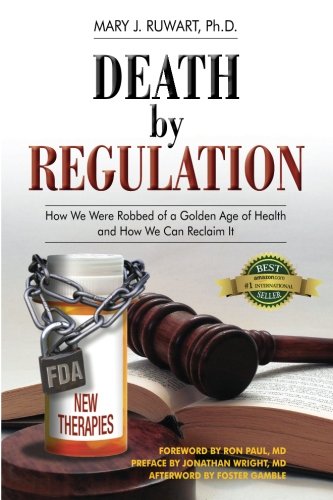
She is the author of Healing Our World: The Compassion of Libertarianism, published in 2015, and the focus of our interview is her latest book is Death by Regulation: How We Were Robbed of a Golden Age of Health and How We Can Reclaim It, published this year.

You can learn more about Mary and her work at: http://www.ruwart.com.

Ed’s Questions

Your book Death by Regulation is more horrific than a Stephen King novel, because it’s real. It all starts with children of thalidomide doesn’t it?

Before the 1962 Amendments a drug had to be “safe for the intended use.” But after the Amendments a drug had to show it was “safe and effective.” Why is this difference so important and what has it done for us?

Makers of water could not advertise that it alleviates dehydration [due to FDA regulations]. But how are Cheerios and cherries drugs?

Healthful snack or new "drug?" According to the FDA it is the latter. 

Healthful snack or new "drug?" According to the FDA it is the latter. 

Even the Centers for Disease Control and the FDA contradict one another in some cases?

There’s so many therapies where you’re using your own cells, stem cells, etc., will these be regulated as a drug?

One of the things we’ve noticed about many leaders in business is that they treat data as if they have a substance abuse problem. Like drugs, they get a little data and they more and more. The FDA demands more and more data from every study. Does the FDA has a data substance problem?

Ron’s Questions

maryruwart.png

You write prescription drugs, properly prescribed, killed 106,000 in 1994 alone (the 4th to 6th leading cause of death in the USA). I guess drugs, even approved ones, are controlled poison?

You conservatively estimate at least half of the Americans who died since 1962 have lost more than a decade of their lives because of the 1962 Amendments to the Food and Drug Act. Unpack for us why researchers look at years off of live rather than number of deaths.

You discuss off-label use of a drug, such as aspirin to help prevent heart attacks and strokes, yet the FDA doesn’t allow drug companies to market this fact, or even to inform doctors. Is that right?

You discuss the high price of drug prices and how many people attribute this to greed, which is a terrible theory—like blaming gravity for airplane crashes. Greed and gravity are a constant, so we can’t blame change on a constant. You say the real culprit is the FDA approval process, and because of the 1962 Amendments the average price of drugs increased 40 times. Real drug prices fell 32% from 1949-61, prior to the Amendments. Drug companies are constantly maligned and impugned in the press, by politicians, the media, etc. You worked for Upjohn for 19 years, how did you put up with these negative accusations?

As you say, the first patent holder to market usually captures 90% of the market, so that approval is really important.

Another statistic you point out is how drugs lower other health care costs: $3.65 saved in medical expenses for every $1 invested in drugs. It’s something of which most people don’t seem to be aware.

The FDA can make two types of errors: approve a drug that kills people (like Vioxx), or not approve a drug that could save the lives of many people. One of the economists we interviewed, Steven Landsburg, proposes that the FDA commissioner be paid in pharmaceutical stock as a way to lessen the incentive to only commit the second type of error. What’s your take on that proposal?

Is the FDA more harmful than helpful? "Yes," according to Dr. Mary Ruwart.

Is the FDA more harmful than helpful? "Yes," according to Dr. Mary Ruwart.

You recommend three remedies: 

  1. Repeal the 1962 Amendments

  2. Revoke FDA’s ability to approve new drugs. Instead, it makes reviews, recommendations, or certifications

  3. Pass the Health Freedom act (HR 2117) to nullify court decision that making a health claim for a food or nutrient makes it a drug

You point out that desperate patients make drugs in their kitchens, enter the black market, or buy from foreign countries. You also point out that surgeons didn’t need FDA approval for knee and hip replacement surgeries, important innovations. Of course, there are downsides: cardiac bypass was overused, etc. But it leads to more innovation which ultimately saves more lives than it costs.

You quote Dale H. Gieringer, a Cato Analyst: “FDA regulation certainly cannot be proved ‘safe and effective,’ thereby flunking its own approval criterion.” I don’t know how anyone can read your book and not come to the same conclusion.

Science isn’t good enough no matter who the decision maker is—the FDA, patient, or doctor. The best we can hope for is an informed decision.

Episode #191: Interview with Phil Rosenzweig

Rosenzweig_Phil_media.jpg

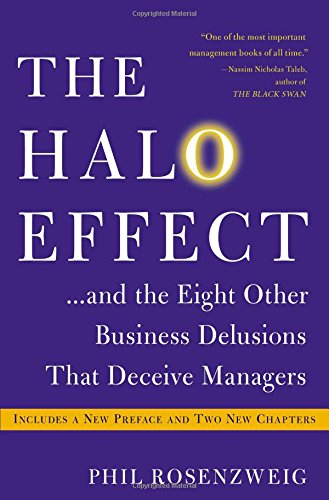
Phil Rosenzweig is professor of strategy and international business. He is Co-director of Transition to Business Leadership, and is also Co-Director of the Dual Executive MBA Program with CKGSB. His areas of expertise include strategy, firm performance, and complex organization design. He is also author of numerous case studies on firms including Microsoft, Daimler Benz, Matsushita, and Heineken. More recently, Phil Rosenzweig has focused his attention on critical thinking and managerial decision making. His 2007 book, The Halo Effect and the Eight Other Business Delusions that Deceive Managers, takes a critical look at the errors that pervade much business thinking. It was named Best Business Book of the Year by get Abstracts, and was favorably reviewed in Harvard Business Review, the Financial Times, The Wall Street Journal, USA Today, and dozens of other newspapers and magazines. His 2014 book, Left Brain, Right Stuff: How Leaders Make Winning Decisions, extends research about decision making into the world of strategy and management. Prior to joining IMD, Phil Rosenzweig was assistant professor at Harvard Business School from 1990 to 1996.

Phil’s book, The Halo Effect…and the Eight Other Business Delusions That Deceive Managers, published in 2007, is one of Ed’s and Ron’s all-time Best Business Books.

His most recent book is Left Brain Right Stuff, published in 2014.

Ed’s Questions

You started your career at HP, how did you get  into academia?

What is the halo effect and what was the brainstorm that inspired you to write the book with that title?

During World War I, an American psychologist, Edward Thorndike researched the ways  of superior rated subordinates

If they were handsome, good posture, shoot straight, etc. These attributions were inferences he called the Halo Effect: The tendency to make inferences about specific traits on basis of a general impression.

In business, the Halo Effect is the tendency to look at a company’s overall performance and make attributions about its culture, leadership, value, and more.

In fact, many things we commonly claim drive company performance are simply attributions based on prior performance.

Does employee satisfaction lead to strong financial performance, or is it the other way around?
Shortly after I read your book, I was interviewed by Harvard Business Review and they quoted me: “Business ain’t science.” What are your thoughts on business benchmarking?

Often when leaders find out they are below the benchmark, they question the data. When they are above, they say, “We’re doing pretty good.”

Another guest from TSOE, Jules Goddard (Episode #27), said in his book, “Strategy is the rare and precious skill of staying one step ahead of the need to be efficient.” Thoughts on that?

Turning from the firm to the individual, do you have any thoughts on using personality profiles, especially in the hiring process?

Let’s discuss performance evaluations.

You talk about measuring customer satisfaction (such as NPS), or employee satisfaction. Financial information is looked at frequently (monthly or quarterly), should customer and employee satisfaction be looked at more than once a year?

Ron’s Questions

You quote Richard Feynman: “Many fields have a tendency for pomposity.” Are most Business books overrated, or just wrong.

The best-selling business books seem to overstate their case.

You ask in the book, “Do business questions lend to scientific investigations?” And answer: “in many instances, yes.” What kind of things in business lend themselves to “scientific study?”

You write: “We have no satisfactory theory of effective leadership that is independent of performance.” I don’t know if you’ve read Jeffrey Pfeffer’s book, Leadership BS; do you think leadership is overrated?

Quick story: Shortly after your book came out, I gave a talk to a group who the next day was going to hear from the author of the best-selling book that you take to task in your book. I quoted George Anders of the Wall Street Journal who said that Good to Great offered a picture of business somewhere between Norman Rockwell and Mister Rogers. I presented a few of your critiques of the book, and recommended they read your book. I got slammed for this, so I can only imagine what you had to deal with. What was the response from the academic community to The Halo Effect?

You quote Michael Porter in the book who says that company performance is driven by two things: Strategy and execution, both fraught with uncertainty. We hear it all the time: We need to execute better; let’s all do a better job. It’s easier to blame lack of execution than a poor strategy. You write: “Whenever someone says ‘We have the right strategy, we just need to execute better,’ I make sure to take an extra-close look at the strategy.” What’s more important in your opinion, given that there’s no good way to execute a bad strategy?

You wrote a follow-up book to The Halo Effect, titled Left Brain Right Brain: How Leaders Make Winning Decisions. Would you provide us an overview of that one?

Episode #190: Interview with Economist Michael C. Munger

munger4.jpg

Professor Michael Munger received his Ph.D. in Economics at Washington University in St. Louis in 1984. Following his graduate training, he worked as a staff economist at the Federal Trade Commission.

Early Career

His first teaching job was in the Economics Department at Dartmouth College, followed by appointments in the Political Science Department at the University of Texas at Austin (1986-1990) and the University of North Carolina at Chapel Hill (1990-1997). At UNC he directed the MPA Program, which trains public service professionals, especially city and county management.

More recently

He moved to Duke in 1997, and was Chair of the Political Science Department from 2000 through 2010. He has won three University-wide teaching awards (the Howard Johnson Award, an NAACP "Image" Award for teaching about race, and admission to the Bass Society of Teaching Fellows). He is currently director of the interdisciplinary PPE Program at Duke University.

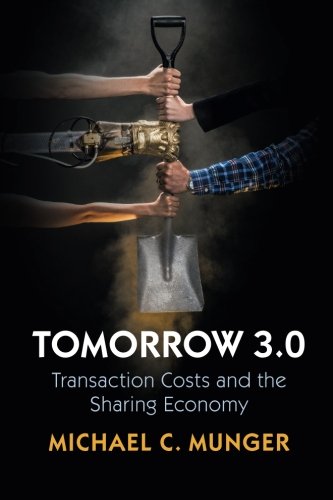
We focused mostly on his latest book, Tomorrow 3.0: Transaction Costs and the Sharing Economy, published this year.

Ron’s Questions

You say book grew out of conversation with Russ Roberts on EconTalk in 2014, one of our favorite podcasts. How did the book germinate?

The main thesis of Tomorrow 3.0 is: “Reduced transaction costs foster permissionless innovation to make more efficient use of, [and commodify] excess capacity.” Explain?

You date this approximately to 1997 with eBay, where we began selling not more stuff but reductions in transaction costs for access to existing stuff.

Uber and AirBNB don't sell taxi and hotel services, they sell reductions in transaction costs.

You describe three types transaction costs:

  1. Triangulation—matching buyer with seller, agreeing terms

  2. Transfer—of product/service and payment terms

  3. Trust—Honesty, performance (ratings and brands fulfill this role, among other traits).

You make the excellent point that to the consumer, all costs are transaction costs: time, search, inconvenience, payment terms, trust, etc. A reduction by 10% is the same as a reduction in price of 10%.

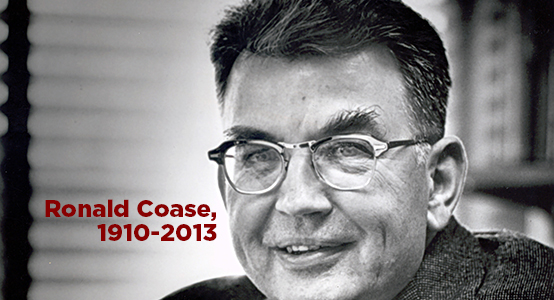
From the buyer’s perspective: all costs are transaction costs. Consider Uber’s surge pricing: You either pay in money or time. The father of transaction cost economics is Ronald Coase.

for-lawecon-feature.jpg

The sharing economy is:

  1. Entrepreneurship applied to reducing transaction costs rather than production costs (Biology active agent: natural selection; economics is entrepreneurship = imagine an alternate reality

  2. Working through new software platforms

  3. Operating on smart, portable hardware

  4. Connected over the web

The Value Proposition is: selling access to excess capacity. In the US, Self-storage is roughly 50,000 facilities, containing 15 billion cubic ft. of stuff. The desire to “own stuff” could decline.

Cars and houses are obvious areas where there is excess capacity, but how about clothing (closet in cloud), appliances, etc. What will 3-D printing allow in the future?

This struck me: You believe Uber not a threat to taxis as it is to Amazon—the ability to reduce transaction costs of renting vs. buying.

I want to go to the day after Tomorrow 3.0, what’s the threat to Uber? Couldn’t Blockchain, autonomous cars, and cryptocurrency disintermediate Uber completely?

Mike’s three predictions:

  1. Third great economic revolution innovation in digital tools, reduce transaction costs, not creation of new products

  2. Better use of excess capacity, sold rather than stored

  3. People will collect “experiences”

You talked with Ed about permissionless innovation, and here in California the courts just ruled that Uber drivers are “employees.” You wrote that saying that is like saying Rotten Tomatoes makes movies. Are you worried that government regulations will slow down some of these innovations?

You write that the purpose of an economy is not to create jobs but consumer surplus.

Ed’s Questions

From another work of yours, you have this concept of Euvoluntary: it’s sort of voluntary, but not really. Philosophers believe people can be coerced by their circumstance, so transactions are only voluntary if there are many buyers and sells, and if the buyer is not desperate and has alternative choices.

Is Uber surge pricing, or hotel rooms during hurricanes, voluntary or Uvoluntary?

When we get into a market that significantly reduce transaction costs, do you think the government should do something about the short-term effects of this transition.

In Spain at the conference I’m at, the number one growth stock on the NYSE since 2010 is Dominos. The reason: because 60% of its sales come from its mobile application—a reduction in TCs. They are shooting for 100% in 3-5 years. Your thoughts?

220px-Daniel_H_Hastings.jpg

Why is 19th century Governor of Pennsylvania Daniel Hastings a hero? Because Hastings vetoed an 1896 law that the Pennsylvania General Assembly passed—the "red flag" law, found in US and England. Any self-propelled vehicle be proceeded by a man on foot walking 50 to 100 feet in advance, waving a red flag in warning.

Of course, it was done ostensibly to “protect the people”—but in reality it was to save jobs related to horses. In 1915 there were 27 million horses in the USA and 100 million people, while in 1970 there were only 5 million horses.

What does company profit and a giraffe’s neck have to do with one another?

George Gilder labels profit as an index of your altruism. Comment on that point of view?

Episode #189: Free-rider Friday - April 2018

Ed’s Topics

korean-peninsula-at-night-planetobserver.jpg

North Korea

Beginning of peace, or false hopes?

Amazonlandia

By Ryan A. Ferguson. Amazon employs 500,000 people, making it the 171st largest country by population. Could Amazon start its own country, with its own digital currency?

Does coffee cause cancer?

California court ruled it does. See “Why California’s Lawsuit Industry Wants You to Think Coffee Causes Cancer,” Walter Olson, FEE, April 1, 2018

A Los Angeles judge ruled coffee shops face potential massive liability due to Acrylamide—a natural substance formed when food is browned or subject to high heat, such as grilled burgers, fried chicken, bread, almonds, potato chips—causes cancer in animals, in high dosages.

We can’t blame the judge, but rather Proposition 65 passed in 1986.

The Council for Education and Research on Toxics brought the lawsuit, asking for fines of up to $2,500 for everyone exposed to Acrylamide, since 2002.

Walter Olson, at CATO Institute, and also Overlawyered.com, has been covering Prop 65’s mandated warnings on scented candles, matches, brass knobs, light bulbs, playground sand, billiard cue chalk.

Why the Girl Scouts Are Marketing Geniuses,” Brittany Hunter, FEE, March 22, 2018

It creates the dominance hierarchy of cookies, what we refer to as offering options. It creates an artificial scarcity (you can’t get them online, you have to interact face-to-face). Pricing: they are expensive cookies.

Juxtapose the Girl Scouts with Elon Musk, in an article from Inc. magazine. Tesla can’t keep up with the demand for its cars. Why doesn’t he raise the price of his cars to lessen the waiting list? Does Elon’s pricing suck?

Which State Will Be the First to Suffer Fiscal Collapse?, Dan Mitchell, CATO Institute poll

 Ron’s Topics

“The End Justifies the Obscene,” Happy Warrior, Kyle Smith, National Review, March 5, 2018

The Haiti earthquake in 2010 for Oxfam meant party time! Oxfam set up brothels in Port-au-Prince, called “pink apartments.” There was a big expose in the British paper the Times.

Oxfam was throwing big parties, with girls wearing Oxfam T-shirts, running around half naked. Oxfam executives concealed details from regulators and the public, while the UK government contributed some $40 million to Oxfam last year.

International-development secretary Penny Mordaunt said on the BBC that Oxfam had denied to her department any misbehavior. When the reporter asked her, “Was this a lie?” she replied: “Well, quite.”

Oxfam was also accused of employing locals as prostitutes in 2006 in Chad, while it was supposedly helping refugees from the civil war in Sudan.

A 15-year Oxfam employee said: “There is a fear that if we tell the truth, the reputational damage to the agencies will benefit the sections of the press and politicians who want to reform the sector.”

Reform? We can’t have that!

 “The old one-two,” The Economist, March 24, 2018

Forget taxing profits, the EU is proposing a 3% tax on locally generated gross revenue.

Pierre Moscovici of the EU said this was an “interim fix.” He denied that USA firms are targets, even though of the projected 120-150 companies that will be affected, one-half of them are American (Apple, Google, FB, etc.), and they will pay up quite a bit.

The tax will apply to companies with global revenues more than $920 million, and EU revenues more than $61 million. Digital firms pay an effective tax rate of 9.5% in the EU, compared to 23.3% for brick-and-mortar firms.

The tax could raise as much as $6.1 billion.

France president Emmanuel Macron pushed hardest for this tax and France, Germany, Italy, and Spain welcomed it, while smaller EU countries will oppose. Steve Mnuchin, treasury secretary of the US, said a gross tax is “not fair.”

Any tax changes in the EU require unanimity among the members. This proposal could be being made to make look more appealing another plan to tax digital profits for those with “digital presence,” defined as: Gross revenue exceeding 7 million Euros, or 100,000 customers, or more than 3,000 business contracts in a given country.

Brexit 2.0, anyone?

Finland to end its universal basic income program by year’s end,” Edmund DeMarche,” April 25, 2018, Foxnews.com

Finland’s experiments gave a $685 monthly check, to 2,000 randomly selected jobless people, ages 25-58.

UBI.png

It’s implementing new measures to cut benefits for those who don’t actively seek employment, pursuing conditionality in public support, not unconditionality.

Proponents argue that Finland’s experiment was not comprehensive to gauge the merits of the idea, while critics complain that a full-scale UBI would require a 30% tax increase to fund.

See our Episode #95: A Check for Everyone? The Basic Income Idea.

“The last of Vaudeville,” The Economist, March 24, 2018

sir-ken-dodd-from-liverpool-is-made-a-knight-bachelor-of-the-british-HRJW85.jpg

Sir Ken Dodd, comedian, died on March 11, age 90.

He holds the world record for most gags (think rapid one liners from the likes of Rodney Dangerfield, Henny Youngman, Phyllis Diller).

Dodd told 1,500 gags in 3 hours and 7 minutes (8 per minute).

“An official told my big aunt Nellie to come off the beach, because the tide was waiting to come in.”

Mother-in-laws: “I haven’t spoken to mine for 18 months. I don’t like to interrupt her.”

In 1989, the Inland Revenue found £336,000 in cash he hadn’t declared, and even more in shoe-boxes under the bed. “I told the Inland Revenue I didn’t owe them a penny, because I lived by the seaside.”

“Against a Weed Industry,” Jonathan Caulkins, National Review, April 2, 2018

Capitalism unleashes productive forces, lowers prices. But we don’t allow markets everywhere, such as selling organs, steroids, etc.

Caulkins argues since no modern nation has ever allowed large-scale commercial production—though Canada will be the first, on July 1, 2018—that we should restrict production to nonprofit organizations.

For example, in the Netherlands, only retail sales are legal, and elsewhere rights inure to individuals, not corporations.

Nonprofits with boards to protect public health could be established, and tasked with undercutting black markets but not promote greater consumption. A second idea is for co-ops that would supply their own members.

Self-Report usage of marijuana grew from 0.9 million in 1992 to 7.9 million in 2016. Approximately 60% of users have a high school education or less, which would be highly sensitive to falling prices.

weed-marijuana.jpg

He points out prices in Washington between 2014-2017 dropped from $23.50 per gram to $7.25. The THC content digested went from 0.032 grams per week to 1.3 grams per day, a 60 times increase.

Episode #188: Interview with Blair Enns

WhoOT6tv_400x400.jpg

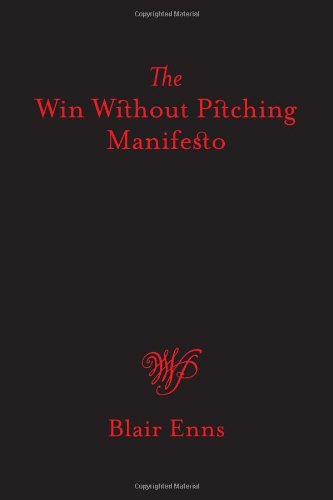
Blair Enns provokes, inspires and challenges creative professionals to radically change how they build and run their businesses. He's spoken to numerous independent networks, peer groups, ad clubs, design schools, Fortune 1000 companies, as well as national & international conferences of advertising, design, & public relations practitioners. He is the author of The Win Without Pitching Manifesto, and his most recent book, Pricing Creativity: A Guide to Profit Beyond the Billable Hour, which Ron said “is another nail in the coffin of hourly billing from one of the industry’s major thinkers.”

Ron’s Questions

Blair’s background and how he got to where he is.

Your first book was published in 2010, The Win Without Pitching Manifesto, which is a cult classic. How’d you land on that concept?

What is the central premise of the book?

Do you find when ad agencies take your advice and step back, the client takes several steps forward?

Your latest book is Pricing Creativity: A Guide to Profit Beyond the Billable Hour. How did you get into pricing? [Blair first read Ron’s book, Pricing on Purpose: Creating and Capturing Value].

What’s the biggest obstacle to implementation?

One of the lines I loved from the book: “Value conversation. Where price theory goes to die.”  I also loved the analogy between the value conversation and the birds and the bees talk with your kid—brilliant!

You suggest a 4-step process for the Value Conversation. Would you explain your framework?

You quote Dan Sullivan’s question:

“It’s three years from today and you and I are having coffee. You are really happy with the progress you’ve made over these past three years. What’s happened to make you so happy?”

What are some of your other favorite questions for the value conversation?

Blair’s approach to get to a theoretical maximum: Theoretically, if we were able to guarantee a $1 million result, would you be willing to pay us $500,000? That’s the high-end of your range for your 3-option proposal.

That ties into your philosophy of, “Say a Price Before You Show a Price,” is that right?

Ed’s Questions

Was there at one time where pitches were ‘semi-paid’ engagements?

On “fairness,” you say that pricing needs to be fair?

I’m going to push back: Isn’t a price agreed to upfront by definition fair?

I love this sentence in your book: “The moment the buyer cares who the seller is, is the moment a brand is born.” Would you elaborate on that?

I personally think why most professionals think of themselves as a commodity is due to low self-esteem. What’s your thought on that issue?

Another point in the book you mention is that “You can have a culture of efficiency or one of customer innovation, but not both—only one will survive.” I’m in violent agreement with you. Why do you think that is?

You talk with incredible aplomb about customer segmentation. Why do you think professionals suck at it?

I’ve studied Agile, and some advocates say it doesn’t work with value pricing. It seems like a good excuse to avoid value pricing. I think Agile works for internal development, like here at Sage, but for custom work, not so much. You mention using Agile doesn’t mean you have to use stone-age pricing. What are your thoughts?

Scope of work can be different, as long as the end-state (scope of value) is achieved. Does that make sense?

Episode #187: Interview with Donald Boudreaux

donboudreaux.jpg

Donald J. Boudreaux is a Senior Fellow with the F. A. Hayek Program for Advanced Study in Philosophy, Politics, and Economics at the Mercatus Center at George Mason University, a Mercatus Center Board Member, and a professor of economics and former economics-department chair at George Mason University. He holds the Martha and Nelson Getchell Chair for the Study of Free Market Capitalism at the Mercatus Center. He specializes in globalization and trade, law and economics, and antitrust economics.

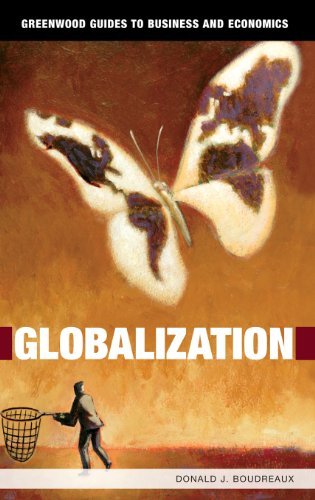
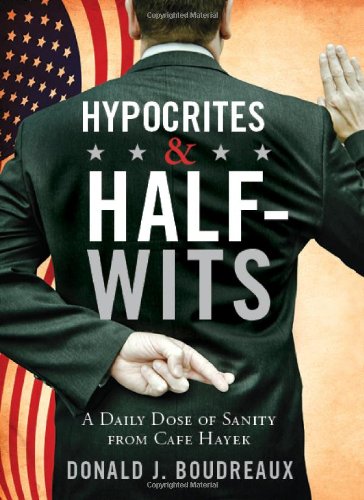
Boudreaux is committed to making economics more accessible to a wider audience. He is the author of the books Hypocrites and Half-Wits: A Daily Dose of Sanity from Cafe Hayek and Globalization. His articles appear in such publications as the Wall Street Journal as well as numerous scholarly journals. He writes a blog (with Russell Roberts) called Cafe Hayek. He has appeared numerous times on John Stossel’s Fox show to discuss a range of economic issues.

Globalization
By Donald J. Boudreaux
Buy on Amazon

Ed’s Questions

Segment One

Thank you for mentioning the Ronald Reagan quote that begins the show!

Editor's note: Donald Boudreaux is the first Guest to have mentioned it. The quote is from President Ronald Reagan's Remarks at Moscow State University, Mikhail Gorbachev's alma mater,  on May 31, 1988. Here is the speech in it entirety. It is remarkable!

  1. You post on your blog (with Russ Roberts) CafeHayek, quite a bit. Are you always in your blog?

  2. A constant theme on this show is the misapplication of the labor theory of value in business. About a month ago, I heard a rather famous economist say the reason Bitcoin has value is because it takes a lot of electricity to mine Bitcoin, and that’s why it’s valuable.

  3. Why is Friedrich Hayek one of your heroes? (See Episode #141, Memorable Mentors: Friedrich Hayek).

  4. One of the subtleties of Hayek’s notion of the difference between law and legislation. Can you expound on that?

Segment Three

  1. This crazy notion that we need to break up Facebook, Amazon, Apple, Google—what are people thinking?

  2. I’ve gotten invited by no less than three new social media sites that are based on blockchain and bitcoin and their mantra is you will own your information on this site. Disruption is already happening?

  3. Who is James Buchanan and why is it important that people know about him? (Co-founded Public Choice economics).

  4. Public Choice can even be applied to group decision making in business. One person one vote is often not the best way to make decisions in business.

  5. Why not create a voting system around social media?

Ron’s Questions

Segment Two

Continued: Elaborate on the difference between law and legislation.

Trump’s Tariffs

  • Talk about widespread economic misunderstanding, such as countries don’t compete, companies do: Why are we talking and caring about trade deficits?

  • It’s an accounting fiction that doesn’t describe economic reality, isn’t it?

  • It’s a good thing our founders established a free-trade zone among the 13 colonies, so we don’t track the deficit between California and Iowa.

  • Thomas Sowell in Basic Economics, the USA ran trade surplus every year of the Great Depression (See Episode #25, our interview with Thomas Sowell, discussing his book, Basic Economics).

  • As George Will wrote regarding fair trade and level playing field: “fields are leveled by bulldozers.”

Trump’s Tax Reform

  • What did you think of Trump’s tax legislation? (Don gives it a “C”).

  • What is your preferred alternative to replacing the federal income tax: flat tax, sales tax, VAT, etc.? (Don prefers a flat tax. A consumption tax is preferable, but he doesn’t trust the political process to get rid of the income tax if a consumption tax were implemented).

Segment Four

All over the news we hear about Artificial Intelligence (AI), Robotics, Deep Learning, Driverless Cars, etc., and how they could destroy 50-90% of jobs. You wrote a great article on the Foundation for Economic Education (FEE) website on April 26, 2017: “Robots Substitute for Jobs, Not Human Creativity,” wherein you argued:

  • What’s more human-like than humans? Shouldn’t we worry about fellow humans taking our jobs?

  • Yet from the 1950s, the USA workforce increased 160%, from 62 million to 160 million.

  • Yet the unemployment rate in 1950 was 5.3%; today it’s 4.5%. The labor force participation is 63% today but was 59.2% in 1950.

  • Believing robots take jobs is based on an incorrect presumption: that the number of productive tasks we can perform for each other is limited.

Boudreaux believes that number is practically unlimited. We agree.

  • We like to say here that the point of an economy is not to create jobs—but to create wealth! If General Motors could produce 8 million cars in one year with one employee, they would. Jobs are a cost, not a benefit. Milton Friedman said if jobs are important “give them spoons.” In your book, Hypocrites & Half-Wits, you say that if public transportation project benefits rise with the number of jobs created, then public transportation should be Rickshaws since there is a 1:1 job for every passenger!

  • What’s your take on the Universal Basic Income? (See Episode #95 for our discussion of UBI). [Don opposes it because he believes it would not replace the current welfare system].

  • Also in Hypocrites and Half-Wits, you quote Bill Gates: “Slowing population growth has proven to be critical to long-term economic growth.” This is insane, isn’t it?

  • What happens when the world’s population starts to decline, since there’s no economic model for this and it’s never happened in human history?

Episode #185: Free-Rider Friday - March 2018

Ed’s Topics

Tweet from Keith

Alchemy Financial (@WeLivetoServe), asking us to discuss Bitcoin. You have to report your sales of Bitcoin on your tax returns, but how do you deal with the “forks”—are they dividends, etc.?

hyperledger.jpg

Also, the HyperLedger, hyperledger.org, a project being run by the Linux Foundation, a who’s who of leading companies.

Ron brought up “The crypto sun sets in the East,” from The Economist, Jan 20, 2018. While Japan has embraced bitcoin, China has banned it, and South Korea is in the middle.

Though South Korea is less than 2% of global GDP, it has nearly 15% of Bitcoin-trading, yet South Koreans pay a 40% premium for bitcoins, due to capital controls.

Bitcoin is supposed to be freedom from government, yet in Asia, it is governments that are making or breaking their fortunes.

Amazon and Berkshire Hathaway Innovating Healthcare

Two articles: Capx.co article by Tim Warsaw on Amazon teaming up with Amazon and Berkshire Hathaway on healthcare.

HealthcareIT news: 5 different areas where Amazon could disrupt healthcare:

  1. Durable medical equipment and supplies

  2. Mail order and retail pharmacy

  3. Pharmacy benefit management

  4. Telemedicine and in-home healthcare using Echo and Alexa

  5. AI-powered diagnostics for continuing care

Facebook Knows Your Politics

Shout-out to listener Hector Garcia.

Go to your Facebook settings > Ads > Your Information > Your Categories > US politics.

Five categories: Very Liberal, Liberal, Moderate, Very Conservative, and Conservative.  You can delete them if you want.

Stephen Hawking, R.I.P.

Barry Brownstein on Stephen Hawking's Final Warning: Why His Worries Were Unwarranted

Steel and Aluminum Tariffs

In response to the charge that the Chinese government was subsidizing its steel producers an economist said, "Number one, it’s very dubious that it’s true, but suppose it were true. Then that would be a foolish thing for the Chinese to do from their own point of view, but why should we object to them giving us foreign aid? We’ve given them quite a bit."

Actually it is Milton Friedman and it was about the Japanese government forty years ago. Why won't this myth die!

Robin Corner, FEE, Toxic Masculinity article

Autonomous Vehicle Update

Regulators Are Asleep at the Wheel on Self-Driving Cars,” Bloomberg, March 26, 2018, Brad Stone

Tragic death of a pedestrian, cutting in front of a car, she was at fault. Will this slow down progress?

Driverless cars given green light to operate in California,” Financial Times, February 27, 2018

On Monday, Feb 26, 2018 California’s Department of Motor Vehicles green light to manufacturers and tech companies to test and deploy autonomous vehicles without a “natural person” inside the car. Also, no steering wheel or pedals required. The car must have a “remote operator.” Arizona, Michigan, Nevada also allow this type of testing. Safety campaigners say this could turn California’s roads into a potentially lethal video game. What are they now?

50 companies are testing in CA, including Alphabet, Uber, Apple, GM, Ford, Toyota. DMV could start issuing permits for locals to take rides by April 2nd. “Disengagement reports” must be submitted every year: measuring how many times a human had to step in, and each car must have a “black box.” Waymo’s score on Disengagement: once every 5,596 miles, and General Motors: once every 1,254 miles.

Ron’s Topics

“Firm direction,” The Economist, March 3, 2018

McK.jpg

McKinsey has been compared the US Marines, the Jesuits and the Freemasons. It consults with 90 of the Forbes top 100 firms, even helping Britain leave the EU, and the Saudis wean themselves off oil.

Kevin Sneader, Scottish Chairman replaces Dominic Barton as managing partner (2,000 partners).

Half of what it does today are capabilities that did not exist 5 years ago (it would be interesting to know how much revenue is earned from those capabilites?)

It is recruiting more data scientists and software developers, but staying relevant with technology firms is proving difficult. Unicorns, Facebook, Google, and Amazon don’t use McKinsey’s services, somewhat because McKinsey helps cut costs, and that’s not an issue in these companies.

Also, these companies compete with McKinsey in recruiting talent.

The former managing partner, Dominic Barton, also oversaw the shift towards a results-based fee model, in line with Boston Consulting Group, Bain and [Accenture].

Russia Ruins Aviation Record

Saratov (SA-RA-TIV) Airlines flight 6W703 crashed soon after takeoff, killing all 71 on board. It’s the first fatal crash since November 2016. There were no deaths in 2017.

I still can’t afford to move to Texas, Ed

CA2TX.jpg

So Many People Are Fleeing the San Francisco Bay Area, It’s Hard to Find a U-Haul,” FEE, Mark J. Perry, February 14, 2018. The San Francisco Bay Area is #1 for out-migration: Sacramento, Austin, Portland, OR. Reason: high cost of housing (even high skilled). A San Jose U-Haul operator’s biggest problem: getting his vans back! Nationwide, cities with biggest inflows, according to Redfin: Phoenix, Las Vegas, Atlanta, and Nashville.

Cost of Renting a U-Haul from San Jose to Las Vegas is $1,990 Las Vegas to San Jose $121.

AI vs. Lawyers,” LawGeex

Another shout-out to listener Hector Garcia. AI achieves 94% accuracy rate identifying and highlighting 30 proposed legal issues in five standard non-disclosure agreements. Human lawyers averaged 85% accuracy. It took the humans anywhere from 51 minutes to more than 2.5 hours to complete all five NDAs, while the AI engine finished in 26 seconds.

Ethical Question: does the Algorithm round up and charge the full hour?

“A tale of two Washingtons,” The Economist, March 10, 2018

Amazon’s second headquarters got bid from 240 cities/regions. It’s culled down the list to 20, including Toronto. Amazon says it will employ 50,000, and invest $5 billion over 15 years.

Three out of the 20 finalists are in the Washington, DC area: the city itself, northern Virginia, and Montgomery County, Maryland. Jeff Bezos already owns a home in D.C., and the Washington Post.

Amazon-Buys-Washington-DC.jpg

Amazon Web Services (AWS) already has a home in Herndon, VA, 10 minutes from Washington Dulles airport (second in Amazon employees). AWS has prominent government clients, including the CIA, and the government spend approximately 5% of the $1.6 trillion spent on technology each year.

Regulatory threat has increased as Amazon moves into financial, home security, logistics, healthcare, etc. It has already beefed up its lobbying, and having 50,000 employees and their children attending the same country clubs and schools as government officials is a shrewd strategy.

Also, having two headquarters makes a split from AWS and Amazon Retail much easier, if the company is ever divided due to antitrust laws.

We Need Bullies: Chris Rock Speaks Truth to Weakness in Tamborine,” National Review, February 15, 2018, Kyle Smith

Who said it?: G.K. Chesterton, John Wayne, Jordan Peterson?

“We need bullies. Pressure makes diamonds. Not hugs. Hug a piece of coal and see what you get. You get a dirty shirt.”

“That’s why there’s so many fat kids in school right now—because there’s nobody to take their lunch money.”

Chris Rock, on his new Netflix special Tamborine.

Hollywood’s New Matinee Idol: Karl Marx,” Kyle Smith, National Review, February 22, 2018

Haitian filmmaker Raoul Peck has done The Young Karl Marx. August Diehl as Marx and Stefan Konarske as Engels.

A crashing dud.” 5.9/10 on Rotten Tomatoes

Critics Consensus: The Young Karl Marx makes a valiant attempt to make the philosophical cinematic, but lacks sufficient depth to tackle its complex themes. No one wants to watch a movie about a nerd scratching away at his desk. Marx did fight power: he was forced out of three countries.

The trailer shows him visiting a factory with a child labor: but Marx never set foot in a factory.

“He may have dreamed up a party, but he wasn’t exactly the life of it.”

“Quoting Marx puts audience in a state of enjoyment approximating winter in Leningrad.”

“Engels, a limousine liberal before limousines.”

Few will walk away with deeper understanding of Marxism or communism, sort of like reading his work.

March iTunes Reviews

Thank you to everyone who has submitted a review, it means the world to us. To review us on iTunes, visit - https://itunes.apple.com/us/podcast/soul-enterprise-business-in/id893874169?mt=2

Modern Sales Training  5-Stars by mlubbe78  March 11, 2018

This podcast has been a great way to continue to drip the ideas and methods of value pricing into my daily work habits. I run an eCommerce software agency, and my business partner, our Sales Director, and I share our sales and business development workload. Many episodes of this podcast have been shared between the 3 of us as we continue to work hard to develop our skills as pricers within the value prcing model. We’re about 3 years in and getting better with every customer interaction. I also appreciate the Free-Rider Friday segments. They’re a refreshing break from the deep value concepts, and also provide some excellent annecdotes from the present. Keep it up guys. Great stuff.

Great content, entertaining delivery  5-Stars by Tlm WM    March 13, 2018

These guys have great practical insight, refreshing they do it with humility, humor and practical experience. I even applied to my own business because what and how they explained was easy to digest. Great podcast.

Taking Down Trickle Down/and MANY others  5-Stars by Greg Lafollette, March 19, 2018

This review is way (WAY) past due. In the interest of full disclosure I must first tell you that Ron & Ed are both long time friends of mine. So there’s that. But—friendship aside, I will tell you that I consume a LOT of information via podcasts and my subscriptions often outstrip my available time to listen. When that happens, something has to give. Here’s the essence of my review: when something has to give, it is never, NEVER, TSOE. I may get behind a week or two occasionally but I always listen to every episode. These guys are smart, witty, have amazing domain knowledge, and are genuinely interested in improving the human condition—well, at least the professional services part of the human condition. Whether it’s emerging technology, value creation, pricing, the (dreaded) billable hour, or some fascinating tangent the show is always entertaining and enlightening. [NOTE: Except when Ed talks baseball—then it’s lights out for the rest of  that episode!] Keep up the great work gentlemen. You are deeply appreciated. gll

Episode #184: Interview with Professor Thomas Hazlett

1200px-Thomas-Hazlett.jpg

Thomas Hazlett holds the H.H. Macaulay Endowed Chair in Economics at Clemson, conducting research in the field of Law and Economics and specializing in the Information Economy, including the analysis of markets and regulation in telecommunications, media, and the Internet.

He served as Chief Economist of the Federal Communications Commission, and has held faculty positions at the University of California, Davis, Columbia University, the Wharton School, and George Mason University School of Law. His research has appeared in such academic publications as the Journal of Law & Economics, the Journal of Legal Studies, the Journal of Financial Economics and the Rand Journal of Economics, and he has published articles in the Univ. of Pennsylvania Law Review, the Yale Journal on Regulation, the Columbia Law Review, and the Berkeley Technology Law Journal.

He has provided expert testimony to federal and state courts, regulatory agencies, committees of Congress, foreign governments, and international organizations. His latest book, The Political Spectrum: The Tumultuous Liberation of Wireless Technology, from Herbert Hoover to the Smartphone, was published in 2017, and The Fallacy of Net Neutrality, published in 2011.

Professor Hazlett also serves as Director of the Information Economy Project at Clemson University. His book, Public Policy Toward Cable Television, was co-authored with Matthew L. Spitzer (MIT Press, 1997), and He also writes for popular periodicals including the Wall Street Journal, New York Times, Reason, The New Republic, The Economist, Slate, and the Financial Times, where he was a columnist on technology policy issues, 2002-2011.

Ron’s Questions

Your Wikipedia says you were a child actor:

He was born in Los Angeles and grew up in the San Fernando Valley. In his youth, he attended Los Angeles city schools and worked as a child actor, appearing in TV shows such as McHale's Navy, The Monkees, and Land of the Giants, movies such as Walt Disney's "Follow Me Boys," and commercials for Wonder Bread and the Ford Torino. Having studied dance, he auditioned to join the traveling Bolshoi Ballet in Hollywood in 1962, but was rejected and ultimately studied economics instead.”

In your latest book is The Political Spectrum: The Tumultuous Liberation of Wireless Technology, from Herbert Hoover to the Smartphone, published in 2017, you write, "No natural resource more critical to 21st century than radio spectrum." Why?

You cite Cooper’s Law: wireless traffic doubles roughly every 2 years. We enjoy one trillion times the wireless capacity of networks than a century ago. Did I read that right?

How can the spectrum be “scarce”—and thus we need government regulation—if it has grown one trillion times?

arms6.jpg

You call it “The Wise Man Theory of Regulation”—the idea that the FCC can know “the public interest.” The price mechanism is very capable of allocating a scarce resource, we do it all the time. It’s superior to a centrally planned economy, as the USSR and other socialist failures have taught us. I love this line from the book, "It’s not the physics of radio waves but the economics of public choice [that help you understand this allocation process]."

The Political Spectrum chronicles the delays imposed on the market by the FCC from Cable TV, Satellite TV & Radio, FM radio, and cellular telephones. I’ll just ask you about one of those. Would you tell the story of Edwin Howard Armstrong, born in 1890?

One of the greatest inventors of the 20th century, largest shareholder in RCA for his patents on AM radio. He invented FM radio in 1933.

  • FCC doubted it would work; incumbents argued against it.

  • Finally, the FCC allows it in 1941, with 67 FM stations in operation.

  • In 1954: Armstrong commits suicide.

  • In 1960 FM rises from the dead; by 1979 FM listeners outnumber AM listeners.

 Is it fair to say that if net neutrality rules were in place in 2007, Apple could not have marketed the iPhone?

tumblr_n6fj8v1MSs1rtynt1o1_500.jpg

Switching to television, spoiler alert: I LMAO at this story in your book. You write about the most famous speech EVER given by an American regulator, in Las Vegas, on May 9, 1961 by FCC Chairman Newton Norman Minow [the “vast wasteland” speech” that equated broadcasters with drug dealers. The passive-aggressive response from TV broadcasters was in the 1964 debut on CBS of the TV show “Gilligan’s Island,” which mockingly named the stranded boat the S.S. Minnow].

You discuss how in 1961 Cox Cable offered 12 channels in San Diego for $5.50 per month, but the FCC delayed Cable TV competition for years. The FCC even squashed the Dumont Network in 1955, which had “The Honeymooners.”

Cellular technology was introduced in July 1945 but the FCC didn’t allocate spectrum until 1982, and granting licenses in 1989. You estimated the delay of licensing cost consumers $100 billion.

As you say, perverse regulatory consequences mean never having to say you’re sorry!

Ed’s Questions

  1. How is your NCAA Bracket doing?

  2. Regarding net neutrality: whenever both sides talk about this, a frequent metaphor is the road system or package delivery service. Do you think those are good metaphors, why or why not?

  3. Whenever net neutrality emerges, I always get two images in my mind: two tennis players on different courts trying to playing each other, and both sides seem to talk past each other, not using the same language, etc., would you address that for a bit?

  4. Is it too far fetched to say that the composition of the FCC is economically nearly as important as the Supreme Court?

  5. Your former colleague, economist Bryan Caplan has coined the term “the political Turing test”: a challenge for you to argue for or against something making the best case for your opponents so they think you agree with them. What is your best argument in favor of net neutrality?

  6. Have you seen any early positive or negative effects from the repeal of net neutrality?

Episode #182: How to Have a Value Conversation

Why is it so hard to have the value conversation? Two reasons: 1) Professionals are solutionists (Mahan Khalsa's great word), i.e., they jump to the solution, which is the antithesis of the value conversation; and 2) Professionals are afraid there is “no value,” what they offer is a “commodity.”

Yet holding a value conversation shouldn’t be difficult since both sides want to maximize value!

Ron confesses his early mistake in 1989: I did pricing in a vacuum. I didn’t have a value conversation. I fell in the trap explained by Karl Albrecht, "The longer you’ve been in business, the greater the probability you do not really understand what’s going on in the minds of your customers."

Resources

Ed’s blog post: “Without the Conversation, There is no Value Pricing.”

Ed’s presentation in South Africa on the value conversation.

Mahan Khalsa’s Book: Let’s Get Real or Let’s Not Play

Backward Bicycle Video

The four steps to move off the solution

  1. Listen

  2. Assuage

  3. Move

  4. Close

The Five Golden Questions—Getting to Value

First, recognize a “measurable” word:

  • Revenue

  • Cost

  • Customer Satisfaction

  • Quality

  • Performance

  • Productivity

  • Et al.

Second, ask Mahan Khalsa’s Five Golden Questions

  1. How do you measure it?

  2. What is it now?

  3. What do you want it to be?

  4. What is the value of the difference?

  5. Over time (usually one year)?

The Art of Questioning

Language was invented to ask questions. Answers may be given by grunts and gestures, but questions must be spoken. Humanness came of age when man asked the first question.

Social stagnation results not from a lack of answers but from the absence of the impulse to ask questions.

––Eric Hoffer, Reflections on the Human Condition

Naïve listening

Calvin Coolidge, said to be one of the country’s most laconic Presidents. When his successor as Governor of Massachusetts met him in the White House he is said to have asked the President how it was that he sometimes stays in the Governor’s office until 11:00 p.m. working and meeting with his designated appointments.

Yet, his aides inform him that when Coolidge was Governor he used to leave the office each day no later than 5:00 p.m. The successor asked Coolidge, “What’s the difference?” Coolidge responded: “You talk back.”

Listening is hard since we think faster than people talk. Talkers may dominate a conversation, but listeners control it.

Our favorite opening for the value conversation: Mr. or Mrs. Customer, we will only undertake this engagement if we can agree, to our mutual satisfaction, that the value we are creating is at least three (to ten) times the price we are charging you. Is that acceptable?

Sample Summary of Findings Report

Click here to access the sample.

Episode #181: Taking Down "Trickle Down"

Linguistics

Words and terminology change, we accept that fact. And indeed, even some proponents of supply-side economics describe it—positively—as “trickle down.” Even Rush Limbaugh does.

But the label doesn’t explain how economy works. Thomas Sowell once wrote something to the effect that it can take 23 pages to refute a bumper sticker, and that’s how we feel about this topic. It’s complicated, with a rich history that goes far beyond the “trickle down” moniker.

What is Supply-Side Economics?

Supply-side economics is perhaps one of the most misunderstood, and mischaracterized, theories in recent times. In reality, it’s quite simple, and very logical. Basically, capitalism is propelled by supply, not demand. Each actor in the economy has a dual purpose—that is, of producer and consumer. Which comes first?

People don’t consume in order to produce, they produce in order to consume. You don’t write a book because you acquire a computer; rather, you acquire a computer in order to write a book. Everyone knows, however, that their ability to consume, on the whole, is no greater than their ability to supply. In real terms, then, demand is supply.

Any buyer of a book, automobile, haircut or stereo pays not in the currency of demand—i.e., money—but from his own provision of goods and services to others.. 

When you obtain a haircut, you are simply trading some of your services as a CPA for those of a barber. Money is simply a convenience; it takes away the need for a “coincidence of wants” necessary in a barter economy. Money allows the trade to commence, even though your barber may not need CPA services at the time of your haircut. 

By focusing on money—that is, demand—we miss the real essence of what makes an economy work. The very idea of people as consumers is deceptive and patronizing, as people must supply first in order to demand later.

This is the reason supply-side models are unconcerned with spending and demand.  Rather, they focus on the producer by removing obstacles to production and trade.  Economist Jean Baptise Say coined Say’s Law of Markets: Supply of X creates demand for Y.

In other words, a society’s income can never exceed its output.

In this case, supply of lemonade creates demand for electronics.

In this case, supply of lemonade creates demand for electronics.

If you’d like more information on supply-side economics, as well as the logic and history behind it, Ed and I have found the following books most helpful. We’ll provide some of the main point from each below.

 “Trickle Down” Theory and “Tax Cuts for the Rich”, Thomas Sowell, 2012

“No such theory has been found in even the most voluminous and learned histories of economic theories…”

In a syndicated column Sowell challenged anyone to name any economist who advocated a “trickle down” theory. Lots named someone who claimed someone else advocated it.

It’s a classic case of arguing against a caricature instead of confronting the argument actually made, very similar to the Strategic Defense Initiative vs. Star Wars.

President Franklin Roosevelt’s speech writer, Samuel Rosenman referred to:

“The philosophy that had prevailed in Washington since 1921, that the object of government was to provide prosperity for those who lived and worked at the top of the economic pyramid, in the belief that prosperity would trickle down to the bottom of the heap and benefit all.”

Much same argument was made by William Jennings Bryan’s famous “cross of gold” speech in 1896.

Economist John Kenneth Galbraith labeled supply-side economics by using “the-horse-and-sparrow” metaphor: The horse is fed oats, some will pass through to the road for the sparrows.

President Woodrow Wilson in a 1919 message to Congress actually understood the negative consequences of high tax rates:

The Congress might well consider whether the higher rates of income and profits taxes can in peace time be effectively productive of revenue, and whether they may not, on the contrary, be destructive of business activity…

There is a point at which in peace time high rates of income and profits taxes discourage energy, remove the incentive to new enterprise, encourage extravagant expenditures, and produce industrial stagnation with consequent unemployment and other attendant evils.

The idea that profits “trickle down” to workers depicts the actual economic sequence in the opposite order. In reality workers are hired and paid first, before any output, or indeed, profits.

The real effect of tax rate reductions: they make future prospects more favorable, leading to more current investments, more economic activity, more risk-taking, entrepreneurship, and jobs.

Econoclasts: The Rebels Who Sparked the Supply-Side Revolution and Restored American Prosperity, Brian Domitrovic, 2009

This is the first scholarly history of the supply-side movement based on primary sources.

The movement was enhanced by a bunch of renegade, mavericks, all under 40, such as Jude Wanniski (author of the fantastic book, The Way The World Works), George Gilder, Robert Bartley editor of the Wall Street Journal, Congressman Jack Kemp and his staffer Paul Craig Roberts, who did have a PhD in economics.

There were two academic economists: Art Laffer and Robert Mundell, the latter a Nobel Prize winner in 1999). Five other Nobel economists were also associated with Supply-Side economics: Robert Lucas, Edward Prescott; the pioneer in “public choice” theory, James Buchanan; and Milton Friedman.

Robert Mundell elaborated on tax cuts and stable money in 1971 at a talk in Italy. His Nobel address is a great statement of supply-side economics and its historical vision.

Mundell has a university in China named after him: Mundell International University of Entrepreneurship.

No one called it “supply-side economics” in the 1970s. Jude Wanniski referred to it as “The Mundell-Laffer Hypothesis.”

Herbert Stein, economist and father of Ben Stein (of Ferris Bueller’s Day Off fame) labeled the movement “Supply-Side fiscalists,” a term of mild derision. Wanniski liked it, and used supply-side economics instead.

In December 1974, at the Two Continents restaurant in Washington, D.C. Arthur Laffer drew his now famous curve on a cocktail napkin. Present were: Jude Wanniski, Donald Rumsfeld (President Ford’s Chief of Staff), and his deputy, Richard Cheney.

napkin.jpg

Paul Krugman in an article in the New York Times, “The Tax Cut Con,” Sept 14, 2003: “Supply-side economics was a political doctrine from Day 1; it emerged in the pages of political magazines, not professional economic journals.”

This is untrue. From Day one it emerged on the pages of the IMF Staff Papers. And with Mundell’s presentation of a paper in 1958 to a Stanford faculty seminar, including the editors of the American Economic Review.

The Laffer curve is nothing more than a common sense view of taxation that comports to reality—that is, there are two rates that will bring zero revenue to the government: 0% and 100%. The crucial rate, to the supply sider, is the marginal rate, not the effective rate—the rate that applies on the last dollar earned, since it affects the decision to invest.

image94.png

If you subscribe to the logic that 0% and 100% will generate the same level of revenue, that logically leads you to conclude that the power to tax is, indeed, the power to destroy. Thus, every human undertaking, short of breathing, can be destroyed by taxation.

Britain, in the 1970s, had a top marginal rate of 98% on investment income. At a time when England was in economic decline, there were many Rolls Royces on London’s streets. This was mistaken as a sign of prosperity, when in fact it was a sign of confiscatory tax rates on investment income. It simply made more sense to consume than invest.

There are basically two effects from reductions in marginal tax rates (as opposed to tax revenues):

  • Income Effect—people have more money, so they work less (a target income theory).

  • Substitution Effect—work pays more relative to leisure, so people work more.

The argument is over which effect dominates. If it were true that people worked harder, in order to achieve a “target level” of income—even at tax rates approaching 90%--then we should tax the poor and lower-to-middle income workers at these rates in order to encourage them to work more.

This is nonsensical and is not consistent with human behavior—the way to get people to work harder is to raise their taxes! One wonders what workers would do if employers proposed the same work at reduced wages? Once you understand that additional effort often requires increasing rewards, then you have the basic logic behind supply-side economics.

This could explain why Americans work more than Europeans?

Unbelievably, this same argument is used for savings—that is, people have a “target level” of savings they want to achieve, and by lowering the tax rate they will achieve it faster, and therefore consume the excess. This also does not comport to human behavior.

Andrew W. Mellon, Taxation: The People’s Business, 1924

Incomes over $300,000

         Year    Rate    Taxes paid at progressive rate          Returns filed

         1916    7%                 $81,404,194                                1,296

         1921    77%              $84,797,344                                 246

In 1921, over 80% of those earning over $300,000 disappeared!

There were 206 millionaires in 1916; tax rates rose, then there were 21 in 1921! After rates dropped, they climbed back to 207 by 1925.

How did the rich avoid tax? Tax-exempt bonds, etc. Congress enacts the high tax rates, then creates the loopholes that allow the wealthy to avoid those high rates. Why?

So they can engage in class warfare rhetoric for votes, and continue to receive Donations from the wealthy.

220px-George_Gilder_handwaving_at_CHM_Apr_2005.jpg

Wealth and Poverty, George Gilder, 1981

The source of the gifts of capitalism is the supply side of the economy.

Even Marx knew enough not to stress control over the means of consumption! (or even the supply of money).

Every economy has unlimited demand, but there is no demand for new or unknown goods.

Say’s Law (supply creates demand) was not only refuted, it was implicitly reversed, with cause and effect hopelessly confused in the proposition that demand creates its own supply—“take and you will be given unto.”

Buying power does not essentially “trickle down” as wages or “flow up” and away as profits and savings. It originates with productive work at any level. Give and you will be given unto.

Consumption doesn’t need encouragement; production does:

“Even in the short run real aggregate demand is an effect of production, not of government policy. The only way tax policy can reliably influence real incomes is by changing the incentives of suppliers. By altering the pattern of rewards to favor work over leisure, investment over consumption, the sources of production over the sumps of wealth, taxable over untaxable activity, government can directly and powerfully foster the expansion of real demand and income. This is the supply-side mandate.” 

Say’s Law and the Keynesian Revolution: How Macroeconomic Theory Lost its Way, Steven Kates, 1998

Kates is the Chief Economist at the Australian Chamber of Commerce and Industry.

John Maynard Keynes tried to refute Say’s Law, but misunderstood and misrepresented it.

Say’s Law: the proposition that failure of effective demand does not cause recession. Your demand power is determined by your supply power. Production is the cause of consumption, not its consequence.

Kates writes that even Sowell failed to understand the core meaning of Say’s Law in his book, Say’s Law: An Historical Analysis, 1972.

Say’s Law declared that demand would never fall short of properly proportioned supply.

Ron equates this using this example: Children are demand-side economists, while parents are supply-siders.

Jean-Baptise Say: “It is the aim of good government to stimulate production, of bad government to encourage consumption.”

Say was the French Adam Smith who coined the term entrepreneur (undertaker), loosely translated as “adventurer.”

Other Resources

John F. Kennedy’s address to the Economic Club of New York on December 14, 1962

Comedian Tim Hawkins: The Government Can

Ben Stein in Ferris Bueller’s Day Off, boring his students in economics