Episode #34 - Interview with Joseph Pine

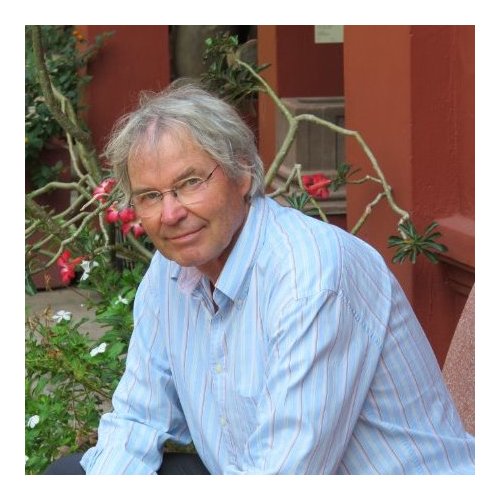
JOE PINE PIC

JOE PINE PIC

Ed and I were honored to interview B. Joseph Pine, author of one of our all-time favorite business books: The Experience Economy: Work Is Theatre & Every Business a State, Updated Edition.

bookspine

bookspine

Joe Pine is an internationally acclaimed author, speaker, and management advisor to Fortune 500 companies and entrepreneurial start-ups alike. Joe’s published work has changed how the business world thinks. His best-selling book The Experience Economy: Work Is Theatre & Every Business a Stage was the first to articulate the potential of experiences as a distinct economic offering, and literally began the worldwide shift to experience strategy. His latest work Infinite Possibility: Creating Customer Value on the Digital Frontier, explores how to use digital technology to stage experiences that fuse the real and the virtual, offering powerful new insights to address digital technology in customers’ experiences. He has consulted with hundreds of companies, bringing value to tactics, strategies, and game-changing, industry-disrupting innovations. Joe’s discoveries, the new frontier, the new economy, the new consumer sensibility, and now the new ways digital technology enables us to fuse the real and the virtual, make him one of the greatest business landscape explorers of our time.

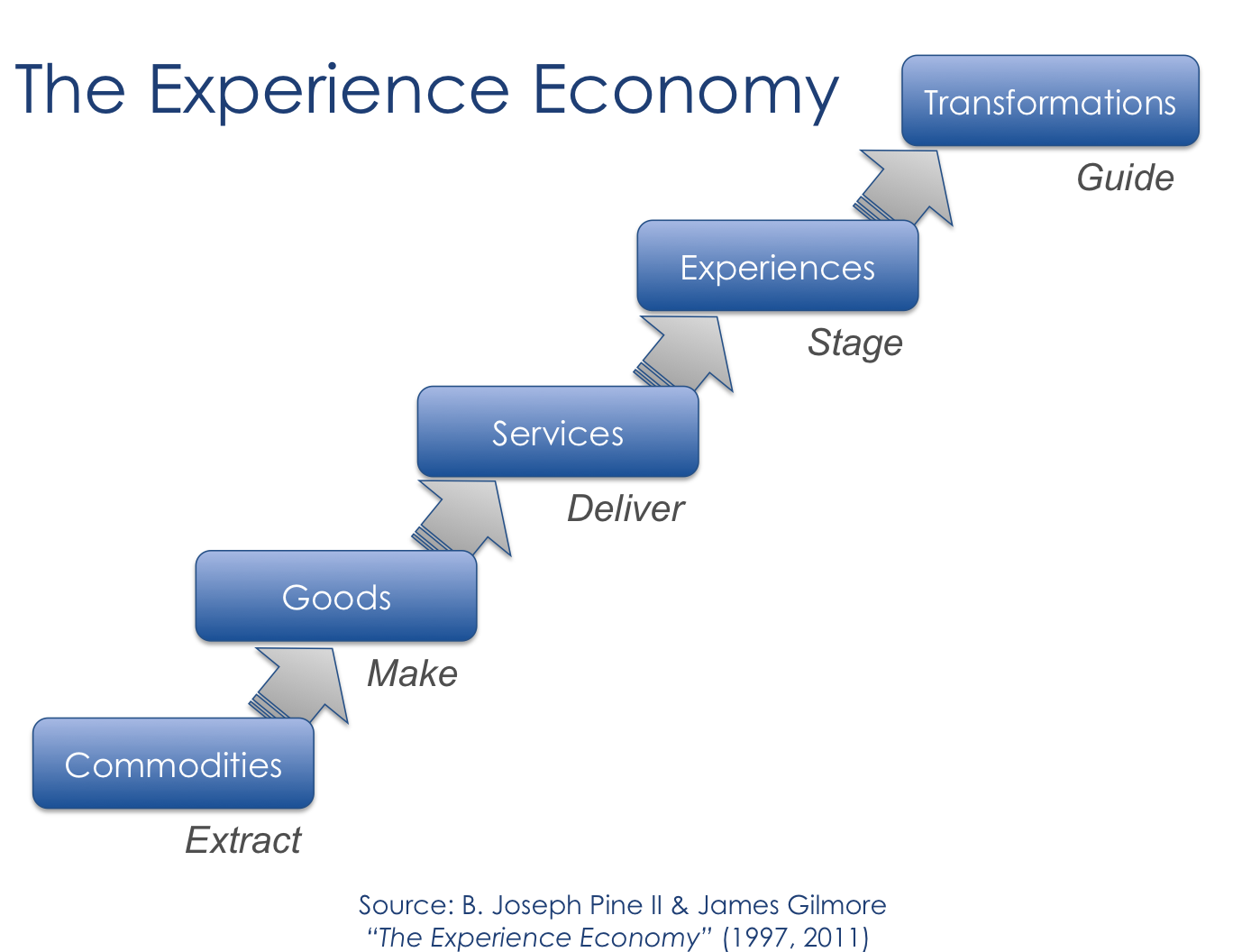
We had an interesting discussion with Joe on The Experience Economy, and especially how professional firms are poised at the top of his Economic Value Progression graph, providing transformations for their customers.

Experience_Economy

Experience_Economy

81AyiHXRiYL._SL1500_

81AyiHXRiYL._SL1500_

We also discussed the concept of multiverse from Infinite Possibility, and some of the concepts from his book The Laws of Managing.

We highly recommend all of Joe's books if you're interested in peering into the future and discovering the landscape where the future of business, and economic value creation, will be created.

Episode #33 - Free-Rider Friday - February 2015

Welcome to this week's “Free-Rider Friday.” Most of our shows are “topic” driven, where we dive deep into one subject. Free-Rider Fridays are designed to be “event” driven—whatever issues are in the news that we (or you) find worthy of commentary. In economics, free riding means reaping the benefits from the actions of others and consequently refusing to bear the full costs of those actions. This means Ed and Ron will free ride off of the news, and each other, with no advanced knowledge of the events either will bring up.

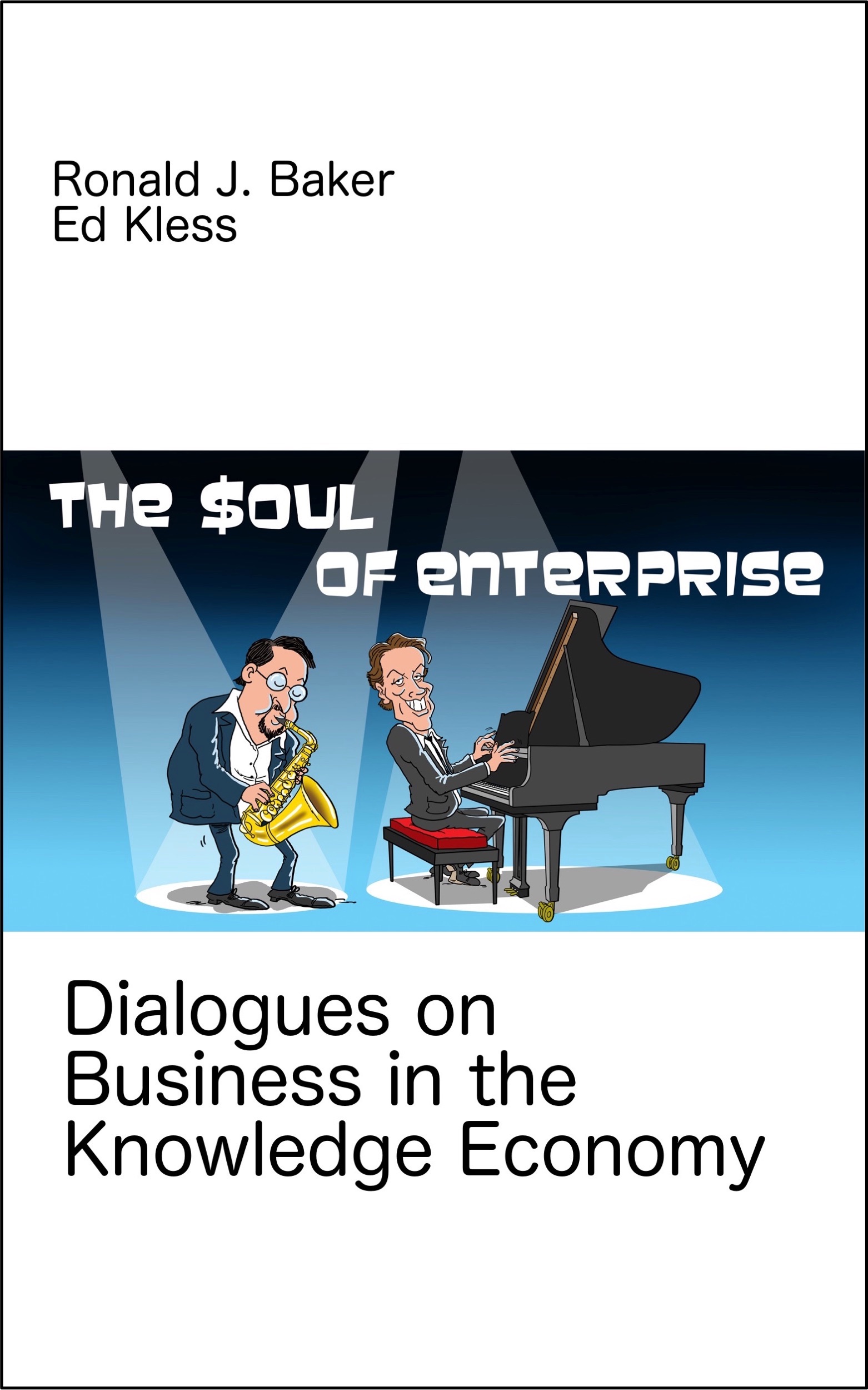
The Soul of Enterprise: Dialogues on Business in the Knowledge Economy is now available on Amazon Kindle

Cover

Cover

Ed and I are pleased to announce the publication of our first book together, based on the topics from our show.

The book is available exclusively on Amazon Kindle. You can download the Kindle app for free to read the book on a device other than a Kindle.

The book contains six chapters, which are from our show, combined into logical topics. We also added an Introduction and Epilogue.

Further, we’ve added links to many of the ideas, definitions, books, and other interesting things we cite. It’s a complete digital experience.

The Foreword was written by VeraSage Instiute’s G. Robert Newhart Non-Value-Added Fellow, Greg Kyte, and it does not disappoint. There’s also some funny illustrations by the cartoonist, caricaturist and illustrator Andrew Fyfe from Australia, a pure genius.

Here’s a more detailed description of the book:

The world’s economy has been transformed from a twentieth-century materials-based economy to the Age of the Knowledge-Based Economy — and the currency of this realm is ideas, imagination, creativity, and knowledge. According The World Bank, 80% of the developed world’s wealth now resides in human capital.

Perhaps President Ronald Reagan said it best in his address to Moscow State University on May 31, 1988:

Like a chrysalis, we’re emerging from the economy of the Industrial Revolution — an economy confined and limited by the Earth’s physical resources — into, as one economist titled his book, “the economy in mind,” in which there are no bounds on human imagination and the freedom to create is the most precious natural resource.

Written by Ronald Baker and Ed Kless, hosts of The Soul of Enterprise: Business in the Knowledge Economy, the popular radio show on Voice America’s Business Channel, The Soul of Enterprise: Dialogues on Business in the Knowledge Economy sounds the clarion call that organizations can no longer ignore this seismic shift that has occurred in the economy since 1959. The Soul of Enterprise introduces the three components of Intellectual Capital — human capital, social capital, and structural capital — and how to leverage them to create wealth in today’s economy, by revealing:

  • The physical fallacy — why wealth no longer consists of tangible things, but of ideas, imagination and knowledge from human minds

  • The best learning tool ever invented: After Action Reviews

  • Why Frederick Taylor and the Scientific Management movement was a fraud and the wrong focus for knowledge workers

  • The fact that effectiveness always and everywhere trumps efficiency

  • The First Law of Pricing: All value is subjective

  • The Second Law of Pricing: All prices are contextual

  • The Morality of Markets: Doing well and doing good

  • Why your organization — and you — need to be driven by a higher purpose than profit

The Soul of Enterprise will inspire and challenge readers to unlock the enormous financial and competitive power hidden in the intellectual capital of their organizations and knowledge workers.

Bill Gates Doesn’t Understand Wealth Creation

Ron mentioned an article from The Economist’s The World in 2015, written by Bill Gates. Some excerpts:

…disease and extreme poverty are not inevitable. In the past 25 years, the number of children who die has dropped by a half. …The number of extremely poor people has been going down at roughly the same rate.

We also know why people are escaping poverty: it is thanks to more productive agriculture, better access to financial services, and the spread of functioning health systems that prevent expensive medical emergencies.

Is he kidding? What’s caused people to escape bone-crushing poverty is the spread of capitalism. Free markets are the cause of all the results he cites, yet he doesn’t seem to understand how markets work.

This never ceases to amaze me. Some of the most successful entrepreneurs, and wealthiest, have no idea how capitalism works. They were able to practice it, but they can’t explain it, or offer a theory in its defense.

It validates William F. Buckley Jr.’s quip: “ The problem with capitalism is capitalists.”

Net Neutrality

Next we discussed the thorny issue of net neutrality. We are both against the recent regulations from the FCC that reclassifies the Internet from an “information service” to a “telecommunication service.”

Can you point to one innovative, heavily regulated industry? Had the government regulated the early days of the computer revolution, we’d probably have Vacuum Tube Valley, most likely in West Virginia.

Even The Economist likes broad rules (fast lanes can’t exceed slow lanes by a certain amount), rather than blanket regulations.

There’s an excellent article by Nick Gillespie at Reason magazine on this issue.

In all fairness, no one has seen the regulations yet. But is there any doubt that once regulation starts, it expands?

Could it be used to require all websites to have a license? Or control content?

I’m sure we will discuss this topic in future shows.

Greg Kyte

Greg Kyte called for the latter half of the show, discussing his work, videos, the Foreword he wrote to our book, and his new business: ComedyCPE.com.

Watch some of his hilarious videos at GregKyte.com, including the above infamous series of queuing up for the Blackberry, Bob’s BBQ, Great Moments in Value Pricing History, Parts I and II, and Billable Hour Scratch & Win.

Episode #32 - Innovating Your Business Model

Andy Grove, founder of Intel said in a meeting with Clayton Christensen:

Disruptive threats come inherently not from new technology but from new business models.

He also defined an Inflection Point as:

A time in the life of a business in which its fundamentals are about to change.

Just think about the following business model disrupters from the past decade:

  •             Craigslist (Pew Research, 2008: more people read news online than paid newspaper subscribers)

  •             Napster

  •             Google Books

  •             Uber

  •             Driverless cars

Defining Business Model

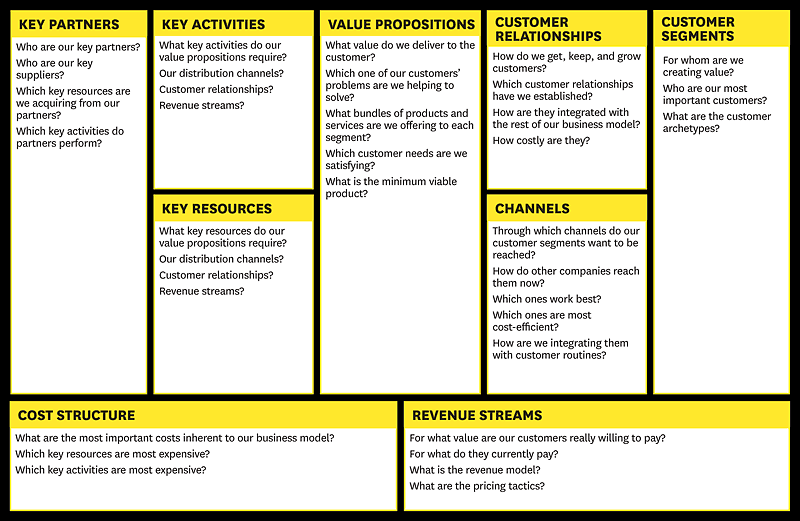
Ed and Ron discussed the book by Alexander Osterwalder and Yves Pigneur, Business Model Generation, wherein they define business model as:

A Business model describes the rationale of how an organization creates, delivers, and captures value.

Notice that a business model deals with capturing value, which is the company’s pricing strategy.

canvas1

canvas1

When you see a business model, you will probably see a pricing change (from CDs to iTunes .99¢, from Blockbuster video rental to Netflix, etc.).

In the book, the authors explore nine building blocks of the business model:

  1. Customers segments

  2. Value Proposition

  3. Channels

  4. Customer relationships

  5. Revenue streams—customer is heart, RS are its arteries (RM, Dynamic pricing, etc.)

  6. Key resources

  7. Key Activities

  8. Key partnerships

  9. Cost structure

You can find more information about the book, and accompanying App, here.

Disruption Comes from the Outside, and Non-Experts

The daunting task for many companies is:

How to implement and manage new models while maintaining existing ones.

Harvard business professor Clayton Christensen wrote:

Generally, the leading practitioners of the old older become the victims of disruption, not the initiators of it.

Steve Ballmer, former CEO of Microsoft once said:

Google is not a real company. It’s a house of cards.

Michael Dell, when asked what Steve Jobs should do with Apple when he returned in 1987, said:

He should just shutter its doors.

Experts rarely innovate. G.K. Chesterton wrote:

The argument of the expert, that the man who is trained should be the man who is trusted, would be absolutely unanswerable if it were really true that the man who studied a thing and practiced it every day went on seeing more and more of its significance. But he does not. He goes on seeing less and less of its significance.

Consider this, from the book, The Experts Speak: The Definitive Compendium of Authoritative Misinformation (1998):

  • 1986 Gottlieb Daimler predicted auto market would never exceed 1Million because you couldn’t train that many chauffeurs

  • Robert Milikan, Nobel Prize, phyics, 1920: “There’s no likelihood man can ever tap the power of the atom.”

  • “We don’t like their sound. Groups of guitars are on the way out.” Decca Records, turning down The Beatles a second time, 1962

Kodak engineer Steve Sasson invented “filmless photography” in 1975, but Kodak’s business model wasn’t designed to deal with any thing but film.

Xerox’s PARC Labs Xerox invented the interface on computers, but Xerox couldn’t figure out how you put a meter on a computer. It just didn’t fit with their business model. Steve Jobs had a different business model idea.

Creativity is Always a Surprise

In The Black Swan, Nassim Nicholas Taleb wrote:

We do not know what we will know. Invention and creativity is always a surprise. If we could prophesy the invention of the wheel, we’d already know what a wheel looks like, and thus we could invent it.

Friedrich Hayek wrote:

The mind can’t see its own advance.

Another book Ron likes on this topic is Seizing the White Space by Mark W. Johnson (2010).

The white space is not uncharted territory or an underserved market, but rather a range of potential activities not defined or addressed by the company’s current business model. It requires a different model to exploit.

Johnson points out that more than 30% of the 350 Business Model Innovations he studied in the past ten years were enabled by internet technology. So it’s not just about technology, but rather a fundamental change in creating and capturing value.

Peter Drucker on Business Models

One of Peter Drucker’s (1909–2005) many articles published in the Harvard Business Review (September-October 1994) was entitled “The Theory of the Business,” which laid out what he considered to be the essential elements executives would have to define in order to create wealth:

Not in a very long time—not, perhaps, since the late 1940s or early 1950s—have there been as many new major management techniques as there are today: downsizing, outsourcing, total quality management, economic value analysis, benchmarking, reengineering. Each is a powerful tool. But, with the exceptions of outsourcing and reengineering, these tools are designed primarily to do differently what is already being done. They are “how to do” tools.

Yet “what to do” is increasingly becoming the central challenge facing managements, especially those of big companies that have enjoyed long-term success.

What accounts for this apparent paradox? The assumptions on which the organization has been built and is being run no longer fit reality. These are the assumptions that shape any organization’s behavior, dictate its decisions about what to do and what not to do, and define what the organization considers meaningful results. These assumptions are about markets. They are about identifying customers and competitors, their values and behavior. They are about technology and its dynamics, about a company’s strengths and weaknesses. These assumptions are about what a company gets paid for. They are what I call a company’s theory of the business.

In fact, what underlies the current malaise of so many large and successful organizations worldwide is that their theory of the business no longer works.

It usually takes years of hard work, thinking, and experimenting to reach a clear, consistent, and valid theory of the business. Yet to be successful, every organization must work one out.

What are the specifications of a valid theory of the business? There are four:

The assumptions about environment, mission, and core competencies must fit reality.The assumptions in all three areas have to fit one another.The theory of the business must be known and understood throughout the organization.The theory of the business has to be tested constantly. It is not graven on tablets of stone. It is a hypothesis. And so, built into the theory of the business must be the ability to change itself.

Even if a particular business did not follow Drucker’s sage advice and postulate a theory of its business, one could certainly argue that since the macroeconomic environment of nearly any developed country is comprised of millions of businesses, the aggregate marketplace is a testable hypothesis in its own right, whereby customers spending their own.

George Gilder on Innovation

In his book, Wealth and Poverty: A New Edition for the Twenty-First Century, George Gilder weighs in on business models and event the efficiency vs. effectiveness debate:

Firms at the top of their S-curves of growth: the time when innovation dwindles and heavily bureaucratized companies seek minor new adaptations, packaging changes, and manufacturing efficiencies in order to wring the last gains of productivity from an essentially static industry that has already long passed its phase of ‘fast history.’

Auto companies at the very pinnacle of productivity had lost all room to maneuver. New developments almost never emerge from the leading companies in an industry. None of the carriage makers and buggy whip producers could create a salable automobile, and the gaslight and candle businesses neglected the promise of electricity; slide rule people at Keuffel and Esser succumbed without response to the handheld calculator; just as IBM lagged behind other companies in adopting most major innovations in business machines, from copiers to word processors; and as even Texas Instruments finally became relatively rigid and uncreative in the microprocessor field.

The very process of rationalization and bureaucracy by which a company becomes the most productive in an industry tends to render it less flexible and inventive. An exclusive preoccupation with statistical productivity—simple coefficients between inputs and outputs—can lead to a rigid, and in the long run, unproductive economy.

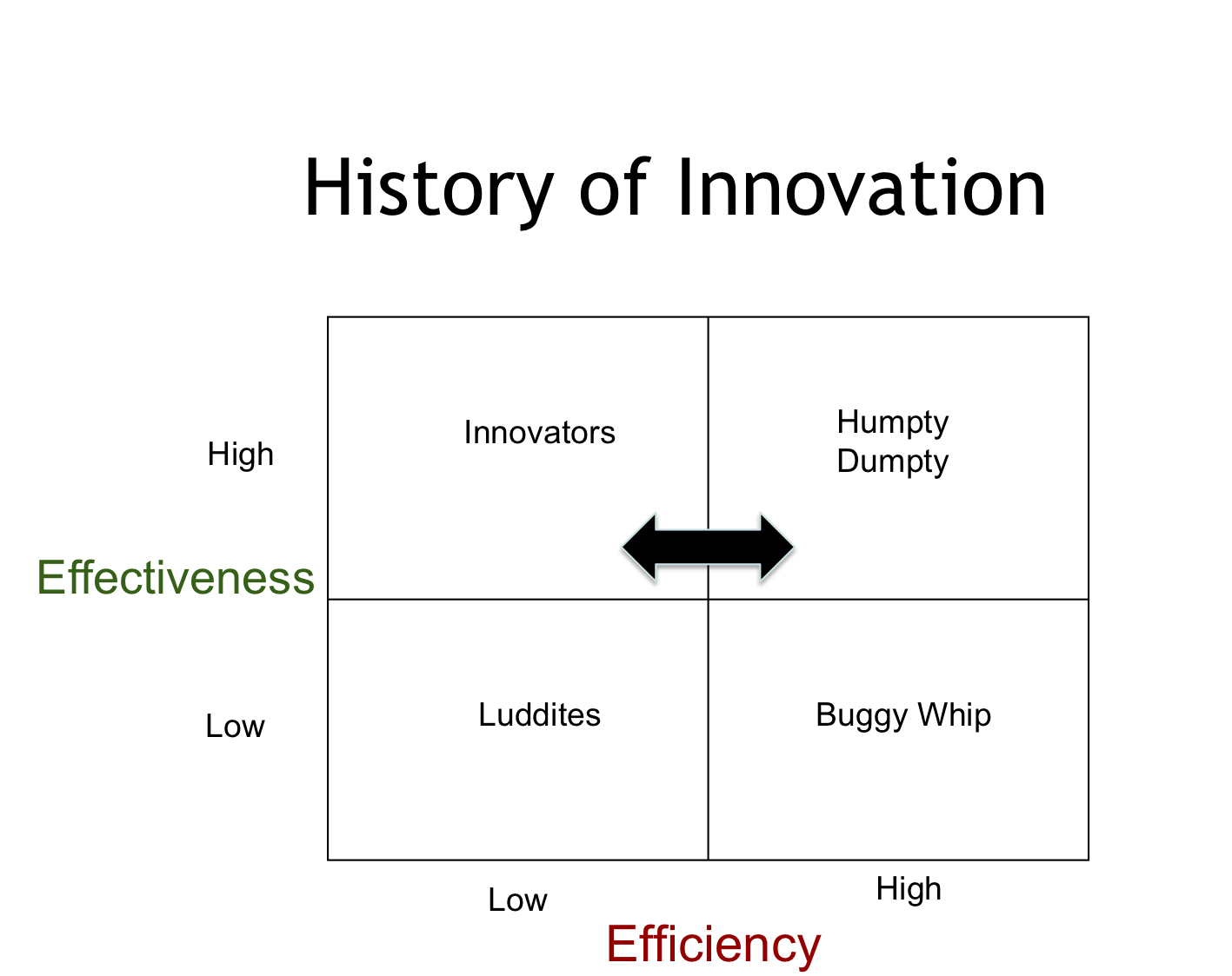
Here's a matrix that explains this phenomenon, from Ron’s book, Implementing Value Pricing: A Radical Business Model for Professional Firms:

History of Innovation

History of Innovation

Luddites: Firms that resist technological advances and other innovations that are merely table stakes risk being Luddites. They have both low efficiency in doing things right, and low effectiveness at doing the right things—not a bright future. Fortunately, not many firms are in this category. If you are here, you are dead already and the funeral is a mere detail.

Buggy Whips: Usually when an industry is at the apogee of its efficiency, it is at risk of being made obsolete by new technologies or business models. As Peter Drucker said, no amount of efficiency gains would have saved the buggy whip manufacturers from the automobile.

Innovators: As George Gilder wrote in Forbes, “Knowledge is about the past; entrepreneurship is about the future. If creativity was not unexpected, governments could plan it and socialism would work. But creativity is intrinsically surprising and the source of all real profit and growth” (“The Coming Creativity Boom,” November 10, 2008). Innovators are firms that are willing to invest some of today’s profits into tomorrow, while at the same time sacrificing efficiency for effectiveness. Innovation, creativity, and Total Quality Service are the antithesis of efficiency—ideas such as Google Time, experimenting with new ideas, investing in education, all reduce efficiency metrics. But if firms do not make these essential investments they are simply coasting on their existing intellectual capital, and in today’s economy, knowledge becomes obsolete more rapidly.

Humpty Dumpty: This is a precarious future. This represents firms that are highly efficient and effective. I am arguing if you are here, you better be sliding back to the Innovators position and start sacrificing some of that efficiency for innovation and making the firm more valuable to its customers. Humpty Dumpty eventually falls and ends up like the industries mentioned under Buggy whips. Efficiency is not the answer. Effectiveness is. This is precisely why we warn companies to avoid putting efficiency ahead of effectiveness. Any industry at the apogee of efficiency is an industry in decline.

Parting Thoughts

Embracing a new business model requires leadership and vision. It requires knowing you are doing the right things, not just doing things right. It requires focusing the firm on the external value it creates for the customer and simultaneously building the type of firm people are proud to be a part of and contribute to—the sort of organization you would want your son or daughter to work for. It requires a sense of dignity and self-respect that you are worth every penny you charge, and you will only work with customers who have integrity, whom you enjoy, and respect. It requires an attitude of experimentation, not simply doing things because that is the way it has always been done. It requires less measurement, less fear, and more trust. It requires boldness and risk-taking—there has yet to be a book written titled Great Moderates in History.

Episode #31 - Who Is in Charge of Value?

We have had the privilege of posing this question—Who’s in charge of value in your organization?—to thousands of leaders around the world. We're usually met with a momentary staring ovation, and then someone will inevitably shout out, “Everyone!” Really? Ron lives in California, where he's told everyone “owns” the Golden Gate Bridge. He would like to sell his portion; unfortunately he encounters what economists call the tragedy of the commons.

If everyone owns something, no one does. No one has an incentive to protect and maintain the value of the asset in question. Think public toilet.

Pricing is far too important to the viability of the company to be left to mediocre pricers. No other area—not cost cutting, efficiency increases, or growth—can have as large an impact on profitability as does pricing.

It is time for organizations to recognize that if they are serious about pricing commensurate with the value they create, they need to establish a core group of enthusiastic pricers to make pricing a core competency within the firm.

value

value

Appoint a Chief Value Officer

To understand value, we have to understand the customer. This is not accomplished with more accurate cost accounting, better project management, or any other internal initiative. Companies have a wealth of information on how long things take and what they cost; they have a paucity of metrics on the value they create for customers.

Someone needs to be in charge of value. BMW has a Customer Experience Officer, responsible for the entire BMW experience, from decision to purchase, to service and trade-in. Many professional firms have now created this position, with the CVO overseeing a value council.

One question that continually comes up is what are the traits of a successful CVO, or value council member? The acronym LACEY is a useful framework for identifying what characteristics are essential for a successful CVO:

  • Leadership

  • Attitude

  • Commitment

  • Experimentation

  • Youth

Leadership

An organization will never rise above its leadership. CVOs implicitly and explicitly understand that the firm’s prices are the language in which they strategically communicate value to customers.

Perhaps the first important characteristic of a successful CVO is high self-esteem; they believe that their company’s services are worth every penny they charge. There is great nobility in being paid what you are worth.

A CVO must have demonstrable leadership skills, while commanding respect and creditability across multiple functions within the firm. She will be responsible for communicating the importance of pricing and value to the media, thereby negating price wars within the industry.

Since competitors tend to judge a firm’s pricing behavior based upon its most ruthless actions, think of the message appointing a CVO would send to others in your industry about how committed you are to price for value and not engaging in self-destructive price wars.

Leadership is essential, and leadership demands tough decisions (the word decision comes from Latin decidere, meaning “to cut off”), and some times individual opinions have to be sacrificed for the good of the organization. Margaret Thatcher, former Prime Minister of Britain, was fond of pointing out: “Consensus is the negation of leadership.”

Attitude

The CVO and members of the value council have to view pricing as an enormous opportunity for the firm to create and capture value, rather than a limitation imposed on them by the market, which they have no control over, like the weather. Pricing is far too important to assign to narrow minds. Pricers have to be intellectually curious, constantly learning, reading, and studying why humans behave the way they do.

Look for a CVO who is moving through the five levels of learning: awareness, awkwardness, application, assimilation, and art. Pricing is an iterative process of the mind and it will always require human judgment.

Commitment

A CVO and value council that does not have the support of the CEO are destined to be feckless. Effective centralized pricing has to have total authority, which needs to be vested in one individual so there is one throat to choke.

Taking it a step further, the CVO should report directly to the CEO. This will send a powerful message throughout the organization that the leaders are serious about value and pricing, as well as to competitors, thereby possibly reducing the threat of price wars. This also provides a competitive advantage, since competitors can only monitor historical pricing, not value.

Perhaps the largest commitment required will be in the area of pricing talent. Since this is a relatively new skill in the marketplace, talent is presently hard to find, and firms will have to develop it internally.

If resources are limited, the best advice is: Read, read, read. There are many more books out there on pricing than there were even ten years ago. Assign the council a reading list, and make every member teach what they learned, and what they think the firm should do differently as a result, to their colleagues.

There are also graduate level courses on pricing taught at many universities’ executive education divisions, which are worth the price of admission. Be sure to join the Professional Pricing Society, which provide seminars, workshops, and a chance to share intellectual capital with other pricers.

As Professor Ernest Rutherford, the man who split the atom, said: “It’s true we don’t have much money so what we have to do is think.”

Also, as with any new initiative there is bound to be inevitable mistakes, failures, and setbacks. The CVO must be committed to the process. Pricing is hard, but so is training for the Olympics, or anything else worth doing. Obtaining a competitive advantage is never free. Determination and commitment defeats diffidence.

Experimentation

The CVO has to take a stand for the customer, constantly asking how the company can provide more value. They have to be willing to experiment and cannot be prisoners of the past. “That is the way we have always done it,” should inspire nothing but contempt from CVOs.

Soren Kierkegaard wrote, “Purity of soul is to will one thing.” What is more important than to champion the cause of value creation within today’s organizations? A CVO is never satisfied with the status quo because they will constantly be on the search for new ways of doing things, all the while eliminating procedures and processes that do not add value to the customer. This is the CVO mandate.

Youth

Out of all of the characteristics in LACEY, we will admit a certain amount of uncertainty as to the implications of this last one. We are not suggesting you cannot teach an old dog new tricks. Instead, research on age and innovation suggests you should not expect an old dog to innovate a new trick to add to the repertoire.

If organizations want innovation and dynamism, they will have to give more authority and responsibilities to their youthful team members. At the least, some people in their twenties or thirties should be on the value council. Organizations, like people, tend to calcify with age, and youth can keep the blood pumping at a more vigorous pace.

No doubt they will make more mistakes and incur more failure, yet risk is where profits come from. What is the alternative? Ossification is not an option.

Not Final Thoughts

It is often said we get what we measure. If this is true, isn’t it time we measure what we want to become? Who in your company is measuring value? Unless someone in your organization owns the value function, it will not get the proper executive attention, respect, and resources it deserves.

If you are competing against a firm with a CVO—either for customers or talent—you may well be at a severe competitive disadvantage. The Roman God Janus had two sets of eyes, one to see what lay behind and the other to see what lay ahead. A CVO is an outward-looking position, with duties carried out in a world of risk, uncertainty, innovation, and faith in the future, where value is solely arbitrated by the customers your firm is privileged to serve. If the only set of eyes you possess look behind you—at historical costs, hours, activities, and efforts—you are destined for a perilous future.

So, who is in charge of value in your company?

Other Books and Resources

Pricing on Purpose: Creating and Capturing Value, Ron Baker.

Human Accomplishment, Charles Murray (for the link between youth and innovation)

To Be or Not to Be: The Customer Experience Officer.

Marriott on Pricing

Episode #30 - Crafting the Value Conversation with Dan Morris

Ed and I had the pleasure of interviewing Dan Morris, co-founder of VeraSage Institute, and one of the world’s leading experts on crafting the value conversation. Dan did a video for the AICPA on the value conversation, which is well worth watching.

We’ve also included an excerpt from the value conversation chapter of Ron’s latest book, Implementing Value Pricing: A Radical Business Model for Professional Firms, as well as some additional books and resources mentioned during the show:

The Value Conversation

Language was invented to ask questions. Answers may be given by grunts and gestures, but questions must be spoken. Humanness came of age when man asked the first question. Social stagnation results not from a lack of answers but from the absence of the impulse to ask questions.

––Eric Hoffer, Reflections on the Human Condition, 2006

Any company that establishes prices based upon value will agree that the conversation with the customer is the most important part of the process. Skipping an in-depth conversation is similar to a contractor attempting to build a customer’s dream home without any architectural plans. The better your firm comprehends the customer’s value drivers, the more likely you will be able to create and communicate maximum value, convince the customer they must pay for that value, and capture that value with an effective pricing strategy custom tailored to the customer.

This is an opportunity for you and the customer to create a shared vision of the future, to analyze where the customer is at this point, and to develop the necessary action plan to move them to where they want to be.

This focus is crucial, because if you do not discus value with the customer, you will be forced into a discussion of costs, efforts, activities, and deliverables, usually by procurement, or some other professional buyer within the customer’s organization. Remember that the customer is trying to maximize the value they receive while attempting to minimize your price. It is far more strategic to engage in a discussion over what the customer is trying to maximize rather than what they are trying to minimize. If all you focus on is price, it can never be low enough. If the customer says your price is too high, what they are really saying is, “I don’t see the value in your offering.” It is not a question of money; rather, it is lack of belief.

Naive Listenting

When I am getting ready to reason with a man I spend one-third of my time thinking about myself and what I am going to say, and two-thirds thinking about him and what he is going to say.

––Abraham Lincoln

Questions require doubt, something salespeople who are experts in what they sell are not comfortable with. After all, we are paid to have the answers, not express doubt; and if you already know the answers there appears to be no need to gather any more information from the customer, chaining ourselves to the limits of our existing knowledge.

For this reason, during the conversation the customer should talk at least twice as much as the salesperson. This is incredibly difficult because it requires self-restraint. Naïve listening is difficult because you think much faster than people talk. While someone is talking, you are usually listening with one-half of your brain and formulating your answer with the other. Active listening is a skill that needs to be developed.

Talkers may dominate a conversation but the listener controls it. Taking notes conveys to the customer that what they are saying is important and that you care enough to record it. It also helps you remember exactly what they said. But most of all—and this is precisely why psychiatrists and psychologists take notes—is the person will provide much more detail. The more you know, the more value drivers you will be able to uncover, and the higher prices you will command.

You also want to deal with the economic buyer—the person who can hire and pay you. Many consultants believe you are wasting your time if you cannot get in front of this person, because most likely you will be dealing with gatekeepers who can only say “no,” never “yes.” This may take a few iterations, but the customer is sending a signal they are not serious if they deny you access to the economic buyer, and you may want to invest your resources in more profitable opportunities—such as servicing existing customers.

Avoid the ever-present temptation to provide solutions to the customer’s needs and wants. That is not the purpose of the conversation at this stage. You are on a value quest with the customer, not in a venue to begin providing solutions. Your role at this point is to ask questions and have the customer formulate—or at least articulate—a vision of the future. Before doctors prescribe, they must diagnose, which is the role you must assume at this stage in the conversation. Anything less is malpractice.

Starting the Conversation

This is one of the most effective statements to utilize somewhere near the beginning of the value conversation, regardless of whether you are meeting with a new or current customer:

Mr. Customer, we will only undertake this sale if we can agree, to our mutual satisfaction, that the value we are providing is greater than the price we are charging you. Is that acceptable?

This establishes the right tone near the beginning of the conversation that yours is a firm obsessed with value, along with the willingness to demonstrate the economic impact that your products and/or services can have for the customer—how it will improve the customer’s life or business. It also subtly suggests that you will not enter into relationships that do not add value for both parties—the exact tone you want to set, as both sides to a transaction must profit if it is to be sustainable.

Questions You Should Ask the Customer

If all patients were the same, medicine would be a science, not an art.

––Sir William Osler, one of the fathers of modern medicine

Something similar to Osler’s statement can be said of questioning—it is an art and skill, not a science. Each customer is unique, and so must be your approach to questions. Just as with naïve listening, one should not be afraid to take the Lt. Columbo approach and ask simple questions. As English mathematician and philosopher Alfred North Whitehead wrote, “The ‘silly question’ is the first intimation of some totally new development.”

Peter Drucker also taught an effective approach to assignments: approach the problem with your ignorance:

I never ask these questions or approach these assignments based on my knowledge and experience in these industries. It is exactly the opposite. I do not use my knowledge and experience at all. I bring my ignorance to the situation. Ignorance is the most important component for helping others to solve any problem in any industry.

There are questions you should ask every customer to assist you in determining just where on the value curve your customer is located. The more information you seek from customers, the better equipped you will be to assess their price sensitivity. Always ask open-ended questions to engage the customer in discussing goals, aspirations, fears, desires, and dreams of the future. This has a tremendous psychological impact, because most people’s favorite topic is themselves. Start with the following questions:

  • What do you expect from us?

  • What is your business model? How do you make profit?

  • What are your company’s critical success factors and Key Predictive Indicators (KPIs)

  • How will the services we provide add value to your customers?

  • Which of our company’s offerings is of the highest value to you?

  • Who is the next best alternative (competitor) to our company?

  • What characteristics do they have we do not, and vice versa.

  • What is your current pain?

  • How do you see us helping you address these challenges and opportunities?

  • What growth plans do you have?

  • If price were not an issue, what role would you want us to play in your business?

  • Do you expect capital needs? New financing?

  • Do you anticipate any mergers, purchases, divestitures, recapitalizations, or reorganizations in the near future?

  • We know you are investing in Total Quality Service, as are we. What are the service standards you would like for us to provide you?

  • How important is our service guarantee to you?

  • Why are you changing suppliers? What did you not like about your former supplier that you do not want us to repeat?*

  • How did you enjoy working with your former supplier?**

  • Do you envision any other changes in your needs?

  • If we were to attend certain of your internal management meetings as observers, would you be comfortable with that?

  • How do you suggest we best learn about your business so we can be more proactive in helping you maximize your business success?

  • May our associates tour your facilities?

  • What trade journals do you read? What seminars and trade shows do you regularly attend? Would it be possible for us to attend these with you?

  • What will the success of this engagement look like?

  • What is your budget for this type of service?

*Do not denigrate the predecessor supplier. First, this insults the customer and reminds the customer of a poor decision. Second, it diminishes respect and confidence in the industry as a whole.

**Even though the customer is changing suppliers, almost certainly the customer liked some characteristics of the predecessor. Find out what these were and exceed them.

Believing Your Worth

There is great nobility in getting paid what you are worth. Nothing is more satisfying than customers who believe—and act on the premise—that they get what they pay for. The best way to achieve this is to have a value conversation.

Book and Resources

Episode #29 - First-ever Free-Rider Friday - January 2015

Welcome to “Free-Rider Friday.” Most of our shows are “topic” driven, where we dive deep into one subject. Free-Rider Fridays are designed to be “event” driven—whatever issues are in the news that we (or you) find worthy of commentary. In economics, free riding means reaping the benefits from the actions of others and consequently refusing to bear the full costs of those actions. This means Ed and Ron will free ride off of the news, and each other, with no advanced knowledge of the events either will bring up.

If you’d like to call-in during the live show, the listener line is: 866-472-5790. You can also participate on Twitter at #asktsoe.

Tip of the Day: Names

First, we’d like to thank Ron’s dad, Sam Baker, for the suggestion that we look at race horse names for ideas to name this show. It’s a great resource if you’re trying to name a product, service and so on.

Ed’s Item

Ed has been on a Mac for over three years, abandoning the Windows platform in December of 2011, but he admitted that Microsoft’s new Outlook program for Mac and iPhone is pretty dang good. "Apple should do hardware and operating systems, Microsoft should do application software. “He likes it, hey Mikey.”

Ron’s Item

On our September 5th, 2014 Show: Corporate Social Responsibility: Progress or PR? One of the issues we discussed was the Bill and Melinda Gates foundation.

In the October 11, 2014 issue of The Economist the article “A New Challenge” assessed the performance of the Gates foundation last ten years.

It’s “14 grand challenges” from vaccines to incapacitate disease-transmitting insect populations, were bold ideas—allocated $200 Million—and perhaps bordering on the “naïve,” a word used more than once in a speech by Mr. Gates.

This collaborates Milton Friedman’s point about entities not having specific knowledge on how to solve problem, despite the best of intentions, and it’s why we believe CSR is more PR than real progress.

Even Bono gets that capitalism is the only real antidote to poverty.

Ed’s Item

The TV show Shark Tank had an entrepreneur who invented the tree teepee. This is a great example of why Ed believes that entrepreneurs continue the work of creation.

Dawn: Listener Question

We had our first live caller, Dawn from Austin, TX. She asked what economic effect the innovations such as Uber, CarsToGo, and other transportation services will have on the economy.

She also commented that her favorite guest so far was Dr. Jules Goddard.

Ron cited an article that discusses this very issue, from January 3rd, 2015 The Economist, “There’s an app for that.” It points out that some 53 million Americans now work in the “On-demand economy.”

Ron’s Item

On our September 19, 2014 Show, we dealt with The Seven Moral Hazards of Measurements.

In the November 8, 2014 issue of The Economist, “Ranking the Rankings,” it pointed out that international comparisons are dodgy, including rankings of freedom, economic freedom, etc.

Andrew Forest, one of Australia’s richest men, decided to take on modern-day slavery, Bill Gates gave him this advice:

Find a way to quantify it, because if you can’t measure it, it doesn’t exist.

Of course, Dark Matter can’t be measured, but physicists know it’s there.

Result: Global Slavery Index, ranks 160 countries, 30 million slaves? It’s probably overstated to hype the cause, raise money, etc.

Ed’s Item

Uber is not a car service, it’s a software company. Also discussed was Uber’s surge pricing policy, which causes a backlash against the company.

Get over it, folks. You don’t have to pay the “surge prices.” Walk.

Read Russ Robert’s book, The Price of Everything, for an explanation of why price signals are so important for allocating resources to their highest use.

Ron’s Item

On our January 16th, 2015 show we interviewed Dr. Jules Goddard, he made a comment that the “jury was still out on long-term vs. short-term outlook of companies.”

In the November 22, 2014 issue of The Economist, Schumpeter, “The tyranny of the long term,” was the Schumpeter column.

The debate between long-term vs. short-term is not easily settled. A long-term outlook is no guarantee of success: Look at Japan. They were held up for looking out 50-100 years, yet they’ve been in the economic doldrums for decades.

Built to Last authors Jim Collins and Jerry Porras, profiled 18 companies, yet a follow-up study 5 years later only 8 that had out-performed market

Long-term and short-term views are both a virtue and vice, it depends on context: stable, mature industries are wise to take the long-term, but hi-tech and social media companies have to much shorter time horizons.

Amazon, Facebook, Twitter, among others, all have paltry profit performance, but investors appear to be committed for the long run.

The Google founders issued a letter with its Initial Public Offering that is worth reading on this very issue. Google is in it for the long run, and they suggest you don’t buy their stock if you disagree.

Ed’s Item

What if businesses were allowed at their discretion to expense all items that by law now they must capitalize. Well according to a Mercatus Center study full expensing might increase GDP 5 percent or more, and raise wages by 4 percent or more. Oh by the way it would likely create 885,000 jobs.

Ron’s Item

The 55% plunge in the price of oil is an unambiguous economic positive. The USA is now producing some 9 million barrels per day, approximately 1 million less than Saudi Arabia.

The losers: Russia, Nigeria, Venezuela, Iran, and OPEC.

The lost point in the media: This is a technological revolution, not an energy discovery (we’ve known of some of these shale basins for decades).

Historically, when price dropped, exploration actually decreased.

Today, however, when price drops, exploration actually increases, just like Moore’s Law (the number of transistors in a dense integrated circuit doubles approximately every two years).

The Economist has a great article on this from its December 6, 2014 issue, “Sheikhs vs shale.” (Please note articles from The Economist are sometime behind a pay wall.)

OPEC has also been rendered feckless since the USA’s energy revolution. For a cartel to be effective cartel, it needs three things: discipline, dominant market position, and barriers to entry. OPEC lacks all three. It now supplies only 30% of the world’s oil.

This also destroys the whole notion of “Peak Oil,” as energy is now in abundance given our technological sophistication and reduced cost of finding it, and extracting it.

Net Neutrality?

How different from air mail, 1st class and 3rd class mail, or coach, bus class, first class?

Won’t one-size fits all regulation stifle innovation?

We’ll return to this issue in another show.

Episode #28 - There's no such thing as a commodity

There is no such thing as a commodity. All goods and services are differentiable.

—Theodore Levitt, Harvard Business Review

G.K. Chesterton once wrote, “Competition is a furious plagiarism.” Yet the fact of the matter is there is no such thing as a commodity. Anything can be differentiated, which is precisely the marketer’s job.

Believing that your company—and the products and services it offers—is a commodity is a self-fulfilling prophecy. If you think you are a commodity, so will your customers. How could they believe otherwise?

This notion of selling a commodity is one of the most pernicious beliefs, which leads to price wars, incessant copying of competitor’s offerings, and lack of innovation, creativity, and dynamism. Consider this story from The Tom Peters Seminar:

Transformation. Breaking the mold. Anything—ANYTHING—can be made special. Author Harvey Mackay tells about a cab ride from Manhattan out to La Guardia Airport: First, this driver gave me a paper that said, "Hi, my name is Walter. I'm your driver. I'm going to get you there safely, on time, in a courteous fashion." A mission statement from a cab driver! Then he holds up a New York Times and a USA Today and asks would I like them? So I took them. We haven't even moved yet. He then offers a nice little fruit basket with snack foods. Next he asks, "Would you prefer hard rock or classical music?" He has four channels. [This cab driver makes an above-average amount per year in tips.]

If a taxi cab driver can establish a rapport with a complete stranger in a 15-minute ride to the airport, what is possible with a customer relationship over the course of a lifetime?

The potential for competitive differentiation is only limited by your company’s imagination. Many leaders lament that since their industries are mature, commoditization is inevitable, despite all the empirical evidence surrounding them that this is simply not so.

Commodity + Creativity = Differentiation

Consider candles, an industry literally in decline for the past 300 years. Yet Blyth Industries custom tailors its candles for the specific location, companion, and occasion, growing from $3 million in sales in 1982 to nearly $1 billion in 2010.

Even the declining lettuce business has been differentiated by prewashing it, cutting it up and packaging it—along with some salad dressing on the side—for the customer in order to save time. As a result, from the late 1980s a billion dollar industry was created.

Imagine investing $1 million of your own money into a start-up company selling dolls to girls. Most people would be deterred from facing Mattel and its flagship Barbie doll, but not former elementary school teacher Pleasant T. Rowland, creator in 1985 of The American Girls Collection.

Inspired by a trip to Colonial Williamsburg, she reflected on what a poor job schools do of teaching history, and how sad it was that more kids could not visit this fabulous classroom of living history. In 1998 Rowland sold the company to Mattel for $700 million.

Would you ever pay more for a share of stock—whose price is publicly listed and traded on the New York Stock Exchange—to one broker over another? After all, how can a share of stock be differentiated?

Before you answer, visit www.oneshare.com, where you can only purchase one share of stock at a time, valued primarily as gifts for babies and teenagers. Included in the ten best-selling shares, which you can have framed for an additional price, are Disney, Harley Davidson, Coca-Cola, and Facebook.

Starbucks. If coffee beans and water can be differentiated—not to mention command a premium price—what is the excuse from your marketing department?

Basic economics teaches that it is very difficult to sell something someone else is giving away for free. Yet notice bottled water. Water covers nearly three-fourths of the earth’s surface. Could there be a larger commodity than water? Perhaps this is why Evian is “naïve” spelled backwards?

Charles Revson, founder of Revlon and a man who understood exactly what his customers were buying, illustrated in his famous saying, “When it leaves the factory, it’s lipstick. But when it crosses the counter in the department store, it’s hope.”

Revson refused to believe that what he sold—a relatively straightforward concoction of chemicals—was a commodity, and reportedly spent 45 minutes in front of a seminar of his international marketing executives having a dialogue with a glass of water, attempting to illustrate the meaning of product differentiation. As explained by his unauthorized biographer Andrew Tobias in Fire and Ice:

. . . [T]he water glass caught his eye. He picked it up, held it out in front of him, and said, in his friendliest way, “Hello, glass. What makes you different? You’re not crystal. You’re a plain glass. You’re not empty, you’re not full . . .” and then he began telling the glass how it could be made special . . . by changing the design, changing the color of the water, giving it a stem, and so on.

Avoiding the Commodity Tax

So many companies are prisoners of their past, assuming that the way they have always done it is the only way. Yet it takes creativity and innovation to separate yourself from the competition. Offering only a cheap price is the last refuge of a marketing department out of ideas for creating value for customers.

There is absolutely no excuse—none—for businesses to think of themselves as commodities. Any company can compete on price; it is truly a fool’s game. The commodity trap is a self-fulfilling prophecy, breeding cynicism and stifling creativity, dynamism, and innovation.

Robert Stephens, founder of Geek Squad, said, “Advertising is a tax for having an unremarkable product.” Commodity thinking is the same type of tax.

Do not let your company acquire a core competency in cutting prices by falling into the commodity trap.

Episode #27 - Interview with Dr. Jules Goddard

Jules Goddard

Jules Goddard

Ed and I were honored to interview Dr. Jules Goddard, author of Uncommon Sense, Common Nonsense: Why some organisations consistently outperform others (co-authored with Tony Eccles).

Biography

Dr. Goddard earned his MA at Oxford, an MBA from Wharton, and his PhD from London Business School. He's a Guest Lecturer at INSEA and formerly Gresham Professor of Commerce and Mercers School Memorial Professor at The City University. He is currently Research Associate of the Management Lab (MLab) at London Business School. He's a teacher, writer and consultant in the areas of business creativity, strategic thinking, leadership and corporate transformation. Lead designer and director of senior-level, high-profile development programmes for many companies, including BP, ICL-Fujitsu, Rolls-Royce, Orange, Prudential, Ericsson, BG Group, Rio Tinto, Mars, Smith and Nephew, SCA, Danone, and Volvo. Over the last 10 years, he has worked with a third of the FTSE 100 companies.

Specialist advisor on strategic issues facing professional services firms, including Freshfields Bruckhaus Deringer, Smith System Engineering, Conran Design Group, Braxton, Banque Paribas, Lazard Brothers, PricewaterhouseCoopers, J Walter Thompson, Benfield, Deloittes, SHL, and Credit Suisse.

Recent publications include articles on futuristic models of management (Sloan Management Review), the economic crisis (Business Strategy Review), cost strategy (Business Strategy Review), a new definition of accountability (Interconnections), as well as a monograph on employee engagement, social media and management innovation (CSC Leading Edge).

My book on organisational strategy, co-authored with Tony Eccles and entitled Uncommon Sense and Common Nonsense, was published by Profile in 2012. He is married, with 4 children, lives in London and Provence.

The Best Business Book Ron Read in 2014 (and Ed's read in 2015)

Uncommon Sense Book

Uncommon Sense Book

His book is the best business book I read in 2014, and Ed says the same so far in 2015! There are so many quotable and profound insights in this work it’s hard to do it justice in a short review.

We highly recommend you read this work, especially if you’ve enjoyed some of the topics we’ve discussed on The Soul of Enterprise. Our thinking seems to be very much aligned with Dr. Goddard’s views on business.

He’s working on a new book on behavioral economics and we will definitely have Dr. Goddard back on the show!

Here are some of our favorite points from the book, sorted by topic.

Purpose of book?

We believe that most enterprises today are insufficiently entrepreneurial.

The great virtues of markets is that they disproportionately reward firms that have the creativity to see the world differently from their rivals.

The book’s thesis is that: market-based competition is a discovery process; that asymmetric knowledge is the object of the search; the business strategist is the intrepid explorer; the effective organisation spurs such exploration.

THE PRINCIPAL ARGUMENT of this book is that profit is a return on knowledge and that therefore decision-making in business should be modelled on problem-solving in science, which is the most reliable and productive form of knowledge acquisition so far invented.

In place of dogmatism, science injects a healthy dose of critical inquiry.

Scientists do not argue from facts to theories, except by showing that some of these facts falsify or refute some of these theories. Facts are used by scientists not as the source for their ideas but as the test of their ideas.

Uncommon Sense, Common Nonsense Defined

The basic law of wealth creation: principle of asymmetric knowledge – that is, any situation when somebody in a market knows something that nobody else in the market knows, and then has the courage to act on that knowledge.

We call this type of knowledge “uncommon sense.

When the same sources of error unite all the competitors in a given space, they become what we call “common nonsense.” Most management theories are little more than sophistry or folk wisdom.

Austrian Economics Influence?

The Austrian rather than the neoclassical tradition of microeconomic theory competition is modeled as a discovery process where the rewards flow to entrepreneurs possessing valuable new insights or unique data rather than as a state of equilibrium.

Strategy

Strategy is less about the application of theory than the activity of theorising.

Chess masters do not achieve their mastery through the application of “best practice.” They are their own masters.

Scientific discovery or a work of art, it is a unique, non-repeatable event. It resists generalisation or theoretical explanation.

Strategic solutions do not generalise. They are built on insights, not rules or principles.

Businesses decline as the production of new insights dries up. A theory of business therefore cannot be a substitute for insight.

Any theory that puts forward a winning recipe for commercial success is a fraud. There cannot be an algorithm for making scientific discoveries or creating artistic masterpieces.

Firms outperform their competitors by aiming to be different, not better

“Strategy is about setting yourself apart from the competition. It’s not a matter of being better at what you do – it’s a matter of being different at what you do.” ––Michael Porter

“You don’t want to be the best of the best. You want to be the only one who does what you do.” ––Jerry Garcia

Budgeting – the undisputed champion of managerial nonsense. Balanced scorecards—the bureaucrat’s revenge.

Markets are battles between belief systems.

Ideas vs. Execution?

Aiming to be “better at implementation” is no more a recipe for success than aiming to be better generally.

Efficiency vs. Effectiveness? The Effing Debate

Russell Ackoff, “The righter we do the wrong thing, the wronger we become. Therefore, when we correct a mistake doing the wrong thing we become wronger. It is better to do the right thing wrong than the wrong thing right.”

Our favorite insight in the book!

Strategy is the rare and precious skill of staying one step ahead of the need to be efficient.

The true test of the innovative capability of a firm is that it never needs to worry about, let alone wrestle with, the cost competitiveness of its business model. An example is Apple. Immunised it against ever having to resort to such mundane and demoralising activities as operational excellence or change management.

Over the life cycle of a business, efficiency is usually exchanged for effectiveness, as focus is sacrificed for scale.

The pharmaceutical industry, more than any other industry, perhaps, understands the importance of “inefficiency” to innovation.

Best Practices/Benchmarking

Losers look to competitive benchmarks rather than to their own imagination for their model of success

The concept of best practice is perhaps the single most value-destructive idea to have come out of business schools and management consultancies over the past 20 years. All they have achieved is to urge the laggards to catch up with the herd.

The lead indicators of strategic failure are typically three: the firm benchmarks its costs against competitors; managers are set targets to close the gap on the most efficient competitor; managers seek solutions among the latest management fashions, with the result that the half-life of each new panacea gets shorter and shorter. Toyota did not get to outperform General Motors by emulating GM practices.

Business is not about best practice. It is about unique practices.

The day that Google starts to take an interest in competency profiling or balanced scorecards or corporate social responsibility or some other form of management sophistry is the day to sell Google stock.

Accounting Profession

I argue that the accounting profession is suffering from what philosophers call a “Deteriorating paradigm”—that is, as accounting gets more complex as it explains less and less.

It seems Dr. Goddard agrees, quoting James Noble of the FCA:

“Over the past decade the [accounting] profession has completely lost any sense of what accounts are for. …Accounts do not reflect reality. They reflect an extremely complex set of standards comprehensible to a tiny minority of professionals, if that. They are full of weird conventions such as goodwill write-offs, share options accounting and revenue recognition that I defy anyone to call reality…If accounts reflect reality and accounting standards are just fine, how is it that every bank in the UK has in effect become bankrupt when every single one received a clean audit opinion, including a going concern test [within a year of going broke]?” James Noble FCA

Small Visions

ASK CEOS TO NOMINATE the business leaders they have most admired, Richard Branson, Warren Buffett, Bill Gates, Steve Jobs and Alan Lafley. They’ll point to their bravery, decisiveness, boldness of their vision, contrarian beliefs, the originality of their strategies, the courage of their convictions, their self-confidence and willpower.

Now inquire into what strategies and policies they themselves are advocating in their own businesses, the answers that you get are depressingly familiar: cost reduction, 360-degree feedback, outsourcing, downsizing, margin improvement, shared services, process re-engineering and change programmes. Actions of most executives fall far short of their aspirations and ideals.

Simplicity is always the result of design

“There seem to be many people making things more complex but very few people trying to make them simpler.” Edward de Bono

Perhaps we should be as worried by complexity as we are about cost. TSM (total simplicity management).

“Black Belts” in simplification.

Many people in an organisation have a vested interest in making things complicated and keeping them that way. No one cuts costs by eliminating their own job.

Episode #26 - Interview with Adam Davidson

On Friday, January 9, 2015, Ron and Ed interviewed Adam Davidson, a journalist focusing on business and economics issues for National Public Radio. He is currently one of the co-hosts of the Planet Money podcast. Previously he has covered globalization issues, the Asian tsunami, and the war in Iraq, for which he won the Daniel Schorr Journalism Prize. His work has won several major awards including the Peabody, DuPont-Columbia, and the George Polk Award. Adam came to our direct attention when he mentioned the VeraSage Institute in his New York Times Magazine article, Welcome to the Failure Age!We discussed that article along with another one he wrote for The Atlantic, Making It in America, which profiles Standard Motor Products.

He did an interview with economist Russ Roberts on this article as well.

Learn more about Adam at his Wikipedia page.

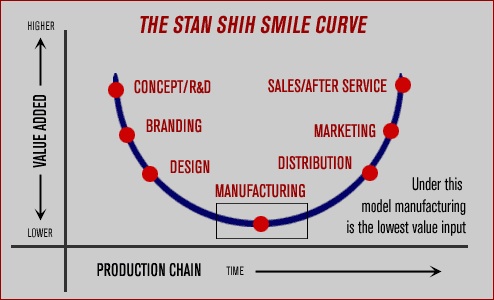
We had an interesting discussion on innovation, manufacturing jobs, the history of accounting, failure, business models, creative destruction, and the Stan Shih Smile Curve.

smile-curve

smile-curve

Adam also discussed a book he's working on, and hopefully he'll return when it's published.

Thank you, Adam, for a fascinating discussion!

Here is Adam's TEDtalk on What we learned from teetering on the fiscal cliff.

Episode #25 - Interview with Dr. Thomas Sowell

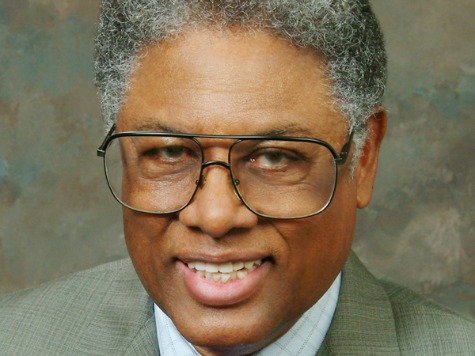
Ed and I were absolutely honored to interview Dr. Thomas Sowell, certainly one of the world's greatest living economists, on The Soul of Enterprise: Business in the Knowledge Economy. Dr. Sowell is currently Senior Fellow at the Hoover Institution, Stanford University. Sowell was born in North Carolina, but grew up in Harlem, New York. He dropped out of high school and served in the United States Marine Corps during the Korean War. He received a Bachelor's degree, graduating magna cum laude from Harvard University in 1958 and a Master's degree from Columbia University in 1959. In 1968, he earned his Doctorate in Economics from the University of Chicago.

Dr. Sowell has served on the faculties of several universities, including Cornell University and University of California, Los Angeles. He has also worked for think tanks such as the Urban Institute. Since 1980, he has worked at the Hoover Institution at Stanford University. He writes from a conservative and classical liberal perspective, advocating free market economics and has written more than thirty books. He is a National Humanities Medal winner.

The new edition of his international best seller on economics, Basic Economics – 5th Edition (Basic Books, December 2015), was the focal point of our discussion.

Basic Economics is the best single volume primer on economics ever written. There are no graphs or equations, and the writing is clear, uncomplicated, eye-opening, and cogent. Ron has recommended this book to hundreds of people, most have thanked him profusely.

We discussed Dr. Sowell's early years as a Marxist, his definition of an economy and economics, early baseball tryout, the notion of a "fair" price, the illogic of the "trade deficit," his views on immigration, Thomas Pikkety's book and income inequality, and why there are only "non-economic values."

We also asked Dr. Sowell during the break what he thought of President Obama's recent policy on easing restrictions on Cuba. He was adamantly against it, and hopefully he will be writing on this topic for his syndicated column.

It's difficult to suggest one of Thomas Sowell's books over another. Be sure to read Basic Economics, 5th Edition, but if you want to venture beyond that (and you will), we've listed Dr. Sowell's books below, though not all of them. He's written two on late-talking children as well, which I hear are excellent.

Ron's favorites are: Knowledge and Decisions; A Conflict of Visions; and Intellectuals and Race.

Other Resources

Dr. Sowell's Wikipedia page.

Fred Barnes interview with Dr. Sowell.

Article by Jay Nordlinger, of National Review, on Thomas Sowell.

Follow Dr. Sowell's syndicated newspaper column on Twitter @sowellcolumn

Books by Thomas Sowell (partial list)

Say’s Law: An Historical Analysis, 1972

Classical Economics Reconsidered, 1974

Knowledge and Decisions, 1980

Markets and Minorities, 1981

Ethnic America: A History, 1981

The Economics and Politics of Race, 1983

Civil Rights: Rhetoric or Reality, 1984

Marxism: Philosophy and Economics, 1985

Education: Assumptions Versus History, 1986

A Conflict of Visions: Ideological Origins of Political Struggles, 1987 

Compassion Versus Guilt and Other Essays, 1987

Preferential Policies: An International Perspective, 1990

Inside American Education: The Decline, the Deception, the Dogmas, 1993

Race and Culture: A World View (Part I of a trilogy), 1994

The Vision of the Anointed: Self-Congratulation as a Basis for Social Policy, 1995

Knowledge and Decisions, 1996 (1980 original)

Migrations and Cultures: A World View (Part II of a trilogy), 1996

Conquests and Cultures: An International History (Part III of a trilogy), 1998

The Quest for Cosmic Justice, 1999

A Personal Odyssey, 2000

Basic Economics: A Citizen’s Guide to the Economy, 2004

Applied Economics: Thinking Beyond Stage One, 2004

Black Rednecks and White Liberals, 2005

Every Wonder Why (collection of columns), 2006

A Conflict of Visions: Ideological Origins of Political Struggles, revised and expanded 2007

A Man of Letters, 2007

The Housing Boom and Bust, 2009

Intellectuals and Society, 2009

Applied Economics: Thinking Beyond Stage One, Revised and Enlarged Edition, 2009

Dismantling America (collection of columns), 2010

The Thomas Sowell Reader (collection of columns, essays, etc.), 2011

“Trickle Down” Theory and “Tax Cuts for the Rich,” (essay), 2012

Intellectuals and Race, 2013

Basic Economics: A Citizens Guide to the Economy, 5th Edition, 2015

Episode #24 - Interview with Jody Thompson, Co-Founder of CultureRx

We had the pleasure of interviewing Jody Thompson, the Co-Founder of CultureRx® and Co-Creator of the Results-Only Work Environment™ (ROWE™), along with Cali Ressler. CultureRx® is the sole global authority on ROWE™ and the sole executor of organizational and individual certification. Listen here to the interview with Jody Thompson

Thompson provides domestic and international keynote presentations on the 21st century workplace and has been featured on the covers of BusinessWeek, Workforce Management Magazine, HR Magazine, and HR Executive Magazine, as well as in the New York Times, TIME Magazine, USA Today, and on Good Morning America, CNBC, MSNBC and CNN. She has co-authored two best-sellling books on revolutionizing the workplace and the practice of management, Why Work Sucks and How to Fix It and Why Managing Sucks and How to Fix It.

Some Nuggets of Wisdom from Why Work Sucks

ROWE defined: Each person is free to do whatever they want, whenever they want, as long as the work gets done.

Sounds like college! It's Tivo @ work.

Work is something you do, not a place you go.

The solution is not flextime. Flexible schedule is an oxymoron.

Work-life balance: balance impossible under current system (employee defined, not employer defined).

Time management – like finding freedom in a prison.

ROWE as the Antidote to the Labor Theory of Value

Employees are paid for chunk of work, not chunk of time.

If I build a cot under my desk but I’m not performing, does that make me a good worker?

If an employee is not performing, more hours won’t matter.

Myth: Time + Physical presence = Results 

Strangely, we only do this at work: “Don’t look at a pile of laundry and think, I’d better make sure I’m putting enough hours into this.”

Presenteeism: Your body is in the building, but your mind is somewhere else.

Ask: “Is there anything you need?” This knocks out Presenteeism.

Sludge: Negative commentary that occurs naturally in a workplace and is based on outdated beliefs about time and work.

Common “How” questions (Appendix II: “Yeah, Buts”)

How are the results going to happen?

How do we know we’re achieving our goals?

How will we know that everyone is pulling their weight?

Answer: “How do you know now?”

True slackers don’t last in a ROWE.

Involuntary turnover (fired) goes up, voluntary turnover goes down.

Final thoughts

Ed and I believe that ROWE is the next wave for true knowledge organizations, as it is centered around results, a high level of trust, and providing autonomy to knowledge workers enabling them to thrive.

Keep up the great work Jody and Cali!

Episode #23 - Interview with Tim Williams

Ed and I were honored to be able to interview Tim Williams, Founder, Ignition Consulting Group, and VeraSage InstituteSenior Fellow. Tim is the author of two excellent books, Take a Stand for Your Brand: Building a Great Agency Brand from the Inside Out, and Positioning for Professionals: How Professional Knowledge Firms Can Differentiate Their Way to Success.

Tim was the CEO of R&R Partners, the ad agency that did the “What happens in Las Vegas stays in Las Vegas” campaign.

Tim's book1

Tim's book1

Take a Stand for Your Brand

Agencies need to do for themselves what they do for customers: build a strong, distinctive, memorable brand.

Standing for everything is just another way of standing for nothing.

You can measure our agency by the clients we don’t have.

Specialist vs. Generalist—traditional dept stores died, Home Depot, PetsMart, etc. The goal is to exclusive, not inclusive.

The essence of positioning/strategy is tradeoffs, and being clear about what you won’t do. Steve Jobs said he was most proud of what Apple didn’t do!

Tim's book2

Tim's book2

Positioning for Professionals: How Professional Knowledge Firms Can Differentiate Their Way to Success, 2010

In business, imitation is not the most sincere form of flattery—it’s just lazy.

Positioning is the foundation of branding because it identifies what the brand stands for.

A brand can’t stand for two things at once.

Specialist vs. Generalist (we’d all fly to the Mayo clinic for a specialist, but not generalist). Of the two, which has:

  1. The greatest earning power?

  2. The largest geographical market area?

  3. The fewest competitors

  4. The greatest degree of respect from customer?

  5. The most sophisticated customers?

Instead of being afraid of focus, you should be afraid of mediocrity!

Check out the humorous our late colleague, Paul O'Byrne shot in Australia on the difference between the generalist and specialist.

Service is a commodity. Smart thinking is not.

Size is not a strategy!

Nobody buys a product or service because it can do everything, but rather because it can do something. Diversity Tax: Coke vs. Pepsi

Stop focusing on reclaiming old territory and instead discover new territory: Columbus, not Napoleon

Successful brands able to position on spectrum: Love and Hate. Either side desirable; middle is death

Tim quotes Rush Limbaugh: “Moderates by definition have no principles.” Ron adds: There’s not big in the library, Great Moderates in History.

“The aim of marketing is to make selling superfluous”—Peter Drucker.

Defining Your Brand Boundaries

Calling

Customers

Competencies

Culture—The formal and informal standards by which your firm makes decisions about serving its customers

Knowledge Workers Are Volunteers

Psychologist Howard Gardner:

If you are not prepared to resign or be fired for what you believe in, you are not a worker, let alone a professional. You are a slave.

Be sure to subscribe to Tim’s Propulsion Blog. We recommend you read as much as you can of Tim, a brilliant thinker and marketing strategist.

Episode #21 - Playing with Fire: Price Discrimination in Practice

I can remember finding a rare first edition of Stanley Marcus’ book Quest for the Best in a used bookstore in San Diego. I had been searching for this book for a couple of years, since this was before the Internet, and was elated when I stumbled across it by chance. As soon as I skimmed through it and learned it was in good condition, and autographed by Stanley himself, I would have been willing to pay $100 for it. Of course, the bookstore owner had no idea, nor does he even know me or of my desire to own this rare book. He priced it at $10. I can assure you I did not offer to split the difference between my value price and his asking price. I left the store, as an economist would say, $90 wealthier, keeping the entire consumer surplus to myself.

Episode #20 - Interview with Rabbi Daniel Lapin

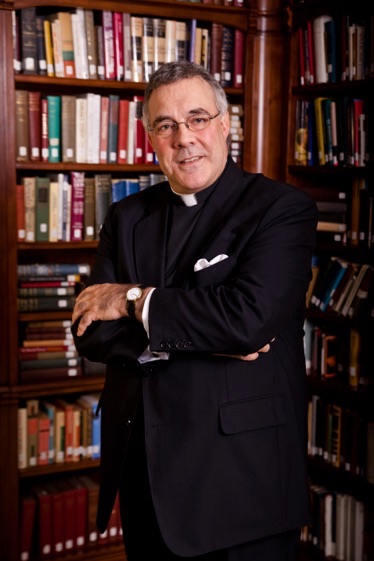
Ed and I were honored to interview Rabbi Daniel Lapin. Ron’s been a big fan of the Rabbi, listening to his radio show, and reading his books, for years. We only had the Rabbi on for about 30 minutes, but he has graciously agreed to return at some point. We then discussed his four books, listed below.

Biography

Rabbi Daniel Lapin, known world-wide as America's Rabbi, is a noted rabbinic scholar, best-selling author and host of the Rabbi Daniel Lapin Show on San Francisco’s KSFO. He is one of America’s most eloquent speakers and his ability to extract life principles from the Bible and transmit them in an entertaining manner has brought countless numbers of Jews and Christians closer to their respective faiths.   In 2007 Newsweek magazine included him in its list of America’s fifty most influential rabbis.

Before immigrating to the United States in 1973, Rabbi Daniel Lapin studied Torah, physics, economics and mathematics in Johannesburg, London and Jerusalem.  This seemingly unlikely combination forms the bedrock of his conviction that no conflict exists between the physical and spiritual, virtue and strength, or faith and wealth.  He quickly became persuaded that God continues to smile on the United States of America and he became a naturalized citizen on what he describes as the proudest day of his life.

Rabbi Daniel Lapin was the founding rabbi of Pacific Jewish Center, a now legendary Orthodox synagogue in Venice, California.  He implanted the community’s mission of demonstrating the relevance of traditional Faith to modern life.

Books

America’s Real War: An Orthodox Rabbi Insists that Judeo-Christian Values are Vital for Our Nation’s Survival (1999)

Buried Treasure: Secrets for Living from the Lord’s Language (2001)

Thou Shall Prosper: Ten Commandments for Making Money (2002)

Business Secrets from the Bible: Spiritual Success Strategies for Financial Abundance (2014)

Other Resources and Readings

 Ron’s review of Thou Shall Prosper

Rabbi Lapin’s website: www.youneedarabbi.com. Be sure to sign-up for Thought Tools, a free weekly email teaching, offering practical tips and insights to enhance your Family, Faith, and Financial life.

Rabbi Lapin on the Radio: Sundays from 7am-8am Pacific Standard Time, (10am-11am Eastern Standard Time) on the Internet. Go to http://www.W4CY.COM  The Call-In telephone number will be (561) 623-9429. You will also be able to join in by Skype and Chatroom

Episode #19 - How vs. What Matters

Ed and I discussed Peter Block’s seminal book, The Answer to How is Yes: Acting on What Matters. In my first discussion in May 2004 with Ed, he informed me he read two books in the prior year that changed his life: my first book [out of print], Professional’s Guide to Value Pricing, and Peter Block’s The Answer to How is Yes.

It is an absolutely profound work. I told Ed it’s the book I’ve always wanted to write.

SCA_Slides_pptx

SCA_Slides_pptx

The following are some snippets from the book, along with the six most common “how” questions, which questions Block says should be asked instead, and then how Ed’s tweaked two of Block’s questions based on his experience in change programs.

Book Snippets

  • Epigraph: “Transformation comes more from pursuing profound questions than seeking practical answers.”

  • We often avoid the question of whether something is worth doing by going to the question of “How do we do it?

  • Give up saying “how” for six months!—give priority to aim over speed.

  • Value what matters, not just what works.

  • How implies we just lack the right tool, it becomes utilitarian and pragmatic.

  • How questions deflect us from considering our deeper values.

  • Also assumes we don’t know, a defense against taking action—we become the blind man looking in a dark room for a black cat that is not there.

Here are the six questions that postpone the future and keep us encased in our present way of thinking:

  1. How do you do it? (Skips “Is this worth doing?”)

  2. How long will it take? (Oversimplifies the world)

  3. How much does it cost? (Ignores what price are we willing to pay?)

  4. How do you get those people to change? (Ignores the fact that you can’t get others to change!)

  5. How do we measure it? (If you can’t measure it, it does not exist. Things that matter most defy measurement [love, art, poetry, music, life]. Our obsession with measurement is really an expression of our doubt—we’ve lost faith in something. So much for imagination and creativity [how do we measure something new?])

  6. How have other people done it successfully? (We want to be leaders without risk of invention and innovation)

The alternative to asking “How” is saying “Yes,” a stance towards the possibility of more meaningful change

Here are Peter Block’s alternative questions:

  1. How do you do it? To What refusal have I been postponing?

  2. How long will it take? To What commitment am I willing to make?

  3. How much does it cost? To What is the price I am willing to pay?

  4. How do you get those people to change? To What is my contribution to the problem I am concerned with?

  5. How do we measure it? To What is the crossroad at which I find myself at this point in my life/work?

  6. How are other people doing it successfully? To What do we want to create together?

Ed has changed two of Block’s questions: #3 to “What is the value of it to me?”

And also #5 to “What is the judgment I need to make?”

Some Final Thoughts from Peter Block

When we follow fashion and ask for steps, recipes, and certainty, we deny our freedom, for we are trapped by the very act of asking the question. Freedom asks us to invent our own steps. “to be the author of your own experience.”

Asking how is an escape from freedom/accountability. We wish to go to heaven and not die.

Knowing how to do something may give us confidence, but it does not give us our freedom. Freedom comes from commitment, not accomplishment.

The pursuit of certainty and predictability is our caution speaking. Freedom is the prize, safety is the prize, what is required is faith more than fact and will more than skill.

There is little discussion of faith in organizations, but it is only with faith that significant changes can begin.

Idealist is “one who follows their ideals, even to the point of impracticality.” The willingness to pursue our desires past the point of practicality (the heart wants what the heart wants).

Who decides what is possible and what is practical?

Idealism dissolves in a world of measurement and instant results.

Institutions are based on consistency and predictability, while intimacy relies on variation and surprise (people aren’t resources/assets).

Without willingness to go deeper, little chance for any authentic change. We prefer actions and answers.

What is absent in a world dominated by the engineer and economist is the artist. The artist needs to enter our institutional experience in order to create a space for idealism, intimacy, and depth.

One of the beauties of volunteer organizations is that they know how to take advantage of people’s gifts, whereas what he calls “systems” are more concerned with people’s limitations.

Demanding a solution, or an action plan for everything, is also arrogant. It’s a wish for perfection. It’s our wish to be God.

We keep going from fashion to fashion, consultant to consultant, looking for an answer that’s not there—like looking for the fountain of youth.

Not “scientific management.” Organizations never in control, the unpredictability and mystery of life.

We do walk by faith, not sight. Peter Block’s philosophical book reminds me of how George Gilder ended his classic book, Wealth and Poverty, by Quoting Reinhold Niebuhr:

Nothing worth doing is completed in one lifetime.

Therefore, we must be saved by hope.

Nothing true or beautiful makes complete sense in any context of history.

Therefore we must be saved by faith.

Nothing we do, no matter how virtuous, can be accomplished alone.

Therefore we are saved by love.

Other Resources

The text of the speech can be found here, including Q&A.

Episode #18 - Interview with Pricing Expert and Mentor, Dr. Reed K. Holden

Ed and I were honored to interview Dr. Reed K. Holden. Reed is a legend in the pricing profession, and has been a mentor to Ron ever since they first met at a Professional Pricing Society conference, back in 2000. Our discussion with Reed covered a variety of topics: Who were his mentors in pricing (Tom Nagle and Dan Nimer, author of Visionary Pricing); Fair vs. Just price; the market share myth; his mantra: innovate for growth, price for profit; how the Stan Shih Smile Curve impacts strategic pricing, will pricing become profession (Reed says it already is), and is he working on any new books. We also discussed his most recent books, Pricing with Confidence and Negotiating with Backbone.

Holden Advisors publishes a monthly newsletter, which you can subscribe to for free here. We highly recommend it for all business owners.

smile-curve

smile-curve

 About Reed Holden

ReedHolden_mgmt

ReedHolden_mgmt

Reed Holden, D.B.A., Founder & Coach  
Dr. Reed K. Holden (Concord, MA), Founder of Holden Advisors, is a world-class pricing expert who helps clients build go-to-market strategies to drive price leadership, selling backbone and profitable growth. Dr. Holden specializes in helping sales organizations avoid the Procurement Buzz SawSM by implementing value strategies to recognize and counter margin-reducing buying tactics. He is an enthusiastic and persuasive advocate for demonstrating customer value and price leadership with companies that need to adapt in highly competitive markets.

A dynamic and engaging presenter with over 20 years of experience, Dr. Holden is a regular speaker and keynote for executive and sales events for Fortune 1000 companies. He is engaged to facilitate negotiation, pricing and customer value workshops and coaches sales people and senior executives in companies that strive for price leadership.

 Additional resources

Episode #17 - What Are You Worth?

When Larry Page and Sergey Brin were students at Stanford they developed technology that was designed to search Stanford University’s Web pages, which immediately became popular among the students and faculty. This was 1996, and everyone thought that Yahoo! was the dominant search engine, and there could never be another one. Larry and Sergey did not think their technological innovation was the basis for the company they wanted to start, so they put it on the market—at a price of approximately $1 million.

Fortunately for the rest of us, there were no takers. Had they found a buyer, Google probably never would have been born. It is an excellent example of how overpricing can have salutary effects.

Unfortunately, most professionals under price their intellectual capital. They justify this with a variety of excuses:

  • We do not have enough quality customers.

  • Customers view what we do as a commodity.

  • Customers do not understand the value we provide.

  • Our people do not understand their worth.

  • When customers engage in hardball negotiation tactics, we capitulate.

  • Our profession has too much capacity, which drives prices down.

Most of these are nothing but excuses to explain away a lack of purpose, strategy, marketing effectiveness, and poor customer selection. But I believe there is a deeper reason, which I truly did not understand until I began teaching value pricing to my colleagues.

Many participants of my courses have commented that they would “feel guilty” about charging a substantial multiple of their hourly rate. The epiphany for me was that this was not a strategic, or even a pricing competency issue, but rather a low self-esteem issue.

Low self-esteem (or self-respect) does go right to the heart of why professionals question the value of the service they provide. Do you truly believe the benchmark of your value is the hours you spend? What about the years of experience that stand behind that $1 million marketing idea that took 15-minutes to create? Is the value really one-quarter your hourly rate?

You Are Your First Sale

The lesson is vital, and it is this: Before you can charge a premium price, you first have to believe, internally, that you are worth it. If you do not think you are worth multiples of your hourly rate, your customers never will believe it either.

Have you ever dealt with a professional, such as a doctor or a consultant, who came highly recommended? When you learned of the price, did you try to negotiate it downward?

Most highly recommended professionals will not budge on their pricing, because they know they deserve it and are worth it. They are secure and confident in their worth, and they price above the market as a result. Obviously, not everyone can do this. But the ones who do all possess a common characteristic: high self-esteem.

Psychologist Nathaniel Branden has done extensive work on self-esteem. His treatise on the subject is The Six Pillars of Self-Esteem, wherein he defines it as:

  1. Confidence in our ability to think, confidence in our ability to cope with the basic challenges of life; and

  2. Confidence in our right to be successful and happy, the feeling of being worthy, deserving, entitled to assert our needs and wants, achieve our values, and enjoy the fruits of our efforts.

In his book Self-Esteem at Work, Branden discusses the critical role self-esteem has in the success of enterprise:

A simple example is the fact that analyses of business failure tell us that a common cause is executives’ fear of making decisions. What is fear of making decisions but lack of confidence in one’s mind and judgment? In other words, a problem of self-esteem."

Branden says “Self-esteem is the reputation we acquire with ourselves.” That is profound. Professionals are deeply concerned, and rightfully so, with their reputations: They care what their customers think of them, of their firm, of their integrity. But what about their reputation with themselves? Most professionals were never taught even to ask the question. According to Branden:

If low self-esteem correlates with resistance to change and clinging to the known and familiar then never in the history of the world has low self-esteem been as economically disadvantageous as it is today. If high self-esteem correlates with comfort in managing change and in letting go of yesterday’s attachments, then high self-esteem confers a competitive edge."

There is no Standard Price for Intellectual Capital

In today’s world, intellectual capital is the chief source of all wealth. Shelly Lazarus, former chairman and CEO, Ogilvy & Mather Worldwide, explained what advertising agencies are really selling:

Advertising is an idea business: That’s all we are. And ideas don’t come from the air, they come from human beings.”

According to the New York Times, Merv Griffin (and his estate) has made between to $70-80 million in royalties from the “Jeopardy!” theme song, which he wrote in less than one minute.

In 1935, Edgar Kaufman, the German-American businessman and philanthropist who owned Kaufmann’s department store, asked Frank Lloyd Wright to design a small summer home for him near Mill Run (75 miles southeast of Pittsburgh).

Wright surveyed the site but procrastinated on the design. When Kaufman telephoned him one day saying he was nearby and would like to stop by to see the design, Wright replied, “Come on Edgar, we’re ready.”

Two of Wright’s draftsmen who heard the call could not believe it, since no one had drawn a single line. Draftsmen Edgar Tafel explains what happened next in his book about Wright:

Wright hung up the phone, walked to the drafting room and started to draw, talking in a calm voice. ‘They will have tea on the balcony…they’ll cross the bridge to walk into the woods,’ Wright said. Pencils were used up as fast as we could sharpen them. He erased, overdrew, modified, flipping sheets back and forth. Then he titled it across the bottom: Fallingwater.

Two hours later, when Kaufmann arrived, Wright greeted him and showed him the front elevation. ‘We’ve been waiting for you,’ Wright said.

They went to lunch, and we drew up the other two elevations. When they came back, Wright showed Kaufmann the added elevations.

This is why intellectual capital, expertise, wisdom, judgment, ability to synthesize information, along with all the other characteristics of knowledge work, cannot be denominated in hours, efforts and costs to produce.

Napoleon Hill wrote in Think and Grow Rich:

There is no standard price on ideas. The creator of ideas makes his own price, and, if he is smart, gets it.

Do not feel guilty or ashamed of your success, and do not let low self-esteem interfere with being paid what your worth.

Other references:

Paul Potts Video

Emotional Intelligence by Daniel Goleman

Working with Emotional Intelligence by Daniel Goleman

Simon Sinek - Start with Why

Episode #16 - Interview with Father Robert Sirico

“We have no right to judge the rich. For our part, what we desire is not a class struggle but a class encounter, in which the rich save the poor and the poor save the rich.” -Mother Teresa

Father Robert Sirico is the president and co-founder of the Acton Institute and the pastor of Sacred Heart of Jesus Parish, both in Grand Rapids, MI.

During the first 15 minutes, Father did more to help articulate why Ron and I named our show The Soul of Enterprise than any of our previous attempts. For that, we are in his debt.

As promised here are some links to his work:

First, his terrific book Defending the Free Market: A moral case for a free economy.

Second, a more detailed version of the story he opened the show with.

Third, a link to one of the articles about Cardinal Rodriquez for which Father provided some insight (and Ed some therapy).

Fourth, links to the two papal encyclicals we discussed Rerum Novarumand Centesimal Annus, and the apostolic exhortation Evangelii Gaudium. All three are well worth reading no matter what your religious background.

Fifth, as mentioned Father's brother is Tony Sirico who starred as Paulie "Walnuts" in the Sopranos, but in my and the good priest's opinion, our favorite work of his is the Bensonhurst Spelling Bee.

Sixth, a link to the outstanding documentary from the Acton Institute, The Call of the Entrepreneurthe movie that introduced both Ron and myself to Father Sirico.

Seventh, a recent interview with Jimmy Lai about the pro democracy student protests in Hong Kong. As Father mentions, keep him and all of these folks in your thoughts and prayers.

Eighth, the trailer to the new Acton Institute documentary, Poverty Inc.

Ninth, a link to Ed's confession. Just kidding!

Episode #15 - The Best Learning Method Ever Devised: After Action Reviews

Episode #15 - The Best Learning Method Ever Devised: After Action Reviews

Companies lose knowledge from people leaving, forgetting, retiring, and so on. Knowledge also becomes obsolete (what Alvin Toffler calls obsoledge) and must be constantly replenished. No one knows what the cost of this lost knowledge might be. Given the coming demographic trends, how can knowledge organizations capture some of that valuable knowledge before it is lost, like the lost Library of Alexandria?

Before we can leverage this knowledge, we must first understand how knowledge is possessed.