
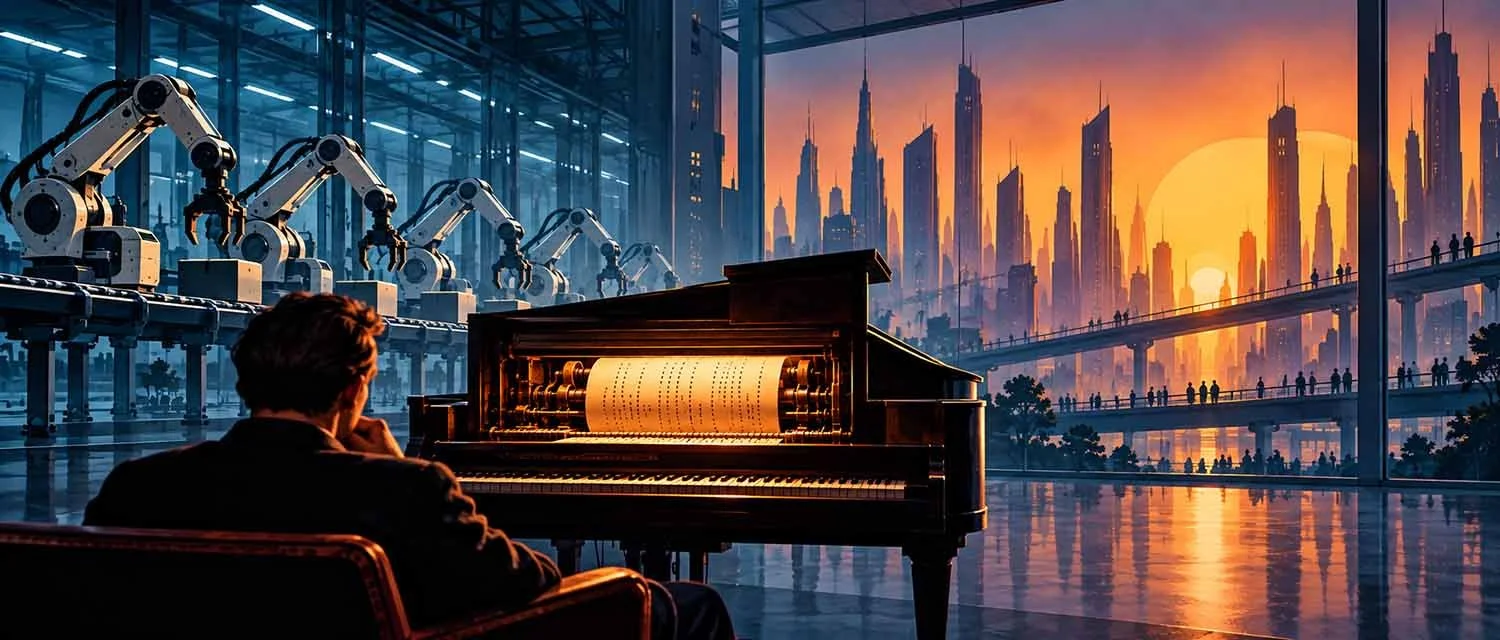
More than 70 years before the emergence of generative AI, Kurt Vonnegut imagined a world in which machines did nearly all the work, leaving humanity to wrestle with a fundamental question: What happens when technology makes human beings seemingly unnecessary?
In this episode of The Soul of Enterprise, Ron and Ed revisit Vonnegut's remarkably prescient 1952 debut novel, Player Piano, exploring its themes of automation, economic efficiency, technological progress, and the search for human purpose. How accurately did Vonnegut anticipate today's AI revolution? Does technological advancement necessarily lead to human flourishing? And what happens to creativity, dignity, and the value of human knowledge when machines can increasingly perform tasks once reserved for people?
Join Ron and Ed as they examine the novel's warnings, its biting satire, and its surprising relevance to the future of work, business, and the knowledge economy. Is Player Piano a cautionary tale about the dangers of technology, or a reminder that human ingenuity will always find a way to reinvent the future?
SHOW NOTES
Segment one
Player Piano is the debut novel by American writer Kurt Vonnegut Jr. https://en.wikipedia.org/wiki/Player_Piano_(novel)
The comparison between Kurt Vonnegut Jr.’s Player Piano and Pope Leo XIV’s most recent encyclical, Magnifica Humanitas: 1) Technology versus human dignity, 2) The loss of meaningful work, 3) The danger of a society built around efficiency
Previously, we discussed both The Verger and Harrison Bergeron on episode 368 https://www.thesoulofenterprise.com/368
The Jevons paradox, or Jevons effect, is an economic phenomenon said to occur when technological improvements that increase the efficiency of a resource's use lead to a rise, rather than a fall, in total consumption of that resource. https://en.wikipedia.org/wiki/Jevons_paradox
Player Piano’s most tragic character is Rudy Hertz, the machinist who was the prototype recorded by the machines. They are player pianos replicating his physical motions. https://en.wikipedia.org/wiki/Player_Piano_(novel)
Segment two
Just a few short multiple choice questions and a few open ended questions. Let us help you reflect on your pricing model at https://thresholdnow.com/reflection
Today I learned that Kurt Vonnegut had a career at GE. He was hired in 1947 as a publicist and in-house journalist in the News Bureau in Schenectady, New York. https://www.ge.com/news/taxonomy/term/1567
“I don’t think this novel is anti-technology. It’s anti-technocracy. It’s really a warning against the rule of experts.” —Ron Baker on the novel Player Piano by Kurt Vonnegut
“Is it all really knowledge? Is wealth knowledge? Is Gilder correct in that wealth equals knowledge?” —Ed Kless during segment two of the show today (great riff, please take the time to listen)
Segment three
What caught our attention about Player Piano by Kurt Vonnegut? Vonnegut wrote Player Piano in 1952, long before computers and artificial intelligence became part of everyday life, yet he imagined a society where machines could make humans economically obsolete. https://en.wikipedia.org/wiki/Player_Piano_(novel)
Adam Smith's Impartial Spectator (the link is a research article from the Vanderbilt Undergraduate Research Journal) https://ejournals.library.vanderbilt.edu/index.php/vurj/article/view/4016
“You still need that human dignity. You still need that builder. That creative act.” —Ron Baker on the future of work as it relates to AI
Segment four
Towards the end of Player Piano, even after rebelling against the machines, the rebels begin repairing them, revealing how deeply they have internalized the very system they sought to destroy. https://en.wikipedia.org/wiki/Player_Piano_(novel)
The principle of subsidiarity states that social, economic, and political problems should be dealt with at the most immediate or local level possible, and only handed over to a larger or higher authority when the lower level cannot solve them alone. https://en.wikipedia.org/wiki/Subsidiarity
“Just because you save time doesn’t mean it’s automatically well invested or well spent.” —Ron Baker
Here’s a truly profound thought to end the show today: Are we watching professional firms build their own player piano? They’re so bent on automating everything. Are we losing sight of what a professional is for?

Bonus Content is Available As Well
Did you know that each week after our live show, Ron and Ed take to the microphone for a bonus show? Typically, this bonus show is an extension of the live show topic (sometimes even with the same guest) and a few other pieces of news, current events, or things that have caught our attention.
Click the “FANATIC” image to learn more about pricing and member benefits.